One of the Joys of Maturity |
|

The Old Guy's Garden Record The idea for Senior Gardening came about from frequent postings I made about our garden on another web site I maintain. The idea was to create a place where folks could share garden lore via blogs and forums. While I'm still struggling a bit with the software that will eventually make that possible on senior-gardening.com, I thought I'd at least put up a record of our 2008 garden in part from those postings, loosely edited, from the other site. November 19, 2007 - Soil Preparation and Seed Catalogs The first snow hasn't arrived here yet in southwest central Indiana, but it's time to get started on our 2008 garden! We keep a fairly large and diverse garden, so getting an early start on soil preparation and plant starts is essential.
Once the liming is done and garlic sets are in, gardening chores move inside. Inventorying seed on hand and deciding what to keep and what to pitch is one of the more onerous jobs to be done, as I keep my extra seed frozen between seasons. Once done, I can get started perusing a variety of print and online seed catalogs. Here's a listing of my favorite seed suppliers, pretty much in order of my preference:
One of our nicest surprises from our garden two years was a then new variety of pea, Eclipse. It's a very sweet pea and quite productive. We froze two bags (about 10# total) of peas that summer, and they were quickly gone. Katherine, our middle grandchild who lived with us at the time, absolutely loved them. When we'd put more on her plate, she'd squeal with glee and clap her hands. February 27, 2008 - Starting Seeds
I still consult my venerable copy of Crockett's Victory Garden March 10, 2008 - Garden Update
If you plan on starting transplants for your summer garden or flower bed, it definitely is time, almost past time, to get started. Garden stores will soon have seed packets displayed, although you can get a much better selection via one of the many excellent mail order seed houses. March 31, 2008 - Garden Report (squish)
I have lots of stuff under plant lights ready to go into the outdoor cold frame once I get a new plastic cover on the it. Broccoli, onions, and some hanging baskets with trailing petunias in them are just waiting for me to get with it! As I move stuff out to the cold frame making space available under my plant lights, I continue repotting small plants where I got too many seeds in a cell. I also plant successive crops of lettuce and broccoli for later transplanting. Several weeks ago, I discovered that my plot I thought I'd prepared for spring peas wasn't in the shape I'd thought it was. I found way too many weeds had gotten started on the spot I'd tilled, so I tried something "a little different."
I had to spot spray some dandelions last week with Roundup, but otherwise, it appears the trick is working. I gently uncovered some of the pea seed and it appears to be germinating nicely!
Since I mentioned the farm above, I thought I'd share a few shots I scanned for a friend a few years ago. The friend needed some farm shots of pigs for a classroom project, and since she knew I'd once been a hog farmer, asked me if I had any. The sow on the left is Leslie, our first purebred Duroc on the farm. She was a great mama. Later, we added a purebred Duroc boar named Gogo (actual registered name: "Go Get Her" :-). Leslie and Gogo were practically pets on our farm. That may be part of why I'm no longer a farmer! April 14, 2008 - Freeze? We have another freeze watch tonight here in southwest central Indiana, so I've brought in my tender plant starts (since I didn't get my cold frame out and covered with new plastic this year). But spring is definitely here and actual direct planting may commence towards the end of the week...if the soil ever dries out enough. April 18, 2008 - Declination Delirium I'm on a break from a garden terracing project - waiting for the cordless drill pack to recharge. Last Wednesday after tilling the garden, I decided it was finally time to do something about our garden runoff problem.
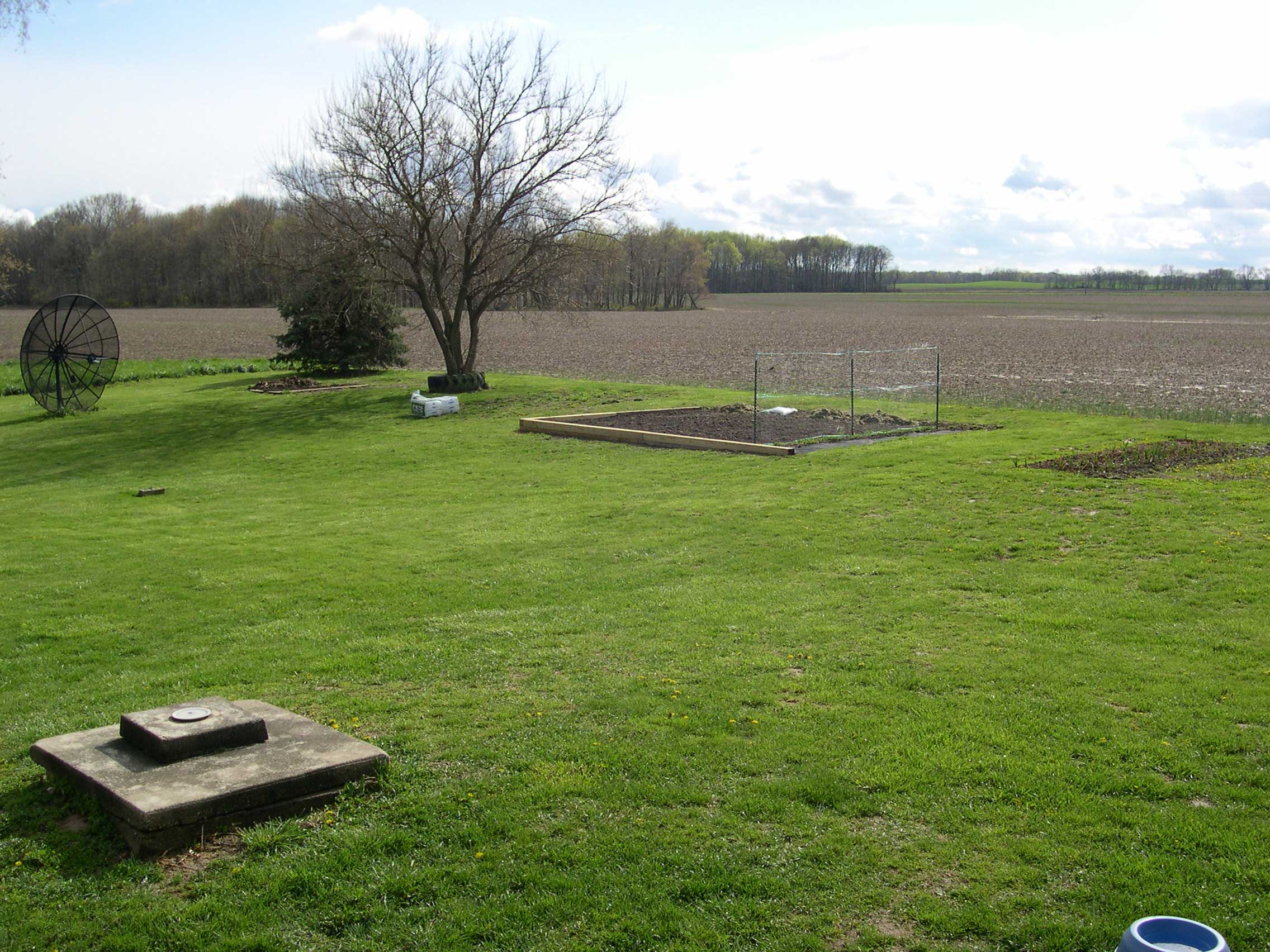
Being somewhat anal, I decided that I really wanted to do things right and get my garden timbers aligned to a true north-south line. That involved getting out the compass and also finding the correction factor from magnetic north. I had to update Google Earth to find my exact latitude and longitude and then found the page for the National Geophysical Data Center correction page. If you're not as anal as I, you can get by with just entering your zip code. Punching in the geographic coordinates revealed a difference between magnetic north and true north of -3.004o at my house. (The value for my zip code was 3.247o.) Along the way, I found a good page of explanation for finding declination from the Compass Store. Once I recovered from my declination delirium, I started on the project with a couple of timbers I had on hand. Of course, I ended up making two more trips to the lumber yard for additional timbers! I'm now down to drilling holes and hammering in rebar to lock the timbers into place. Once done, the project will create a raised bed of sorts that will help with drainage. If necessary, I'll add a dry sump in the center of the raised bed later. A dry sump is a trick I picked up when living on a farm. You just dig a hole as deep as possible with a post hole digger and fill it with sand! I used the technique years ago to help dry out the approach to our back door of the farmhouse. I lacked sand on that one, but successfully substituted pea gravel. Your mileage may vary :-). April 21, 2008 - Terracing
April 28, 2008 - Apple Blossoms
They don't last all that long, but when the apple blossoms come out, they're really beautiful. I think I've tried every spring for ten years to get a shot of them that I was happy with. This year I think I got it. The photo above and others are available for use as desktop photos (wallpapers) from a Desktop Photos page elsewhere. May 22, 2008 - Wet Spring We've had a very wet spring in west central Indiana this year. While farmers just a bit north and south of us are in fair to good shape on spring planting, around here, they're way behind. (Note untilled, unplanted field in the background of the May 21 shot below!) The wet spring also has slowed our gardening, but some of the early crops we got in are doing great.
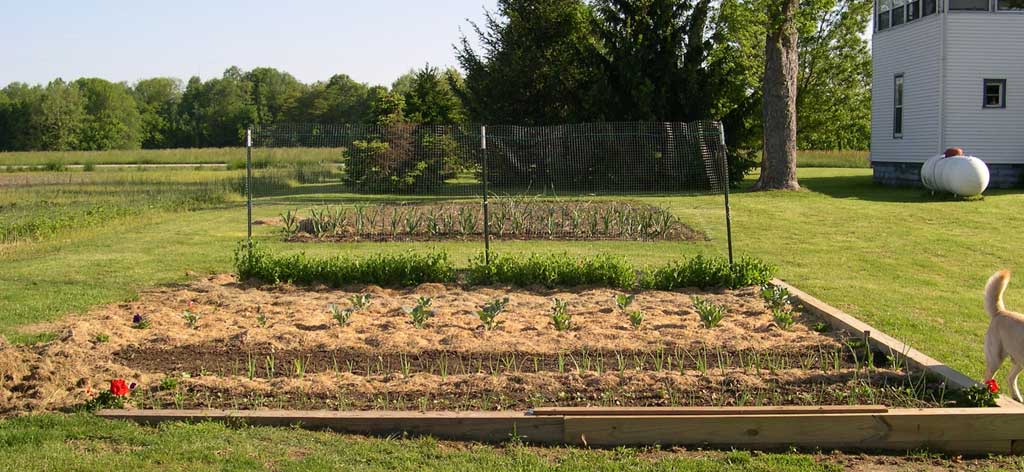
While our "main garden" for this year looks pretty good (section with timbers creating a raised bed), our larger plot is still not planting ready. I had it close at one point, but didn't get our beans, tomatoes, and corn in before the rains came again.
Asparagus from Seed Jim Crockett did a feature once on his PBS TV show, Crockett's Victory Garden, about growing asparagus from seed. It takes some doing, as you have to freeze the seed and even sand or apply an emery board to it a bit to get it to germinate. We actually let ours grow for almost a year under plant lights in a seed flat indoors before setting out the asparagus roots in a well worked seed bed. (Lots of peat moss, cow manure, and lime were worked deeply into the seed bed.) Starting an asparagus bed from seed is a bit slower than purchasing asparagus roots, but it has some advantages, as noted on the University of Illinois Extension site:
One more advantage to growing from seed is that you can pick either the all male seed type or from the older male and female varieties such as Viking, Martha Washington, etc. We chose the mixed varieties, despite the fact that all male plantings may produce thicker, larger spears "because they put no energy into seeds." We find that the seed production is a good thing, as the seeds can thicken and reinvigorate the stand of asparagus as it ages and experiences good and bad seasons and some expected winter kill.
This is the third year for our asparagus from seed. Most garden references say you can take a light picking from third year asparagus, but we choose to give ours one more year before picking. Last summer was extremely dry here, and our asparagus suffered from it, so we're going to wait another year. This is the second bed of asparagus from seed I've done, as I did it years ago when I had a small farm. There, the asparagus planting thickened over the years as the female plants produced viable seed. We're also in a bit of a holding pattern, as I had to go back in for a "tune-up" on my elbow this week. I'd had some large cysts removed a year ago and ended up wearing a brace the nursing staff called "the club" for six weeks last summer. I guess I'm lucky that the reoccurrence wasn't as serious this year, and I only have a mildly inconvenient dressing and am restricted from lifting for two-three weeks. Yesterday, even typing was a chore. But then, doing anything more than snoozing in the easy chair was a chore, considering the pain-killers I was on. June 13, 2008 - Been Busy in the Garden
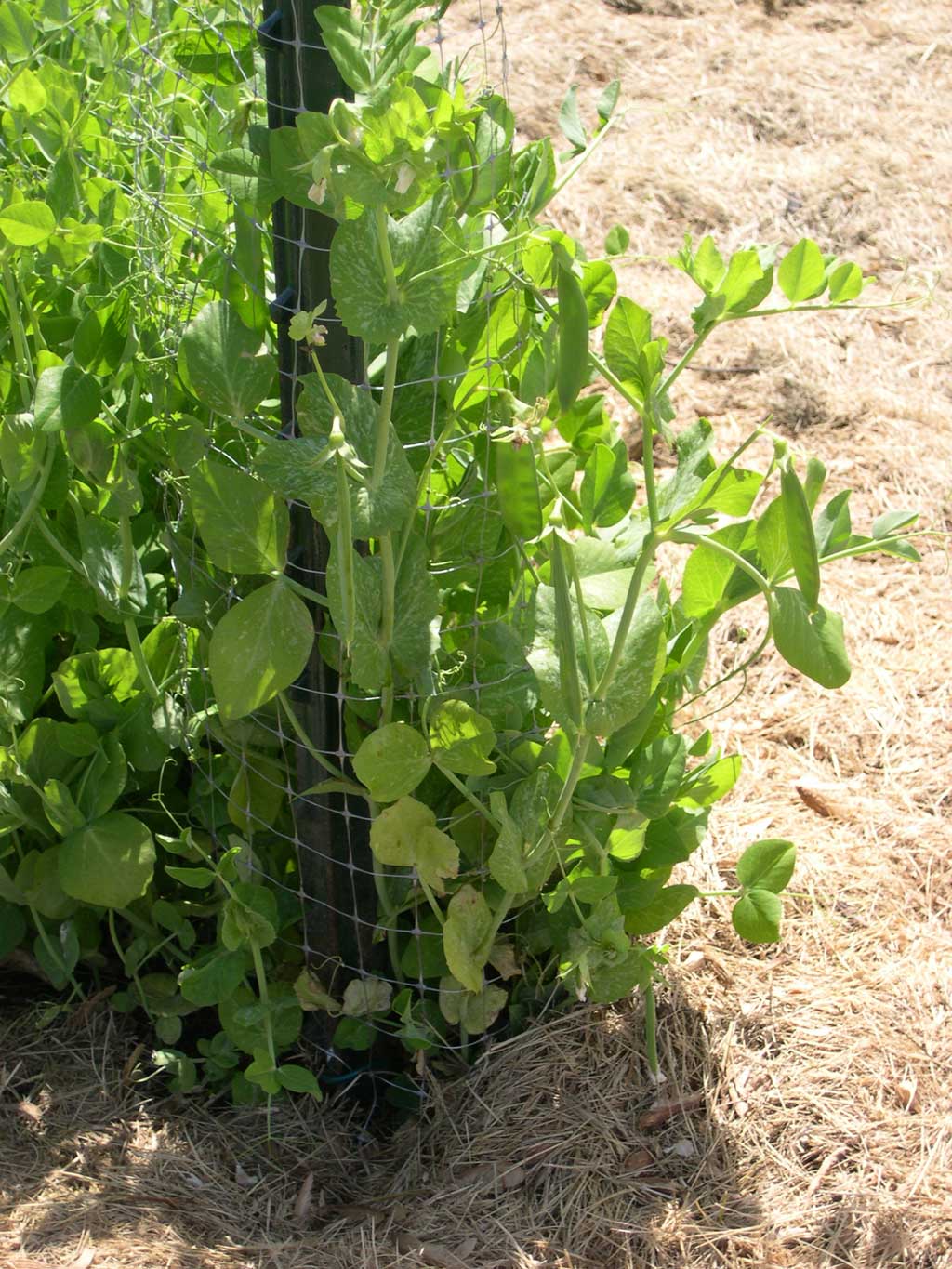
I wrote last March about a trick I tried getting my peas in early on ground that really wasn't worked up as it should have been. I bought some cheap, bagged top soil and some very expensive sphagnum peat moss as a cover. I put landscape fabric over a bit of ground for a flowerbed, but put the pea seed right onto the ground and covered it with the topsoil and peat. While our harvest wasn't anything like what we've had in some good years with properly prepared soil and better weather, the "trick" worked and we had a nice harvest of peas this week. We also had a hot spell (like a lot of folks) that pretty well shortened the pea harvest, so I pulled the plants for the last picking, pulled back the mulch, worked in a lot of 12-12-12 and lime, and replanted Sugar Snap Peas One part of the trick that didn't work was planting two different varieties of peas in the same row. I was using some year and two year old seed (that had been frozen...a great way to preserve your garden seed). One variety was a dwarf, bush type. It was far more vigorous in germination than my favorite, Eclipse, a slightly taller variety. If I'd gone just with the taller variety, I think we might have gotten a better harvest. BTW: While planting two varieties in the same row wasn't such a hot idea, canning is a different matter. Something I've noticed over the years is that canned green beans always seem to taste better when I put up several varieties together.
We've already harvested some fantastic cauliflower (variety Amazing June 19, 2008 - Hummingbirds
We've had a stretch of 70 degree weather this week, so I've spent a lot of time in the yard and garden. While sitting on the back porch today, I was watching a couple of hummingbirds fight over the feeder. One took the time to scold me a bit for sitting there too close to "its feeder." The shot above is one I caught late last summer as a hummingbird darted around a begonia on the porch. The begonia has moved to the front porch, but we still have lots of hummingbirds visiting our feeders. Up until last summer, I'd always used the red, commercial hummingbird liquids sold in a lot of stores. While shopping at Rural King in Terre Haute last summer, a nice couple was telling me about their recipe for hummingbird nectar. The just mix water and sugar in a 4:1 ratio, which eliminates the red dyes used in the commercial stuff. It's also a lot cheaper. One thing to remember, though, is to keep the mix fresh. This week when I took down one feeder for a refill, I realized the nectar had started to ferment! Our hummingbirds weren't flying around in a drunken haze, so I think it had just gone over, but I realized the commercial nectar probably has some kind of preservative in it to prevent fermentation. June 25, 2008 - Nice Days
Our garden is a bit dry, but productive. We've had lots of great cauliflower, lettuce, and some broccoli. The main broccoli harvest is just coming on with soccer ball sized heads. We cut the main heads, fertilize the plants heavily with compost, when available, and 12-12-12 when the compost is short, and cut side shoots for several weeks before pulling the plants. It appears the plants above are about ready to be sprayed again with Thuricide
We've also had some beautiful sunsets with clouds from afternoon thunderstorms (that have missed us both north and south). June 27, 2008 - A Bit About Intensive Gardening Even when I had a "small" 40 acre farm, I used intensive gardening practices for some of our vegetables. I was introduced to the practice via the old WGBH/PBS TV series, Crockett's Victory Garden. The late James Underwood Crockett demonstrated how it was actually easier in some instances to grow vegetables in a tight planting regimen as opposed to the traditional long, single row.
We manage to keep our weeding down quite a bit in both the intensive plot(s) and the regular garden by using grass clippings from the yard to mulch in the crops. I generally let the clipping lie and dry a day before gathering them with the lawn sweeper and applying them around the veggies. (Tip to smokers: Don't smoke in the garden with dry grass clippings applied!) And yes, it takes a lot of grass clippings to mulch a big garden. We own just over an acre, but mow around three acres, as we take care of the barn and pond lots next door for the owner. That makes for a lot of clippings. Do be aware that you can bring in all kinds of nasty weed seeds in your grass clippings. Also, if you use any herbicide lawn treatments on your yard to kill weeds, the clippings may contain some residue of the herbicides that could adversely affect your vegetables. Even on our current property, we don't have to intensive garden, as we have lots of space available. I just find it easier to do so with things like carrots, beets, onions, and lettuce. Some crops, such as the potato trenches shown below, don't favor intensive culture.
You can easily find lots more information on intensive gardening online via a Google search. Some good ones include:
July 3, 2008 - Giant Ragweed
Actually, we're enjoying lots of broccoli, the last of our first planting of cauliflower, a few grape tomatoes, and I even dug a couple of garlic (regular and elephant) bulbs for a great garlic chicken and shrimp dish we enjoy. I'll probably be busy this weekend taking the first of our baby carrots and some beets. And as you can see, our sweet, white onions (Walla Walla) are bulbing. I'll also have to replant our green beans, as heavy rains took out most of the three rows I'd seeded a week or so ago.
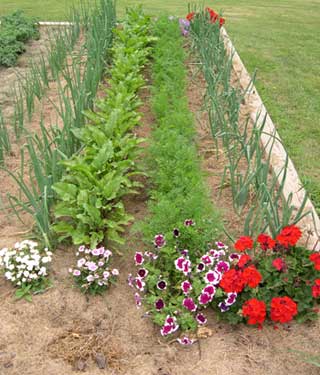
And What About All Those Flowers in the Garden... Almost from when I began gardening, I've worked flowers into the vegetable plantings. Sometimes they're for bug control, such as nasturtiums to deter nematodes and smelly marigolds to deter...uh, I forget what. Okay, you've got me. I just like flowers in the vegetable garden. They do serve a purpose beyond aesthetics, though. If you look closely, the photo below reveals that many of the flowers are at the ends of vegetable rows. Rather than leave my stakes and string after planting seed, I often just transplant a flower on each end to serve as row markers.
July 10, 2008 - Hey! The Skies Cleared a Bit!
I find that broccoli is one of the crops we can grow and freeze enough of to meet our needs for the whole year. Even in the heat of July, our broccoli is still sweet. I generally end up munching on some of the mini side shoots as I pick. To keep the harvest going, I'll again (did it once already) pull back the grass clipping mulch and work in a bit of lime and fertilizer around the base of the plants. I'll also give the broccoli, cauliflower, and kale a good shot of Thuricide
And of course, it's nice to just step back and look at the main garden plot a bit. We actually have three garden plots now. The raised bed below is the main plot and carries our intensive beds of vegetables and flowers.
Another plot to the right of our raised bed has the garlic, our caged tomatoes, and our green beans and potatoes...if they every get going. We've struggled with the plot on the right, as it was gardened by the previous owner...and was pretty well spent. I've green manured it with a year of alfalfa and also let it sit out a year two different times, but I think we'll be cutting it down in size and just return part of it to yard next year.
A third plot in a nearby field left fallow by the farmer has melons and squash in it. I'd originally hoped to plant sweet corn into the plot, but the weather and another round of elbow surgery for me put us too late into the planting season to get a corn crop. The plot has just a tilled and mulched strip with butternut squash, cantaloupe, watermelon, and one caged tomato plant (not shown) in it.
Years ago when I owned a small farm, we grew and roadsided about two acres of sweet corn each year! We just put up a sign on the highway when the corn came in and let folks drive back to our farm to buy it. The one year we grew four acres of supersweet sweet corn, we'd hoped to sell it at a nearby farmers market. Unfortunately, when the day to pick came, the wholesale price on sweet corn dropped from 65 cents/dozen to 35 cents. We just put a hotwire around two acres of it and turned some feeder pigs in on it! ScienceDaily had a good article about using coffee grounds in compost heaps this week. We've done so for years, but Coffee Grounds Perk Up Compost Pile With Nitrogen gives some perspective on why it works and how to do it best. August 7, 2008 - A Busy Time
The Japanese Long Pickling variety of cucumbers produces abundant crops of long, thin and often straight fruit when trellised. The fruit easily grow to 16-20" long while remaining thin and tender enough for slicing for pickles or table use. There's a story on another page here on Senior Gardening with my Japanese Long Pickling cucumber story.
August 13, 2008 - Succession
Our sweet onions, Walla Walla's, are about all gone, other than the ones I chopped and froze. They just don't keep very well, but we love the flavor of them, so I grow a row or two each year. Our first harvest of storage onions, this year Pulsar and Milestone, have dried on the porch, been sorted and bagged, and have gone to a cool, dark room in the basement. We have a second planting of them just getting going. I don't really know if they'll beat the frost or not. If they mature in time, they should store well into the winter for us.
I also started some cauliflower and broccoli, although I've not had much luck with fall plantings of either. Maybe starting the plants under the lights in our cool basement will help this time around. It was also time to start my all time favorite pot plant, gloxinias. I started one pot of saved seed that my students had produced by hand pollinating the gloxinia plants in our science classroom years ago. I also started a pot some commercial seed of the Empress variety. I was really happy to see that there is finally a US supplier for the Double Brocade variety of gloxinias again, Pase Seeds. It's my favorite variety of gloxinia to grow under plant lights, but Park Seed quit carrying the variety several years ago.
Getting back to succession in the garden, I find it a bit sad when I clear garden sections, renovate the soil, and then begin replanting.
While the garden takes a good bit of time, it's a satisfying feeling to look out the office window and see the garden and the cornfield next door.
Thermal Shock for Tomatoes!
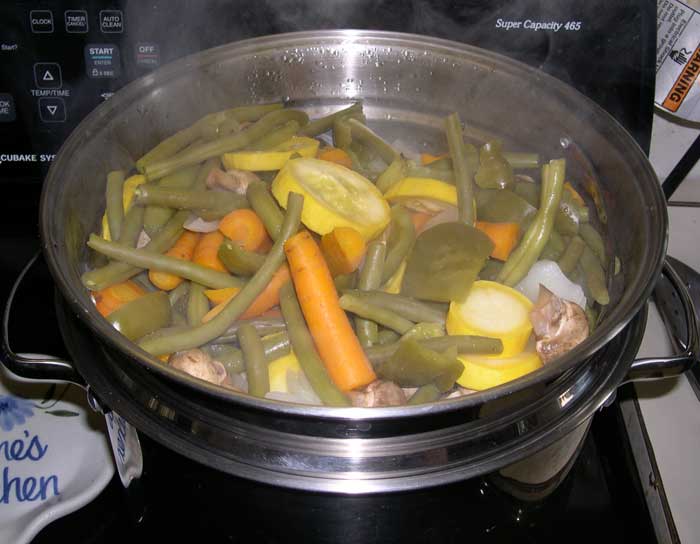
With one of those "Ah hah" smacks to the head, I realized that the fruit was quite warm coming in from the garden and the cold rinse water had thermal shocked it, just like glass will do. Since then I've been careful to let the grape tomatoes sit a bit and cool off before rinsing them. Doing so has reduced split fruit to almost zero. And if you were wondering, yes, the green beans, sugar snap peas, peppers, onions, and carrots from the garden are in the steamer right now, along with some yellow squash and mushrooms from the grocery.
August 20, 2008 - A Very Busy Time (for some...) School is starting around the country, so even though I do substitute teach a day here and there, I'm pretty happy to be retired and have time to putter around our garden (and write about it here). Even so, I've been busy.
The winesap came labeled as a semi-dwarf apple tree. It apparently grew right through its grafts and you can see that I really was brutal pruning it down in height this year. To its right is our third dwarf Granny Smith apple tree. Our first got cut off by a piece of farm equipment. Our second produced fruit its first year...and then languished for three more years before dying. I picked all the blooms off of the new tree this year, but it's still making slow growth.
Our asparagus obviously has responded well to its manuring and mulch. I can't wait until next spring when we'll take our first pickings.
I guess I'm just bragging, but maybe I can get away with saying I'm thankful for the time and the bountiful harvest this year. Our extra garden area in the field next to us is showing good fruit. Now, it's a race to see if there's enough rain and growing season left to ripen the fruit and if we beat the squash vine borers. A friend last week wrote that her zucchini had all wilted overnight. She wondered what had caused it. My guess would be the squash vine borer, which can devastate a plant rather quickly, got her zucchini. Crop rotation helps ward off the pest, but the only sure way is lots of toxic sprays. Having said that, I'm not sprayed our vine crops yet, but watch carefully for the telltale sign of sawdust-like shavings around the stems of the plants. Of course, when you see the shavings, you're already in trouble and need to slit the stem from the hole where the shavings are towards the base of the plant until you find the borer. Removing it and burying the slit stem may save the plant. The best description I've seen for organic control of the pest is on Tom Clothier's Garden Walk and Talk site, Squash Vine Borer Control.
August 21, 2008 - A Few Words About Vining Crops While our Japanese Long Pickling cucumbers on are a trellis in the main garden, crops such as melons and squash can easily take over a garden without careful training of the vines and some occasional pruning. Pruning also leaves open wounds in the vines that allow easy entry for insects and disease, so it's best to just stick with the training, or, if you're lucky, pick a large area for these items.
Since the farmer who rents the ground around us decided to leave the small field east of us fallow last year and this year, he was kind enough to let us have use of part of it for our vining crops. Originally, I'd planned to plant it to sweet corn, but didn't get it in soon enough. I'd also been cautioned by the farmer that the ground was pretty burnt up. Since I'd mowed a section of the field, I decided to put it to melons and such. I just tilled a strip about five feet wide and added copious amounts of lime and fertilizer. Since I hadn't grown any transplants for such crops, I made a quick trip to our garden store and picked up a peat pot of watermelon, two of cantaloupe, and a butternut squash. Each large peat pot had about three plants in it. I added a bit more lime and triple 12 fertilizer in a large hole I dug for each plant, poured in a five gallon bucket of water with some starter liquid fertilizer, and set the plants in. I immediately added some dried grass clippings around each plant. Each time I mowed I'd enlarge the area of grass clippings to hold down weeds. I also cheated a bit and sprayed some of the surrounding area with Roundup Once the plants became established, it's been a race to keep the mowed area mulched with grass clippings to stay ahead of the ever expanding vines. I left about ten feet between each of the plants, but you can see that they've easily filled the area and are now overlapping. All of this tender, loving care for this plot may seem a bit excessive, but I plan to use the area next year for sweet corn (if they let it lie fallow again). August 22, 2008 - A Rainy Day We are finally getting some much needed rain on the senior garden today. I hurried out onto our porches early this morning to take down some of our hanging plants that are sheltered from the rain and set them on the steps to soak up the precious water.
Gloxinias are related to african violets and are just as easy to grow. I've started my gloxinias for years in the old bottoms of soft drink bottles. Bottlers don't use the reinforcing bottoms anymore, but I've saved several just for this purpose. I use sterilized potting soil with a dusting of peat moss across the top of the "pot." Before seeding, I set the pot in a dish and add very hot water and let the soil soak it up.
It will be a seven months or longer before the plants flower, but the payoff is well worth the effort. Below is a collection of gloxinias that I took into my classroom (in 1996!).
August 27, 2008 - Tomatoes We had BLTs for supper last night, our first with real tomatoes from the garden. I really think my wife and I could have gotten by with BLTs, holding the bacon and lettuce. There's nothing quite like fresh tomatoes from the garden.
We usually plant some determinate varieties (Rutgers, Moire) as bedding tomatoes and have some Better Boy or similar varieties caged. I had germination problems this year with some old seed I thought I'd kept frozen properly, so we ended up going with what we had plus one purchased Better Boy plant that is caged in our melon area in a separate garden section. Tomato Cages
Years ago, I came across something about using concrete reinforcing wire to make large, tall tomato cages. Once I tried it, I never went back to any other way of caging my tomatoes. The wire usually comes in either 25 or 50 foot rolls, and for most gardeners, the 25' roll will make enough cages. If you shop for this item, be sure to get it with 6"x6" openings so that you can reach through to harvest your fruit. I'm on my third set of cages made from the wire (called welded wire in some stores), as they do rust. This time around, I also picked up a few cans of rustoleum paint and painted the cages green when I was putting them together. It does seem to make them last a bit longer, although the welds eventually break. The cages are tall enough to support indeterminate varieties, although from the photos below you can see that the plants eventually swallow up the cages and have to be pruned a bit.
When I have the time (and enough money for a roll of the wire), I hope to do a feature on how to build these cages. For now I'd refer you to a couple of good links I found online.
September 1, 2008
Putting up onions, peppers, and sugar snaps this way makes cooking with them really easy. We just grab a handful of whatever we need from the freezer bag. Our lettuce and brassicas growing under plant lights required some attention as well. Since I'd seeded more than one seed per cell, a good bit of transplanting was required to get to just one lettuce, broccoli, or cauliflower plant per cell. The transplanted plants went back under the plant lights, while the ones that weren't seriously disturbed went onto the back porch to harden off for a few days before going into the garden.
Once the transplants had been moved to individual cells, things looked a bit less crowded under the plant lights.
It will be a full seven months before we see flowers from these gloxinias. I'll need to move them to individual cells in a few weeks where they'll grow for a month or so before going into four inch pots. And I guess I saved the best for last. I decided this morning to run out to our "extra garden" in a farmer's field next to us to check our vining crops. I didn't have the camera with me, so I can't show you full slip or half slip of cantaloupes. But I did pick two cantaloupes!
For me, bringing in a crop of cantaloupe or watermelon without having to spray with Sevin or some other highly toxic product is a real high. I hope your Labor Day weekend has been as joyous and blessed as Annie and mine has been. September 15, 2008 I picked our first watermelon of the year last week. It weighed in at 28.6 pounds! It was ripe when I cut it, but I really should have let it sit another day or two before picking. Our cantaloupe are now coming fast and furious. Of course, once they play out, they're gone, but we still have a dozen or so on the vine. Lots of folks in central Indiana are having trouble with their tomatoes this year. I'd guess it may be due to the very wet spring we had. I waited until late May to transplant our tomatoes. They also were mulched immediately after transplanting. We've had a good harvest so far, but two of the rather top heavy cages blew over when the remnants of Hurricane Ike passed through yesterday.
I'd prepared both beds weeks ago when other crops had vacated the senior garden adding peat, lime, and fertilizer to both planting areas. I then added a six inch layer of grass clippings over the beds and let them just sit and wait until the time, weather, and transplants were ready. Even with some good showers, I noticed dry spots remained under the mulch when I transplanted. Since I always add a little liquid starter fertilizer to transplants, I just gave them a bit more than usual. The heavy rains yesterday should get them well on their way.
Our sugar snap peas have just about played out for the year. I picked a grand total of just six pods the last time around. I usually get 30-50 in a picking, so I'd guess it's time to pull up the vines. Getting back to peppers, we couldn't grow good peppers on this ground for a long time. We kept trying each year, only to have the plants mysteriously die just as the blossoms turned into small peppers. Then about eight years ago, we started getting bountiful harvests of peppers each year. I'm still not sure what happened. I'd successfully grown peppers in other gardens before moving here, and I didn't do any radical change to the soil, other than each year trying to increase the organic matter in the soil. September 20, 2008
I worked for several years with an excellent special education teachers, David Hale. Dave was also an avid gardener, but had never grown zuchinni. He decided to try them and bought a whole flat of plants. He set them all out in his extensive garden. When harvest rolled around, if you left your car unlocked at school, you were likely to find a bushel of zuchinni inside at the end of the day!
We're not filling co-workers cars with cantaloupe, as I planted only two hills of them. As with most other plants, a succession of harvest would have been nice. But, I'm not complaining. It was time again to turn the compost heap this week. The heavy rains over the last weekend had it thoroughly soaked. When I turned and moved it, I found that it was hot in the center as it should be. I also pulled up the sugar snap pea vines and piled them onto the heap. The compost pile also received a sprinkling of lime to keep it sweet and triple-12 fertilizer to keep it "cooking." Interestingly, around the edge of the compost heap where it doesn't heat up as much, I found seedling cucumbers from those that I tossed in earlier. While I did germination tests on the seed I saved from the Japanese Long Pickling variety, it was somewhat gratifying to see the seeds germinate. It also reminded me of the importance of turning and stirring the compost from time to time.
Our fall lettuce is obviously doing well. I had to replace a couple of plants from apparent mole damage, and one appeared to have been nipped off from the top by a rabbit or deer. There's obviously more lettuce than the two of us can eat, but at this time of year, there's plenty of space. I like the contrast of the bright greens and reds of the lettuce as well.
I still use sterilized potting soil for the transplants at this stage. They're still succeptable to all kinds of ills, especially moss in the pot. I add a dash of Captan to hold the moss back as much as possible.
It is important to continue bottom watering gloxinas regularly. The soil can dry, but one needs to not let the plants totally dry out. If all of this seems to be a lot of trouble, let me share the photo at left with you. It's a flower type that I really don't think was part of our original plants. It was produced on a plant grown from seed we saved in my classroom. September 27, 2008 - Applesauce
The squeezo will take whole apples, although I remove the blossom end and split each apple before throwing them into the pot of apple juice to warm and soften. Splitting them is necessary for me, as these are all groundfall apples. Almost all of them have a small bruise from where they hit the ground that needs to be cut out. Recipes for applesauce are really unnecessary if all you want is just straight applesauce. Both the Squeezo cookbook and the Ball Blue Book Since apples are an acid fruit, you can safely water bath can them for 20 minutes. This batch from ten gallons of apples won't last long enough to make it worth getting the water bath canner out and cleaning it. (I think I used it last to sterilize some potting soil!) Our crew of kids (grown) and grandkids will make quick work of it. One note I might add that I noticed in one of the cookbooks is that using several varieties of apples improves the taste of the sauce. Since our Granny Smith tree died last year, I'm making our applesauce this year just from apples from our Stayman Winesape tree. I have already noticed that the applesauce, while good, isn't as good as it has been in past years when we've had more than one apple variety to sauce. A Friend in the Garden
September 28, 2008 - Fall Lettuce We enjoyed our first picking of fall lettuce (and a bit of spinach) in a salad for lunch today.
I've planted far more fall lettuce than we can eat this fall. And on the odd chance that we might not have an early, killing frost, I'll planted a bit more today. As I've related before, I like how the lettuce looks in the garden (and in a salad or on a sandwich). Hummingbirds Most of "our" hummingbirds appear to have started their migration south for the winter. We still have a few visiting our feeders, although they seem much more shy than our summer long residents.
I moved our feeders in front of the windows on our porch so that we could enjoy the few migratory or late stayers that are still visiting the feeders. They'd also become a bit of a hazard, zipping the length of the porch as they jostled for position at the feeders at opposite ends. October 1, 2008 I can't think of a better time than the first of the month to post a reminder about ordering garden catalogs. Soon, the weather will be too bad to do any outdoor gardening, and garden catalogs can help the avid gardener pass the time productively. Even though I often order online, I still like to have a physical catalog to peruse, mark my favorites in, and check back into for variety information at later times. Here's a listing of my favorite seed suppliers. Johnny's and Stokes get most of our business, but we use the others from time to time for odd items. I currently have an order in for elephant garlic sets from Johnny's. I was surprised to see that they're already sold out of some varieties of garlic for next year. If you plan to order garlic sets, better hurry!
I picked another huge (42 pounds) watermelon this week. I bought a peat pot of seedless watermelon this spring at a discount store, but apparently all the seedless died out and we're getting giant Charleston Grays (probably the included pollinator). I'd guess that's another reason to buy your own seed to put out!
When I checked my seedling gloxinias this morning, I was shocked to see many of them bleached out. Some appeared to have died as well. It appears that I got my plant lights a bit too close, so I've backed them off several inches. Fortunately, the whole planting wasn't lost. Maybe to make restitution, I got busy on a continuing feature I'd started in August and got it up on the site. See Gloxinias. October 6, 2008 - Sooty Mold on Apples We are having another great apple harvest from our Stayman Winesap apple tree this year. Unfortunately, the apples are covered with a black substance I assumed was some kind of mold. When I did a little research online, I found it was called "sooty mold," a general name for several different fungi that can grow on honeydew deposited by sucking insects. My wife and I spent a good bit of time this weekend washing the black stuff off our apples with scrubbie pad. The apples seem fine after washing, although the black covering appears to have impeded ripening a bit.
The real downside of all of this is that the black stuff can get on leaves and interfere with photosynthesis. I'd noticed we'd lost more leaves than usual by this point on the tree. Control of the fungi can include organic or stronger materials. The honeydew was most likely produced by aphids tended by ants. So, controlling ants under and on the tree "should" stop the sooty mold. October 8, 2008 - A Trick for Draining Wet Spots
This garden trick only requires a shovel, a post hold digger, some sand, and a bit of effort. While it's not a wetvac for the garden, it can help. October 10, 2008 - The First Seed Catalog for Next Year Arrives Today's mail brought a pleasant surprise - the first seed catalog for the 2009 gardening season. I just had a few moments to look at the Thompson & Morgan Seeds Another Round of Kale Soup
Today's labor of love was making and canning another batch of portuguese kale soup (recipe). Unlike the previous batch of kale soup we did in August, this time around we had plenty of our own tomatoes for the hearty soup. I was pleased that we still had a nice picking of green beans to go into the soup. We're getting awfully close to our first frost date, if not there yet.
Another really pleasant surprise in the kale making was the total absence of white cabbage moth and/or cabbage looper worms. I'm not sure if our spray regimen (liquid sevin to knock down the population followed a week later with thuricide), the cooler weather, the recent heavy rains, or some combination of the above or something else. Although we absolutely love living in the country, my wife and I occasionally grouse about the drive to work, how far away the grocery is, and the lack of restaurants and such in our small community. Just as I was putting in the photos above, I looked out the west window on the gorgeous sunset shown below. It reminded me of how blessed we are in our country life.
October 20, 2008 - Where'd He Go No, I haven't dropped off the face of the earth. But I'll let you in on a little secret about what gets this blog written. I generally look at my picture files to refresh my memory of what I've done recently in the garden. Late in September, I put my Nikon Coolpix 4300 and an empty tea glass on the newel post at the top of the stairs. I frequently do that to remind me to take something down with me when I leave my upstairs office. Unfortunately, this time I forgot what I'd done and compounded the error by not turning on the hall light. The tea glass and the camera made a quick trip down the stairwell. The camera really did far better than the tea glass (which took hours to clean up). With a bit of work, I was able to get the 4300's lens to extend and retract properly most of the time. It still worked, which is a tribute to the ruggedness of some aspects of the camera. But it was obviously on its last legs and needed to be replaced.
And yes, if I weren't retired living on a somewhat fixed budget, I would have popped for the Nikon Coolpix P5100
Some of our flowers in the Senior Garden are still blooming furiously in mid-October. In one corner of the garden we have snapdragons, vinca, petunias, and nasturtiums.
October 26, 2008 - Break Out the Cold Frame
We've harvested the last of our gorgeous peppers, picked the last of the good tomatoes several days ago, and today brought in most of the lettuce that won't fit under the cold frame. Our cold frame is a small one I built a number of years ago out of 2x4's. I've written up some very rough directions for building a cold frame in A Simple Cold Frame in the Features section of Senior Gardening.
November 7, 2008 Fall is definitely here, so it's time to begin preparations for next year's garden while still finishing up some things from this year. Of course, it's also a great time just to stop and appreciate the fall colors. Our "neighbor" who owns the farmground around us keeps an asparagus patch just behind our yard. The golden asparagus, green grass, brown corn stalks, and multi-colored trees in the distance are a feast for the eyes.
I chopped some of the heavier material as I added it to the pile. Things like tomato plant stems, butternut squash that didn't quite make it won't decompose as quickly as grass clipping and household scraps. So I use a corn knife to chop the heavier stuff into chunks that I hope will rot a bit more quickly. I also mixed the old compost pile in layers into the new material with liberal doses of lime and fertilizer. And of course, the reason my pile had gotten stinky was that I hadn't turned it often enough, nor had I added enough lime to it. A good rain a day or so after the picture above was taken helped the pile compress downward almost a full foot.
When I finished transplanting some of them to four and six inch pots and bottom watering them, I started to snap a picture to document the event. Through the viewfinder I saw, dead center of the plant, a bloom bud! That's not unheard of, but it is unusual for plants just two months old. And, it's definitely not good for a plant still growing to size. So, I hardened my heart and pinched off the bloom. And yes, I really wanted to leave it to see what color of flowers the plant will someday produce.
Gloxinias are a great house plant to brighten things up through the winter. The ones above were grown from seed under plant lights and then went into my classroom (circa 1996!). If you can successfully grow African violets, you can probably grow gloxinias without much trouble.
November 11, 2008 - Fall Broccoli
Even with several hard frosts, we are still able to pick brassicas (broccoli and kale, and waiting on the cauliflower), lettuce, spinach, and some onions that haven't quite bulbed. For our area and climate, that's remarkable. Fall Garden Prep on Hold I'd written in the last posting that it was time to get started getting the garden ready for next season. While I had good intentions, a perfect storm of my immune system being on a roller coaster from Efudex treatments, a day of subbing in a special ed room with lots of sick kids, and then working outside too much in the changing weather has put me in bed with a the flu that morphed into bronchitis. Quite honestly, cutting that head of broccoli wore me out. Over the last week, just sitting at the computer has been too much for me. I've not written about health issues here as yet, as we're all getting older and we all face some senior health challenges. The long and short of it is that my garden prep will have to wait until I'm able to do it. I have areas to clean up and till yet, although our main flower bed in the garden still has snapdragons blooming in it that refuse to be seriously damaged by the frost! I hate to pull them up. It's also time, almost past time, to be planting garlic in the garden and tulips in the flower beds. But as with much of living long enough to be a senior citizen, a lot of life at this point is enjoying the moment and learning (having learned?) to roll with life's ups and downs.
November 18, 2008 - Seed Catalogs and Vendors
I looked around a bit on the Internet for a good narrative history of seed catalogs. I didn't find one, so there's a subject for some enterprising writer that needs to be covered. I did find that the Smithsonian has a large collection of old seed catalogs, but I can't show a graphic of one here, as the Smithsonian charges for image use! (Don't the taxpayers own the Smithsonian?) I got started ordering from seed catalogs sometime in the 70's when a neighbor loaned me his Burpee Seed Catalog. It wasn't long until I began to discover other vendors that matched and exceeded the Burpee catalog. Our main seed suppliers for years for the garden have been Stokes Seeds and Johnny's Selected Seeds. Both carry a good selection of both flower and vegetable seeds. Johnny's specializes in hardy varieties for northern latitudes. When we were growing sweet corn commercially (20 years ago!), we were pioneers in our area growing sh2 supersweets from Otis Twilley Seed. While we don't grow 2-4 acres of sweet corn each year anymore, we still order our sweet corn seed and a few other items from them each year. All three suppliers (Stokes, Johnnys, & Twilley) are excellent for both home and market gardeners. I'll not add my whole list again here of recommended suppliers, as I posted it in October. G I added another recipe to the site today that might prove useful over the upcoming holidays. My mother's yeast rolls were always one of the highlights of our family gatherings. She passed the recipe along to me, and I've passed it along to our kids. I hope you enjoy it.
November 22, 2008 - More Seed Orders
I also noticed that Johnny's Selected Seeds listed my favorite pea variety, Eclipse, as out of stock. While they may change that soon, I quickly logged into one of my old, favorite farm suppliers, R.H. Shumway. When Shumway's was located in Illinois years ago, we used to get field corn seed and a great annual hog pasture mix from them. Shumway did indeed have Eclipse, along with a number of other items I had on my "dream shopping list," the order I make as if I didn't have to consider price and my current checking account balance. I found myself crossing off items from my Stokes and Johnny's orders in favor of cheaper seed from Shumway. Of course, it remains to be seed about seed quality and viability!
Several years ago, I realized that saving the old packing slips from vendors wasn't a very good way to keep track of my garden orders. Since I'm a bit of a computer nerd, I started an Excel spreadsheet of my orders in 2007 and have found that a great way to see what I'd ordered, when, and from whom. It takes a bit of data entry time, but now I wouldn't do it any other way. One last place I might recommend for finding garden seed is the Seed Savers Exchange. I used to be a member of the exchange when I was farming. We worked to preserve the old open pollinated field corn variety, Reid's Yellow Dent. The Seed Savers Exchange now maintains and online catalog and order system. Back when I started, you traded postage stamps or another variety of seeds with other members! Once I get all my orders in, I'll begin plotting out my garden as to where and when each variety will grow. As with lots of things like this (builders' blueprints?), when I'm in the dirt next spring, the plan can change rather quickly. I try to document the main plantings into the Senior Garden, although I get a bit sloppy at times. Our main raised garden diagrams are shown below. I still keep them in the old AppleWorks draw document format, as this still works well for me. At some point, I'm sure I'll have to shift to a new application.
I also keep a narrative record for future reference. I find that I don't keep it up to date as well as I do the diagrams. It may have something to do with touching my keyboard when I'm hot, sweaty, and covered with dirt! November 23, 2008 - Lots of Leaves
BTW: No, that's not our lawn sweeper pictured at left. It's an ad photo of a similar model from Sears. Ours is now about 10 years old...and looks it. But it's been a good one. One year when I lived and gardened in suburban Indianapolis, I worked all of our leaves into one small area of the garden. I limed the area well and transplanted broccoli into it the the next spring. We got 12-14" heads! I've been a big fan of using leaves in the garden every since then.
Besides the plots shown above, I also poured leaves onto our extra plot in the farm field to the east of our house. Obviously, we have lots of leaves.
Let me leave you with something that might bring a grin to the faces of some old rock 'n roll fans. While looking through the onion seed in the Stokes Seed catalog, I ran across two uniquely named varieties of red onion, "Red Zeppelin" and "Grateful Red!" I'll probably try both just based on the cool names. November 25, 2008
November 26, 2008 - Cinnamon Rolls Recipe
Have a great Thanksgiving! November 27, 2008 - Thanksgiving Day (US) Best wishes to you for a happy and safe Thanksgiving day. We'll be spending the day with family, one of the great blessings of our life. One of our sons, Zach, publishes a weekly online devotional. This week's devotional is Jesus Does Not Exclude: ALL You Who Are Weary And Burdened. November 30, 2008 - Putting the Garden to Bed With rain and snow predicted for today, I got busy yesterday afternoon and put much of the Senior Garden to bed for the winter.
Fall soil preparation is one of the most important gardening chores one can do. Clearing the final plants from the garden removes places for garden pests to winter over. And in our area, the required dose of lime to the soil has time to work its magic over the winter to bring the soil up to around 6.8 pH. I picked the last of our fall lettuce that had been growing under a cold frame. I also tilled in some of the leaves I'd collected a week ago and turned them into what will be our "soft bed" for onions, carrots, beets, etc. in an intensive planted bed. I covered that area with more leaves and then stripped off the leaves from our remaining kale and covered the the leaves with them. The kale stalks are far too tough to even go into the compost pile, so they were stacked to go onto the burn pile.
I still need to get out and cut our asparagus stalks and put them on the compost heap. I've read that borers can overwinter in asparagus trash, so that chore will get done soon. Also, I need to get the stalks off so that I can apply a layer of cow manure to the asparagus patch to give it a boost next spring. Another chore that didn't get done as yet was finishing enclosing the main Senior Garden with landscape timbers. The 6x6" treated timbers are terribly expensive, so I decided to give our budget a break and wait on that job. Maybe Santa will have some 6"x6"x8', 6"x6"x12', and especially a few of the horrifically expensive 6"x6"x16' timbers on his sleigh this year. As November winds up, it's hard to believe that just two weeks ago, we still had a few viable crops growing in the Senior Garden. Lettuce under the cold frame, some very hardy spinach, kale, broccoli and cauliflower, and even a few onions that didn't quite bulb were there for the picking. We've had a lot to be thankful for in the Senior Garden this year.
While I got out late to finish up my fall soil preparation, I noticed last night that the farmer who does the fields around us worked until 10:30 P.M. last night, chisel plowing the field next to us. Looking ahead a bit, I'll be starting a feature next month on growing geraniums from seed. In January, it will be time to start onions for the 2009 Senior Garden. So even while the winter winds blow and snow falls on the Senior Garden, there will be garden chores to do. December 1, 2008 - Seed Geraniums With a light snow and winds gusting to 25 MPH, today seemed like a great day to stay inside and get started on our geraniums for next year's garden.
It's sort of hard to believe that I was outside yesterday afternoon plugging garlic sets into the ground! December 5, 2008 - Asparagus Seed
I couldn't help myself and stripped off the seed containing berries from the asparagus foliage. I may enlarge the patch a bit next year, and while it will fill in on its own, I may start a few new roots to transplant. December 6, 2008 I transplanted the last of the gloxinias out of the starter "pots" today and also moved most of the ones in four packs into 4" pots. I knew I had to get this work done, as I have around 50 geranium seeds germinating over the heating pad that will need to go into four packs next week. (See: Growing Geraniums from Seed.)
Of course, while rattling around downstairs in the plant area, I couldn't help but notice my poor begonia was really looking bad. Upon unpotting it, I found it was rootbound. I found a larger hanging pot that gave it another inch or so on the sides and a couple of inches more in depth, cut back the spindly growth, and transplanted it. It has faded a bit since its glory days when the hummingbirds couldn't leave it alone.
December 20, 2008 Despite my efforts to discourage it by pinching off blooms, one of the gloxinias started in August is now blooming. The blooms will be a pretty addition when I move the plant upstairs, but obviously, the plant's energy is now split between growing foliage and blooming. I'd much rather it just be growing right now for a tremendous splash of blooms in a few more months.
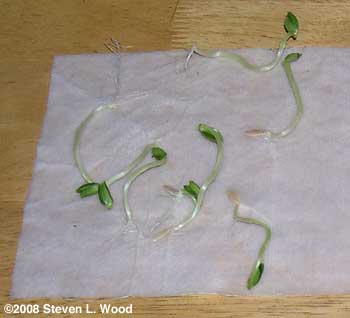
While it may sound like I'm "Mr. Green Thumb" so far in this update, I found that after twenty days, I only have one geranium seed that germinated. Since I sowed over 40 seeds from three different suppliers, I think the bad seed excuse is out the window, right along with any economy I'd hoped for in this project. The seed dried out a bit at one point in the baggies I'd used to hold the seed germinating on paper towels. I thought I'd caught it in time, but it looks like a total loss on the first planting! I've replanted some seed I had stored in the freezer and also sent a panic order for a couple more varieties from one of my seed suppliers. From the
at Senior Gardening |
||||||||||||||||||||||||||||||||||||||||||||||||||||||||||

 One of the most important fall chores in our region is applying lime to the garden. Lime "sweetens" the soil up to an ideal pH of around 6.8-7.0. In our neighborhood, liming is critical, as one of our neighbors is the Hoosier Energy Merom Generating Station, which seems to push the soil to the acid side at a rather accelerated rate. I generally use ground dolomitic limestone from our local TSC store, as the powdered version seems to work faster than the somewhat safer, pelletized kind.
 One way to beat the winter blues is to get some plants started inside to set out into the garden and flower beds when it warms up. It really doesn't take a lot to grow plant starts indoors, just a warm spot in a sunny windowsill or under a good shoplight. I started with petunias today, planting some trailing varieties for hanging pots and some bedding types. They're sitting under a clear plastic cover, as some require light to germinate, on a plant rack I built years ago. There's also a heat pad underneath to supply bottom heat, as my basement isn't all that warm. Tomorrow, I'll get some onions started. They're a chore to transplant, but growing your own transplants from seed is cheaper than buying onion plants, and you have more varieties to choose from in seed than from the plants offered in garden stores.
  for guidance on when to plant what. Although all are long out of print,
  , and
, and  are still the best volumes I have on gardening. Fortunately for others, they're still available used at a very reasonable prices through
  .
. Even though it's only March, the outside garden is beginning to show some signs of life. Garlic planted last November is emerging despite continuing spells of freezing weather. It won't be ready until mid-summer, but it's good to see something sorta green pushing through our garden soil. When I checked my notes, I saw that two years ago I tilled the garden around March 1. With the cold, sleet, and continuing snow we've had, it will be quite a while before I can till this year.
  Seedlings started last month have also germinated inside under plant lights (and for some, over a heating pad). Onion, broccoli, cauliflower, cabbage, and many flowers (petunias for hanging pots) are underway on the plant rack in our basement. It's still too early for things like tomatoes, melons, and squash in our climate zone. I'll seed them inside late this month.


 Years ago when I had a farm, our first garden there went into ground that I scalped with the mower, covered with mulch, newspaper, and black plastic, and planted through holes cut in the layers. Lacking free mulch at this time of year, I bought some cheap, bagged top soil and some very expensive sphagnum peat moss as a cover. I put landscape fabric over a bit of ground for a flowerbed, but put the pea seed right onto the ground and covered it with the topsoil and peat.


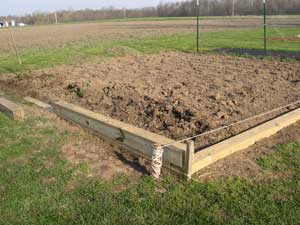 All I really wanted to do was put in some treated timbers to keep our garden from eroding. Our lawn slopes from a farm field through the garden and down through the yard towards a pond. The pond overflow runs across a swampy wooded area into a creek that feeds

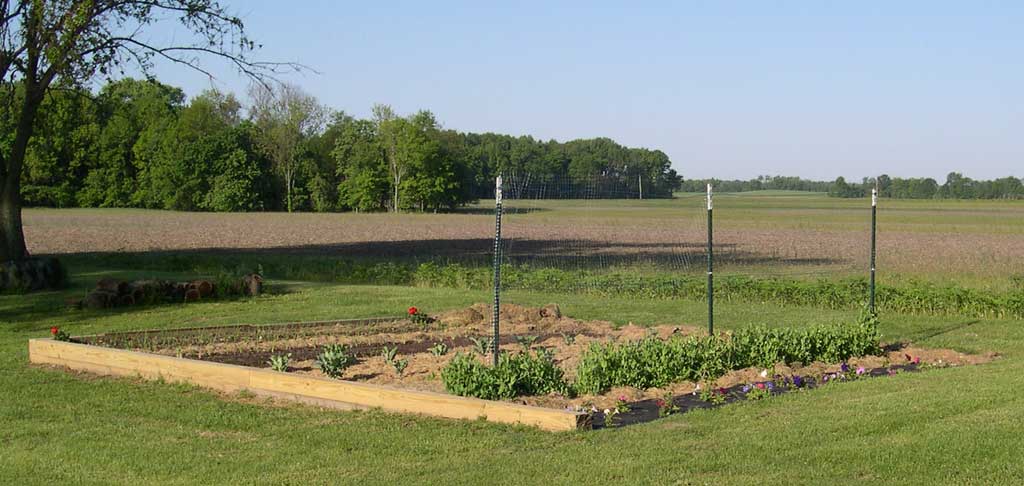


 , transplanted the peppers into it, and mulched them in.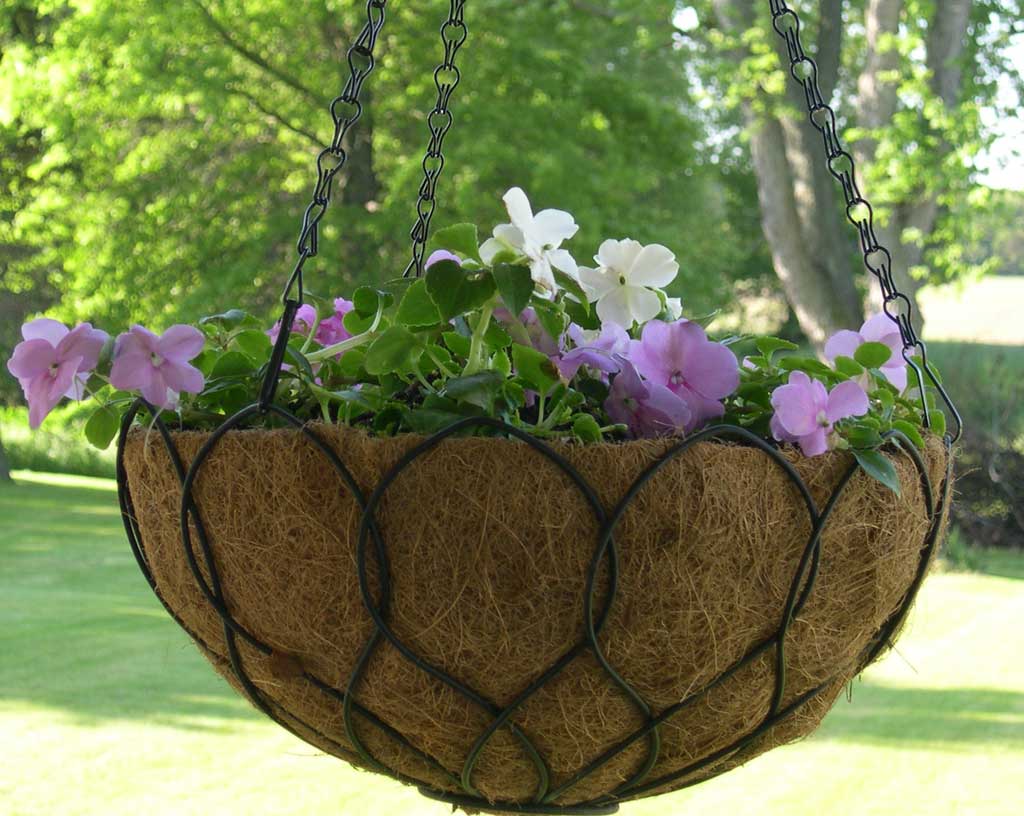

 .
.  We still have lots more planting to do once the weather clears up and the soil dries a bit. Our back porch "holding area" still has lots of impatiens for our shady flower beds in front of the house, and lots of onion starts to go somewhere!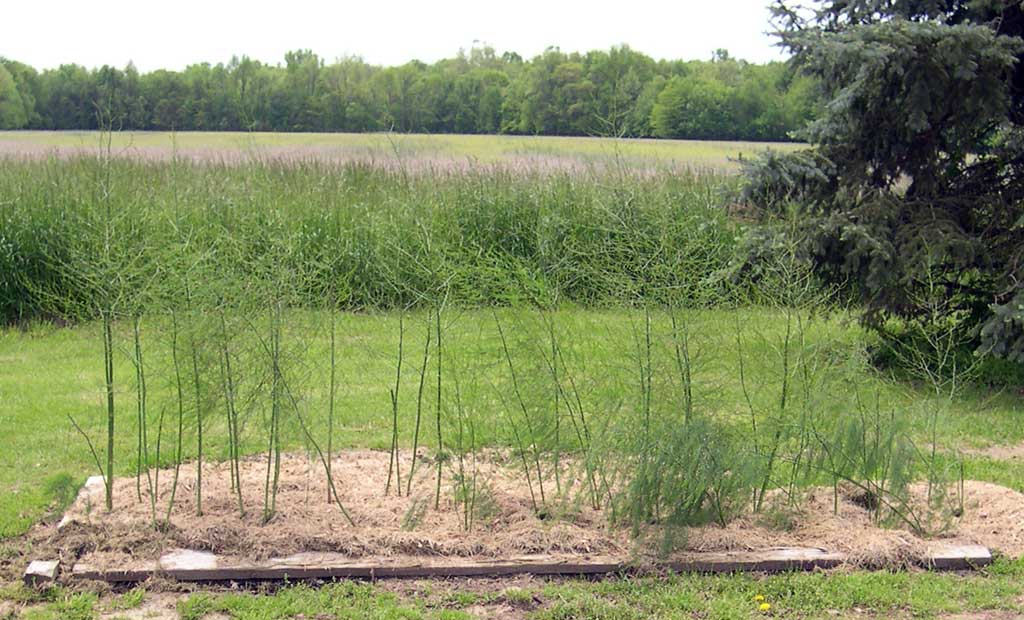


 . It's a biological control for cabbage looper moths and worms on all brassicas (and helps with bag worms on evergreens as well). We use the Thuricide spray early in the season, but usually have to switch to
  combo first.)

 In the photo at right (from right to left), we have double rows sweet white onions, baby carrots, beets, and then a single row of storage onions. We leave about 4-5 inches between the double rowed vegetables with 8-12 inches separating the rows.
 We also received permission this year to use part of a field next door the farmer chose to leave fallow. By the time things dried out enough to work the ground, it was way too late to plant sweet corn, which was my original plan. So for now, there's just one lonely bunch of watermelon transplants in the area. I'll probably fill out the row with whatever vine crop transplants I can find at the garden store that might still mature before fall (cantaloupe, squash, ??).


 We grew three varieties of broccoli this year. I tried Imperial for the first time and was pleased with its growth habit and main heads. It doesn't seem to produce side shoots, however. I also grew two tried and true varieties, Premium Crop and Goliath. Both produced large main heads followed by excellent side shoots.
 biological spray. Since the Imperials don't seem to produce side shoots, those plants will go into the compost heap. I'll replant the row after renovating it with lime and fertilizer with the remaining cauliflower transplants I have on hand.


 We have great green peppers and onions this year that go great in those steamed or grilled vegetables. I planted a mix of green, yellow, and red peppers, but we really haven't had any turn color this year. I guess we pick and eat them up a bit too soon before the yellow and red ones fully ripen!
 Oh, yeah, I titled this section succession. Succession in the garden is one of those things I really have trouble doing. I get busy (and lazy) taking care of things outside and forget to get plants started inside for fall harvest. This year I was late again, but was gratified this morning to see that some of our lettuce had germinated.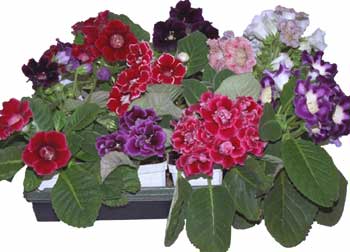




 We have a really nice standard winesap apple tree that produces great amounts of fruit when it's kept sprayed properly. I've done better this year with the spray, but we still have a lot of fruit that shows insect damage. We'll keep the best apples for fresh eating, but will have far more with a bad spot or two that can be cleaned up for applesauce.


 , but nipped the butternut with the spray! It survived, but I lost a couple of the butternut vines.

 Gloxinia seed is dustlike. The hardest part of seeding them is to try to distribute them evenly across the pot.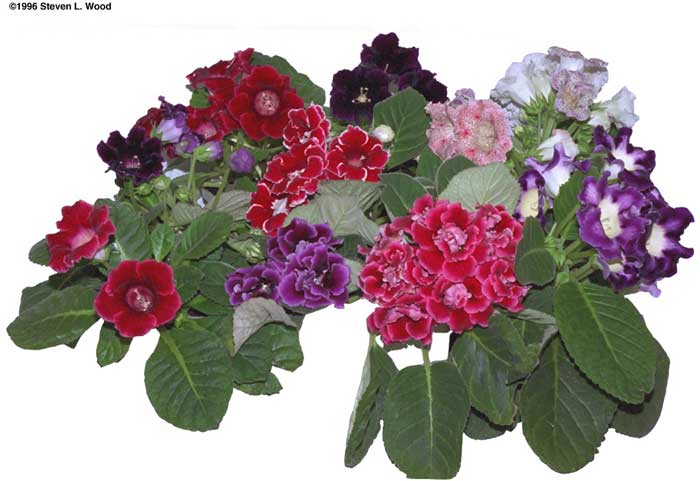
 I did a quick germination test on the seed from the first few JLP cucumbers I'd harvest and saved seed from. I'd actually forgotten about the germination test, but was thrilled today to see that I had viable seed. To do the test, I just counted out ten seeds onto a paper towel. I folded the paper towel over the seeds, wet it, and put it in a zip lock freezer bag. Then I set it in a warm space and forgot about it for a week. The warm space was on top of a shoplight, so the seeds picked up some reflected light and show some good green on the shoots. From what I could count, I got eight out of ten seeds to germinate. I'll gladly take 80% germination, especially when this spring I thought I'd lost the variety!


 Our peppers are finally producing red, gold, and yellow fruit along with the standard green bell peppers. Annie made some great cheese and pepper omlets for lunch yesterday. And I just can't resist posting pictures of ripe peppers of various colors, as I think they're one of the prettiest things that comes out of the garden.
 Our bountiful harvest continues in the senior garden, with green beans, tomatoes, peppers, and melons. When I went out one day this week to check the melons, I found that ten cantaloupes were ripe! Such concentrated harvests can make one rather popular with friends, neighbors, family, and co-workers.

 Some of our gloxinias started from seed last month were read to be transplanted into four packs this week. I tease the soil and lift the plants with a knife, trying to not sever the unusually long "taproot" they often have. One can actually wait until the plants show a small corm at their base.


 for "grinding" into applesauce.
 have excellent directions.You just wash your apples, warm them (core them if you don't have a Squeezo), put them through a strainer, and add sugar to taste.


 The lawn cart holding apples to be washed (now done) has been a dandy. We bought it fifteen years ago to ice down soft drinks, beer, and wine for our wedding reception. (We got married in our hundred year old farmhouse.) Since that time, it's served in a lot of capacities. About the same model is still available. It's an
  . While the link is to Amazon, you can probably find one at your local hardware store for about half of what Amazon wants. It appears they've bumped the price up to cover the "free" shipping.


 . I haven't as yet taken any "keepers" good enough to put up on my
  that could still use my Coolpix 4300 teleconverter lens and macro light. Of course, if I weren't on a budget, I might have gone whole hog and gotten the
  of my dreams:-). But on the really positive side, the new camera, although made of plastic, has more features and double the resolution (megapixels) as the older one and cost just a fourth of what the 4300 cost!


 We still have hanging plants outside, as we brough them in for the previous frosty days. I'm not sure how long we'll be able to do that, but one of our granddaughters loved watering them last weekend!


 In addition to the quick order for elephant garlic I sent to


©2008 Senior-Gardening.com