One of the Joys of Maturity |
|

| Affiliated Advertisers |
Clicking through one of our banner ads or some of our text links and making a purchase will produce a small commission for us from the sale. The Old Guy's Garden Record
I suspect that many seniors have "Where has the time gone" moments as we see our babies having babies and grandkids growing like weeds. For gardening seniors, the coming of September and Labor Day weekend are stark reminders that the summer gardening season is drawing to a close. But September is also another big payoff month for the crops we've been nurturing all summer. There are still melons, sweet corn, eggplant, tomatoes, peppers, cucumbers, and even some Sugar Snap peas to be brought in, stored, frozen or canned, and enjoyed. We may begin harvesting potatoes and sweet potatoes and possibly the fall carrots we seeded in mid-July this month. And we'll just have to wait and see if our rather late planted paprika peppers produce a crop for ground paprika and seed saving. While there's not a lot of planting and transplanting to do this month, a welcome rain last night makes possible direct seeding some fall spinach and transplanting our fall lettuce into the garden. The three week, hot, dry spell we're coming off of has been devastating to some of our garden crops, and without continued regular rains, some crops will just be done for the year. September is also a month where we begin to clear out spent crops, clean up garden debris, and get ready for the next gardening season. Nylon trellis netting gets dried vines cleaned off of it and then is carefully stored for reuse next year. T-posts come out of the ground and if necessary, repainted before being stored in the garage. Pots, seed flats, and inserts will also have to be thoroughly washed and sanitized before being stored for the next season. As crops come out, there will be some fall tilling, although most of that will occur in October.
Our collection of gloxinia plants are finally recovering from their near death experience and are now coming into bloom. We lost almost all the top growth off the plants early this summer. Busy with outdoor garden chores, I think I missed two or more weekly watering days and came close to losing many of our plants. Trimming back the dead growth allowed them to resume normal growth. The error has pushed the plants into a fall and early winter blooming cycle, not really a bad thing.
Our "new" compost heap will grow to mammoth proportions this month and next as leaves, stalks, and vines go into it. Our old pile will be screened with undigested matter going to the new pile. Since the old pile never did heat up to my satisfaction, the compost from it will only be used in places where potential plant diseases and still viable seeds won't be a problem. The most common weed in our raised asparagus bed is tomato seedlings from compost added that hadn't heated sufficiently to kill the tomato seeds. In our climate zone, we don't expect our first frost until sometime in October. Barring a freak, early frost, we should have a full month of wonderful gardening ahead.
Monday, September 2, 2013 - Labor Day (U.S.)
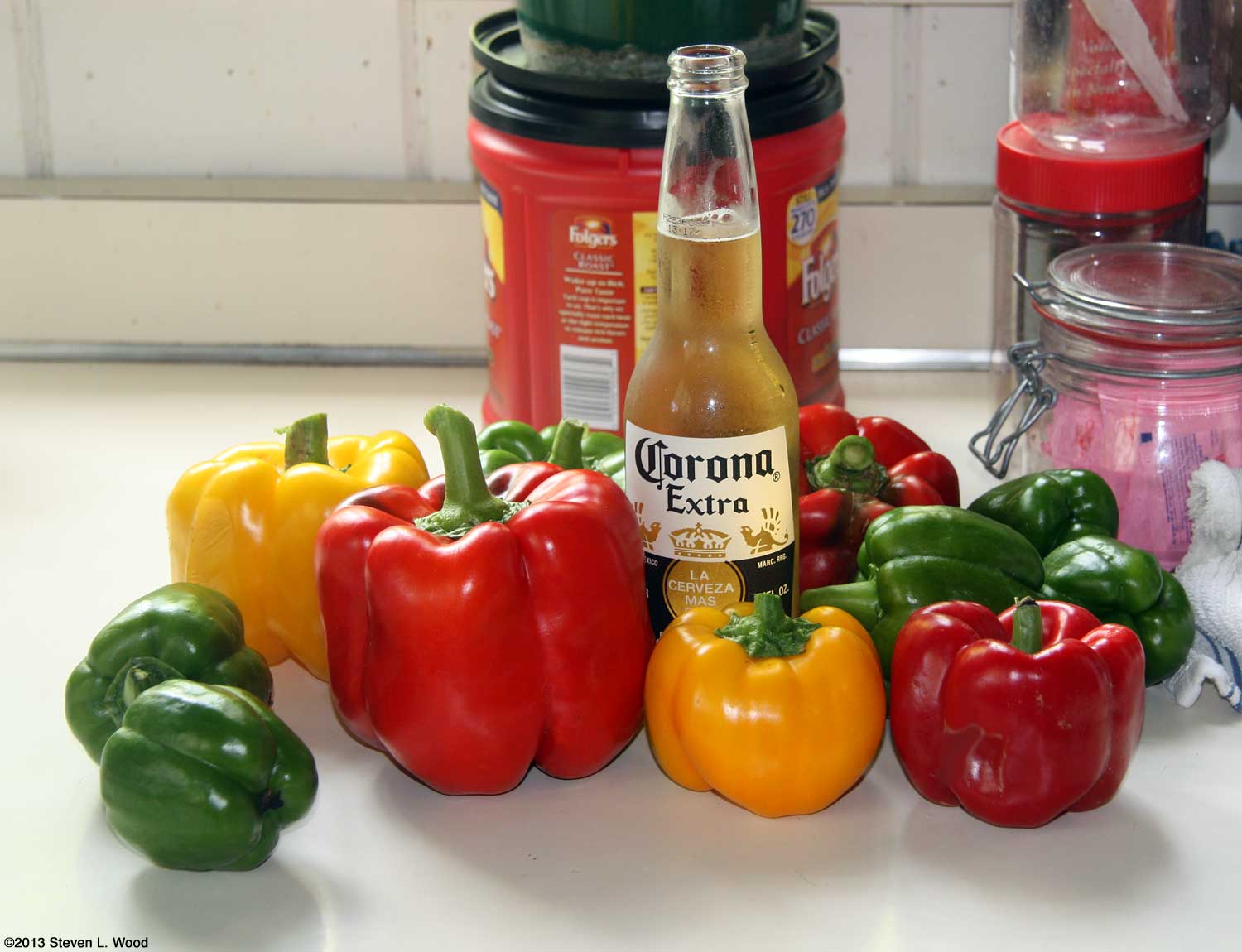
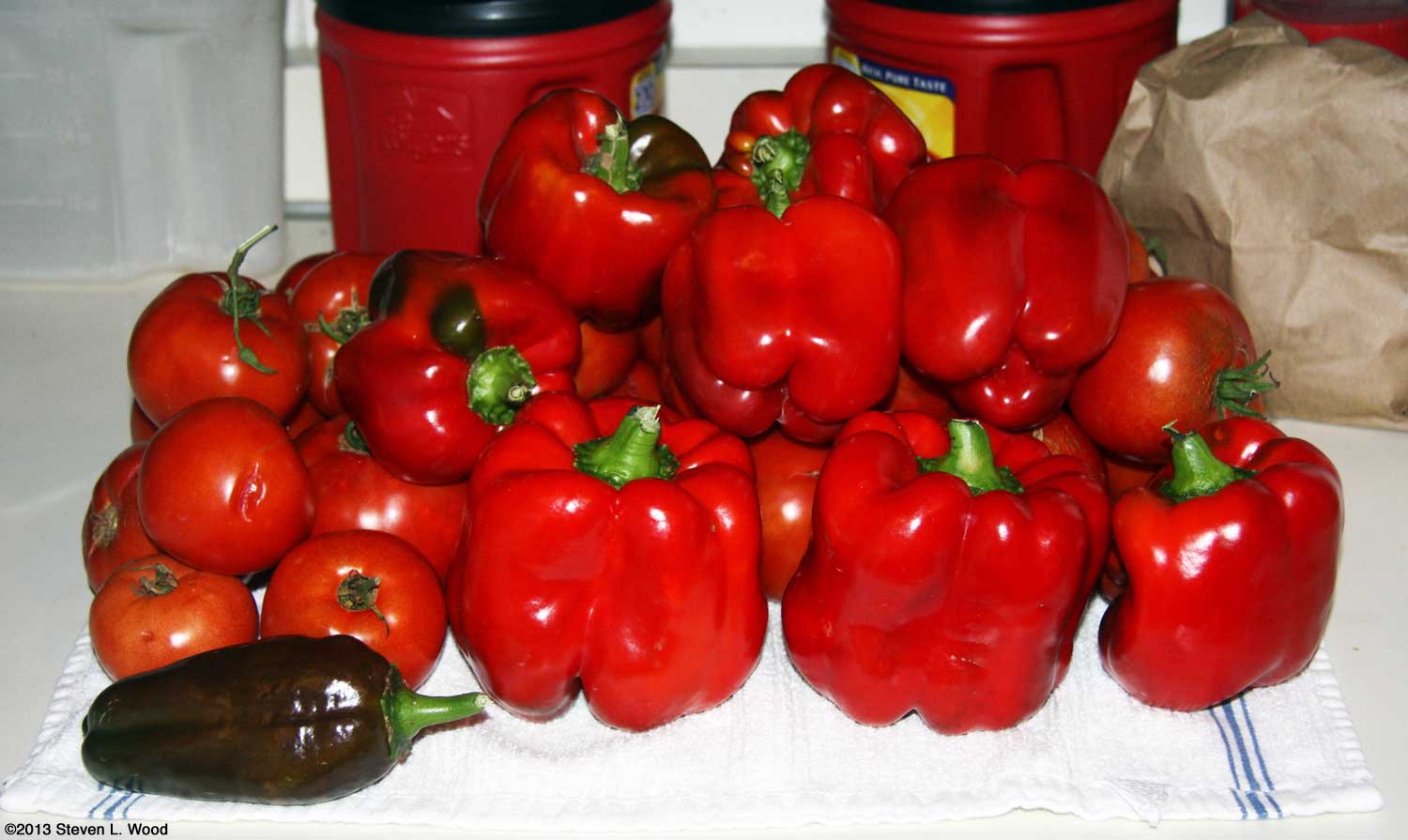
I also had to pick peppers, as the storm had snapped a few of the pepper's brittle branches. Since I often forget to add a frame of reference when shooting pictures of unusually large produce, I set my beer down by an enormous red pepper I picked for size reference. A Fool's Errand? Sadly, all my work with the direct seeded broccoli and cauliflower may prove to be a fool's errand. Most of the brassicas moved and left in place were about the size of good tray grown transplants you'd buy in the spring (but are never available in the fall). Our earliest broccoli variety usually takes about 58 days from transplanting to putting out a usable head (in spring). If you take a September 1 transplanting date, add 58 days, you wind up with a possible maturity date of October 28. But day lengths in September and October are steadily decreasing, so one probably should add a week or so to the maturity date. Direct seeded plants that didn't get moved or have any extras around them removed may benefit from not having transplanting shock. But anyway you cut it, we'll be well past our traditional first frost date of around October 15 when the plants might begin to produce.
Fortunately, broccoli and cauliflower can withstand a light frost or two. Using floating row covers for frost protection may also extend the growing season for our fall brassicas. Two years ago, we were cutting small heads of cauliflower and broccoli sideshoots in mid-November, but that was an unusually late fall. So all my work yesterday could end up looking like a savvy gardening move to eke out yet one more harvest from our garden. More likely, a return of the rabbits or a hard frost will make it a fool's errand. But I had to try. Lettuce and Spinach
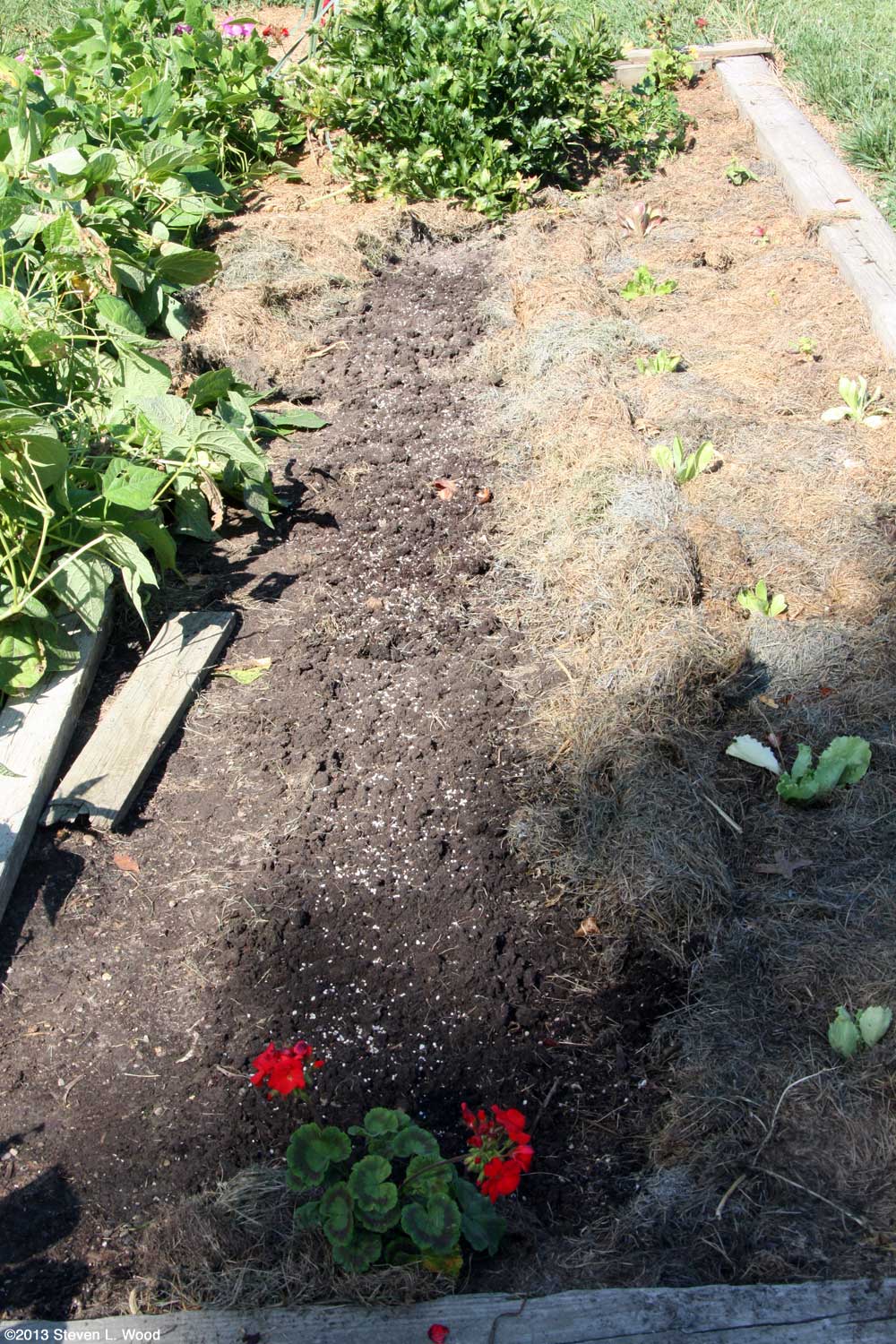
In contrast to our fall brassica time quandary, our fall lettuce should have plenty of time to mature before a frost. I only transplanted a dozen or so plants yesterday. Even though different varieties will mature at slightly different times, they'll all mature in a fairly tight time frame, and one can only eat so much lettuce. To finish up the job in the lettuce area, I planted a row of spinach this morning. That involved pulling back the grass clipping mulch, hoeing the ground to loosen it up a bit, adding a bit of 12-12-12 fertilizer and hoeing it in, making a dibble for the seed with a 1" piece of lumber, and seeding the America, Melody Note that the new spinach planting shares its row with some existing celery and leeks.
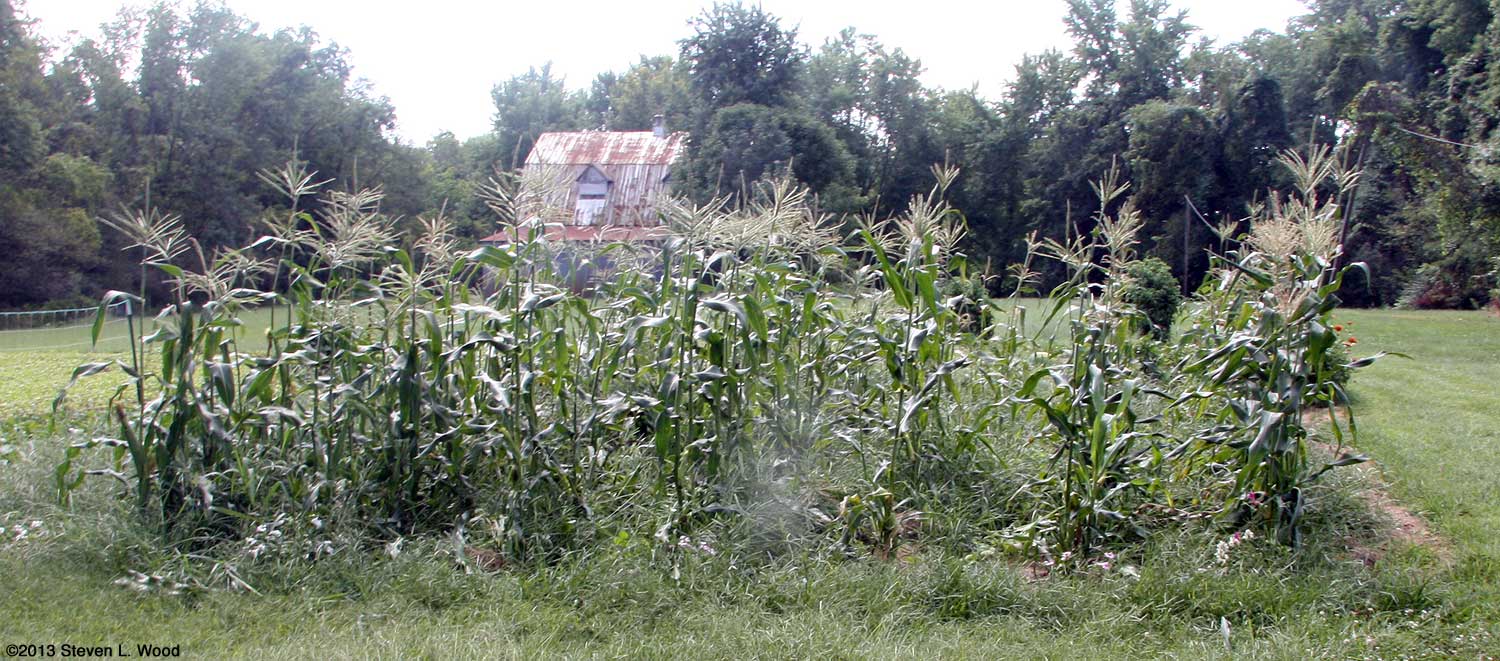
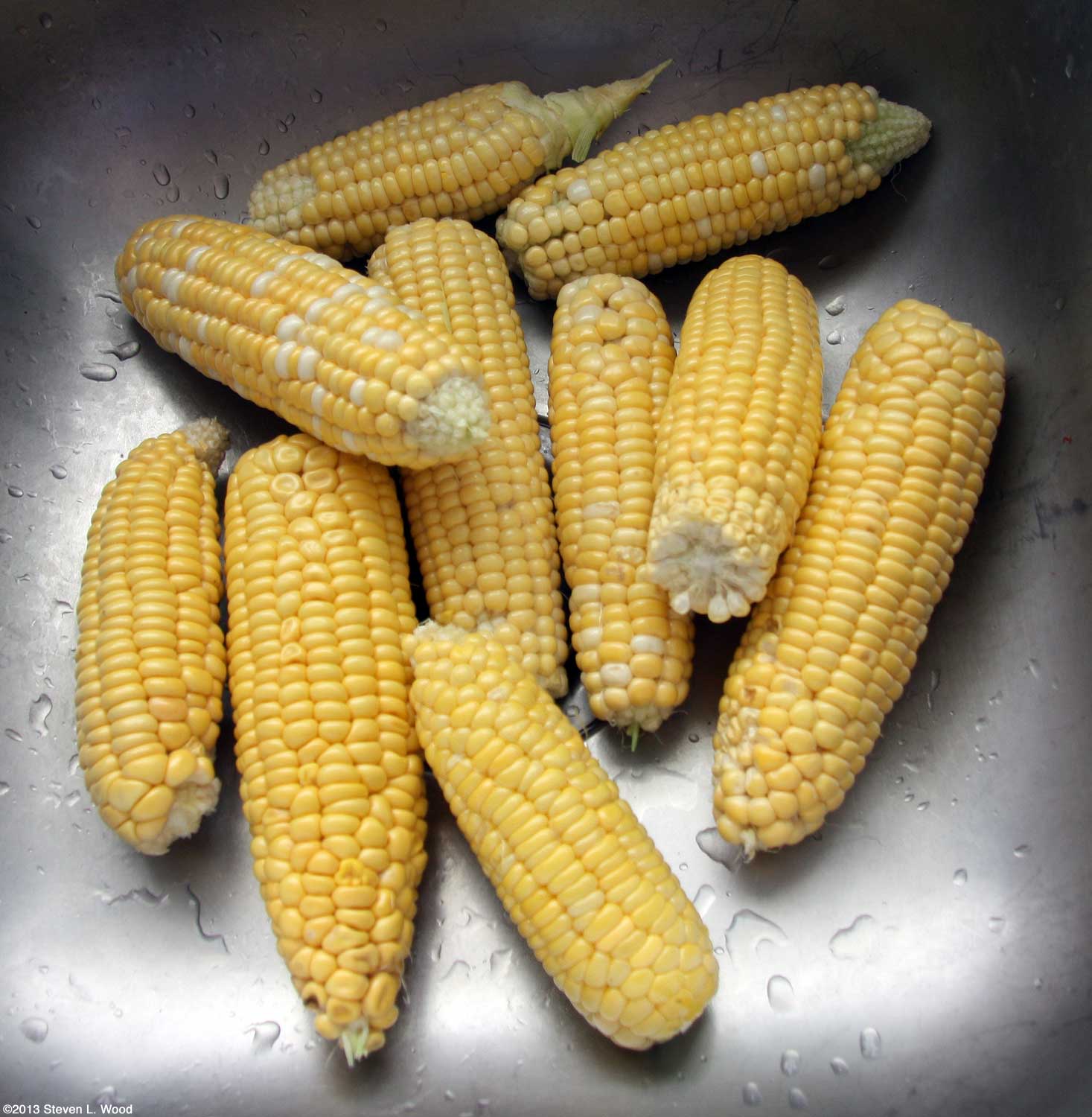
While we used several deer and raccoon deterrent products, I really think our "five dog alarm system" is responsible for keeping the critters away this year. Of course, the dogs have been known to snag and eat an ear of sweet corn here and there. My main job for today was supposed to be mowing the lawn now that it has rained and ruined my excuse of conditions being too hot and dry to mow without killing the grass. But I was saved by the sweet corn and will spend the rest of our Labor Day sitting on the glider on the back porch shucking corn, followed by blanching, cutting, bagging and freezing said corn. But you should see our kids go after our homegrown sweet corn at Thanksgiving and Christmas!
Most of the corn we put up yesterday was Twilley's Summer Sweet 7640R, an excellent 84 day main season sweet corn. It produces large ears with heavy wrappers and a very tight tip wrap. We had not used any pesticide on the corn but still only had two or three ears that showed earworm damage. I found it interesting that the 84 day variety was ripe, almost overripe, at 80 days from seeding. That is consistent with what happened with our early corn as well, indicating that there were more degree days this summer than I thought. While days to maturity is helpful information, it really pays to keep an eye on the maturation of ones crops.
Our outbreaks this year were in one ear of corn and another at the base of a corn stalk. Smut often first shows itself on the tassels of sweet corn, a good reason to carefully observe ones crop as it matures. It also bulges out from leaf joints in the crop, and anywhere along the stem. It can also hide inside an ear wrapper, as our first instance of smut this year did. If you have a very fat, soft ear developing, it may contain smut. When smut appears, it is best to remove the entire infected plant and dispose of it off site. While a compost pile may heat up enough to kill smut spores, bagging the smut for the trash service gets the disease totally off your property! Serious infections such as the stalk infection shown at right must be handled gently. The smut may erupt and shed spores, spreading the infection further. Prevention is the best defence against corn smut. Practicing good crop rotation with several years between crops of sweet corn helps, as the disease can survive in the ground for several years. But smut spores can blow into your sweet corn patch from a neighbor's garden (or a farm field of field corn). Sadly, I know of no fungicide or other treatment that can help once smut appears. We quit growing sweet corn in our main garden plots due to corn smut infections there. When the East Garden space became available, we resumed growing sweet corn there, only to find we had outbreaks of the infection there on what should have been clean ground. Our current system of crop rotation for the East Garden allows three full seasons between sweet corn plantings. But even with that and some vigilance in watching our corn, I still hold my breath each year hoping the nasty disease won't appear. We have a few late ears of sweet corn maturing, so it will be a few days until I can clean up our sweet corn patch. I don't turn down our corn trash, instead chopping it with a corn knife and hauling it to our compost pile. Some of the roots do get turned under, though, as they can be hard to pull. Removing the crop trash has seemed to help in our struggle with corn smut. And if I get the patch cleaned up in time, I'll till and seed the area to buckwheat for fall weed suppression and a bit of organic matter to turn into the ground. Thursday, September 5, 2013 - Tomato Purée I picked a little over ten pounds of tomatoes from just one Earlirouge plant on Tuesday! I'm beginning to understand why Earlirouge was the most commercially successful of Jack Metcalf's several tomato variety releases in the 70s and 80s. Just a little more picking from our other tomato plants gave us enough to do a batch of tomato purée yesterday. After washing, coring, and halving the tomatoes, I heated them a bit. Doing so seems to produce more juice and pulp when we strain them. The straining prompted the first appearance this year in the kitchen of our old Squeezo Strainer After straining, I very gently boiled down the juice and pulp for several hours, remembering to stir frequently. I've burnt more than one batch of tomato purée and ketchup in my time. Interestingly, the Ball Blue Book I was rewarded with twelve pints of homemade tomato purée for my efforts. Peas, Potatoes, and Sweet Corn
When I went out to pick peas, I also took a garden fork and cart to dig some potatoes. Our Yukon Gold potato plants died recently, either from lack of moisture or blight. While it looked like blight to me, it didn't seem to spread to the rest of the potatoes. But in any case, I dug the Yukon Golds. Most of the potatoes were small, but there were very few rotten ones and none showing signs of disease. I guess the dry weather got them. As I started back to the house, I noticed a ripe ear of corn, so I walked our rows of corn, picking ten good ears. That certainly isn't a lot of corn, but after our thorough picking of the patch on Monday, it was nice to get any more corn at all. One of My Favorite Sites
When I last visited Dan Knight's excellent site, I was a bit dismayed to read his column, How You Can Support Low End Mac. It seems that Low End, like many independent web sites, is having a tough go of it financially. Without paid sponsors, affiliate advertising and even "beg buttons" don't seem to make ends meet. I haven't decided yet whether to buy a new mug, send a donation, or do both to help maintain the really helpful site for those of us who still work with older Macs. (And yes, I have a relatively new MacBook Pro laptop, but actually do most of my web construction on a "low end," 2010 Mac Mini.) In the meantime, I thought the very least I could do was add a mention here about Low End.
Free Shipping on orders $50+ with code 9THIRTEEN through 9/30 at Burpee.com! Saturday, September 7, 2013 - Good Yield of Eclipse Peas for Seed
With the excellent yield from our very few Eclipse plants, I should be able to offer limited quantities of the seed to listed Seed Savers Exchange members this winter. (Note: Listed members are ones who are also offering seed they've saved to other members via the SSE annual yearbook. Only listed members may request seed that is listed as "limited quantity.") Hopefully, others will pick up the preservation effort. Of course, the sudden unavailability of the Eclipse variety this year could be just a one year thing due to a crop failure and/or the drought. Buckwheat
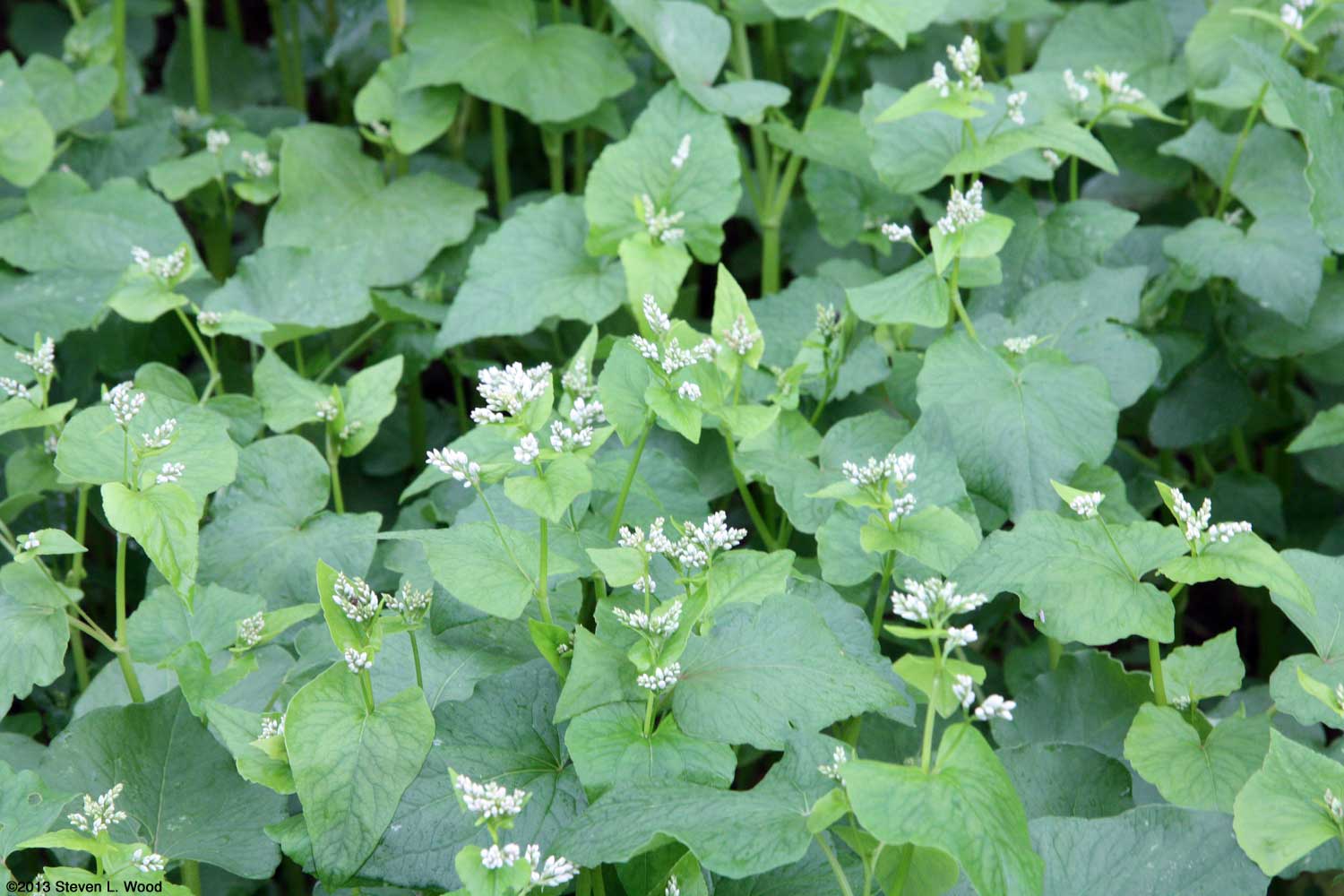
While growing, buckwheat does a good job of smothering weeds. When cut and turned under, it provides a bit of organic matter for the soil. Cleaning Up the Sweet Corn Patch Just before sundown on Thursday when things had cooled down a bit, I started chopping out stalks from our sweet corn patch. I use an old fashioned corn knife to cut each stalk at its base and then chop the stalks a bit in our garden cart. I got the first three rows (out of seven total) chopped and composted. I also ran our riding mower over the area a few times, turning the remaining rubble and high weeds into a nice, chopped mulch than I hope will turn under rather easily.
I had planned to seed the sweet corn patch to buckwheat when I got it cleaned out and tilled, but...we're running out of summer! Buckwheat takes about six weeks to mature and won't tolerate frost. Planting sometime next week would be a pretty iffy proposition for the buckwheat, so I think I'll just wait and fall seed alfalfa into the area, as it is scheduled to be rotated out of production for the next two years.
While plopping a squash plant into the ground should be an easy task, I have a habit of making things complicated. I decided to mix compost in the hole for the squash. When I started to screen some compost, I found that our old compost pile had one of the nastiest odors I've ever encountered. It smelled like an animal had died in it! I suspect the odor was from anaerobic decomposition, the result of my not turning the pile often enough. But I went ahead and screened enough compost for the squash and another transplanting and mixed the smelly stuff into the hole for the squash. I added a bit of time to the project by adding five gallons of water to the planting hole to make sure the transplant has enough moisture to get off to a good start. I also added grass clipping mulch around the transplant to hold down weeds and conserve soil moisture.
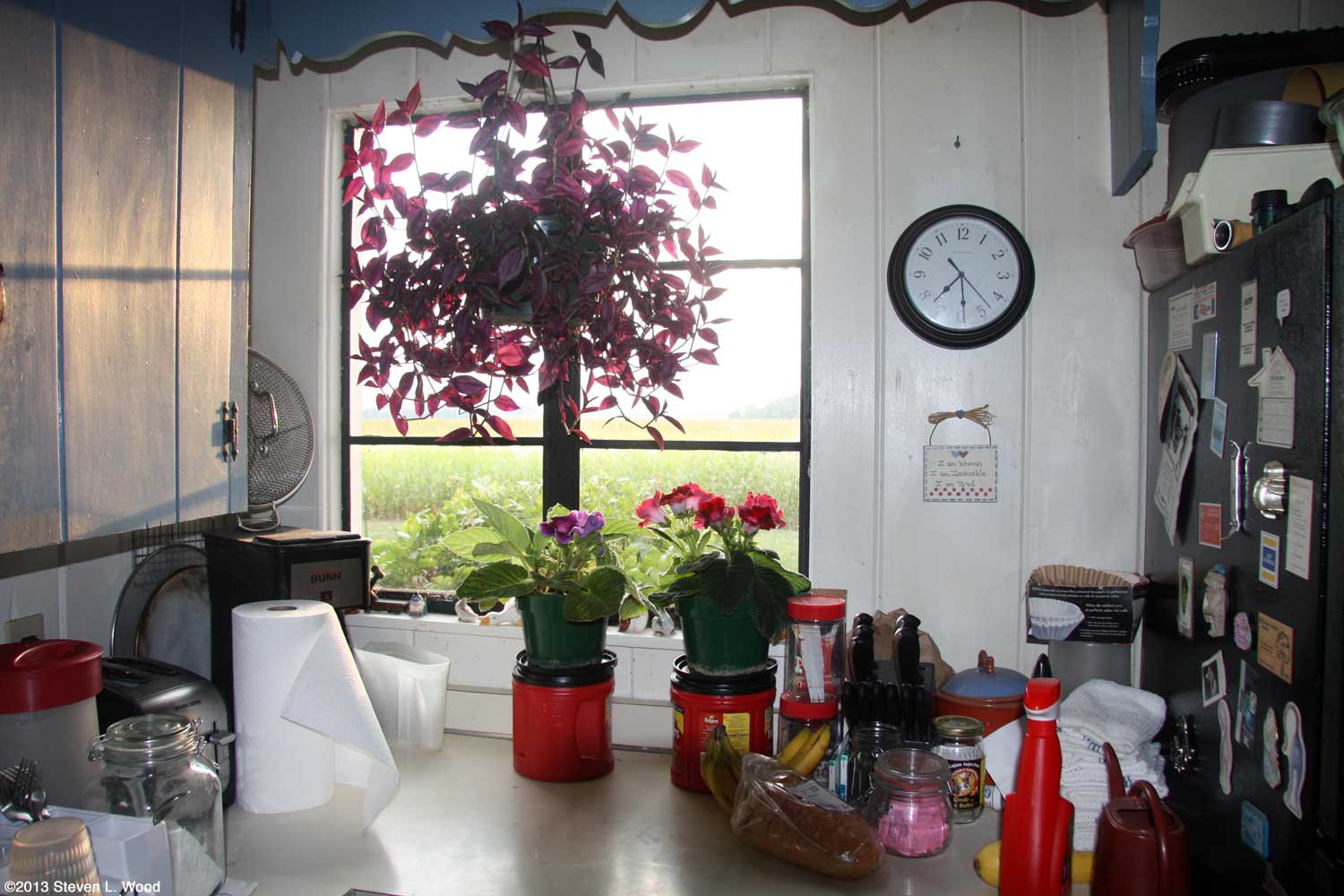
The poor sage plant has survived on our back porch since spring. It was originally to go beside another sage plant in our back yard in an area I hoped to make into a perennial herb garden. That didn't happen, so the plant just sat for months. Whether it deters deer or not, I will now have something more visible and obviously more attractive than a plant stake marking one of the corners of our East Garden. And the last fifteen gallons of water I hauled went onto our new compost pile, as it has had a lot of dry grass clippings, corn stalks, and such added to it in the last week. Let me wind up a busy week with a shot of our west facing kitchen window, now graced by two gloxinias in bloom. We had a small disaster this spring with our gloxinias and they are just now beginning to bloom again.
Tuesday, September 10, 2013 - The Roofers are Here
When I looked at the image I shot of the roofers, it sort of reminded me of the chimney sweeps in Mary Poppins
As our saga of growing a seed crop of the Eclipse pea continues, I started an essential step last evening. I counted out twenty-five seeds at random from the cookie sheet of drying Eclipse seed for a germination test. For this test, I used a wet, unbleached, white paper towel The remainder of the pea seed remains on a cookie sheet on top of a kitchen cabinet. I want the seed to dry down as much as possible before storing it. I haven't yet decided whether to freeze the seed or store it in a dark jar with a tight fitting lid, or possibly split the seed and do a bit of both. Oops! I took out our two rows of green beans on Sunday. I went out to do a third and final picking from them and found I'd waited too long. The overripe beans and plants all went onto the compost pile.
An interesting aside is how various seed houses list the Red Knight. While Stokes simply lists its days to maturity at 72 days, the descriptor from Johnny's Selected Seeds is much more helpful, listing green maturity at 57 days and red at 77 days. Friday, September 13, 2013 - Buckwheat
I really wanted the crop to grow a bit longer to help keep the area free of weeds, as buckwheat is good at smothering stuff trying to emerge under its canopy. But it appears that I'll need to cut and turn under the crop in a week or so to prevent it from setting seed. When checking online to find about when buckwheat normally blooms (about 35 days after seeding), I ran across two excellent postings about growing buckwheat as a smother and/or cover crop.
The photo above illustrates some of the contrasts that often exist in our garden plots in September. The bright green yellow squash plants blooming in the foreground were transplanted in August. The melon patch in the foreground is pretty well done for the year, other than a couple cantaloupe plants still bravely hanging on through our mini-drought. And of course, the buckwheat in the background is growing like crazy.
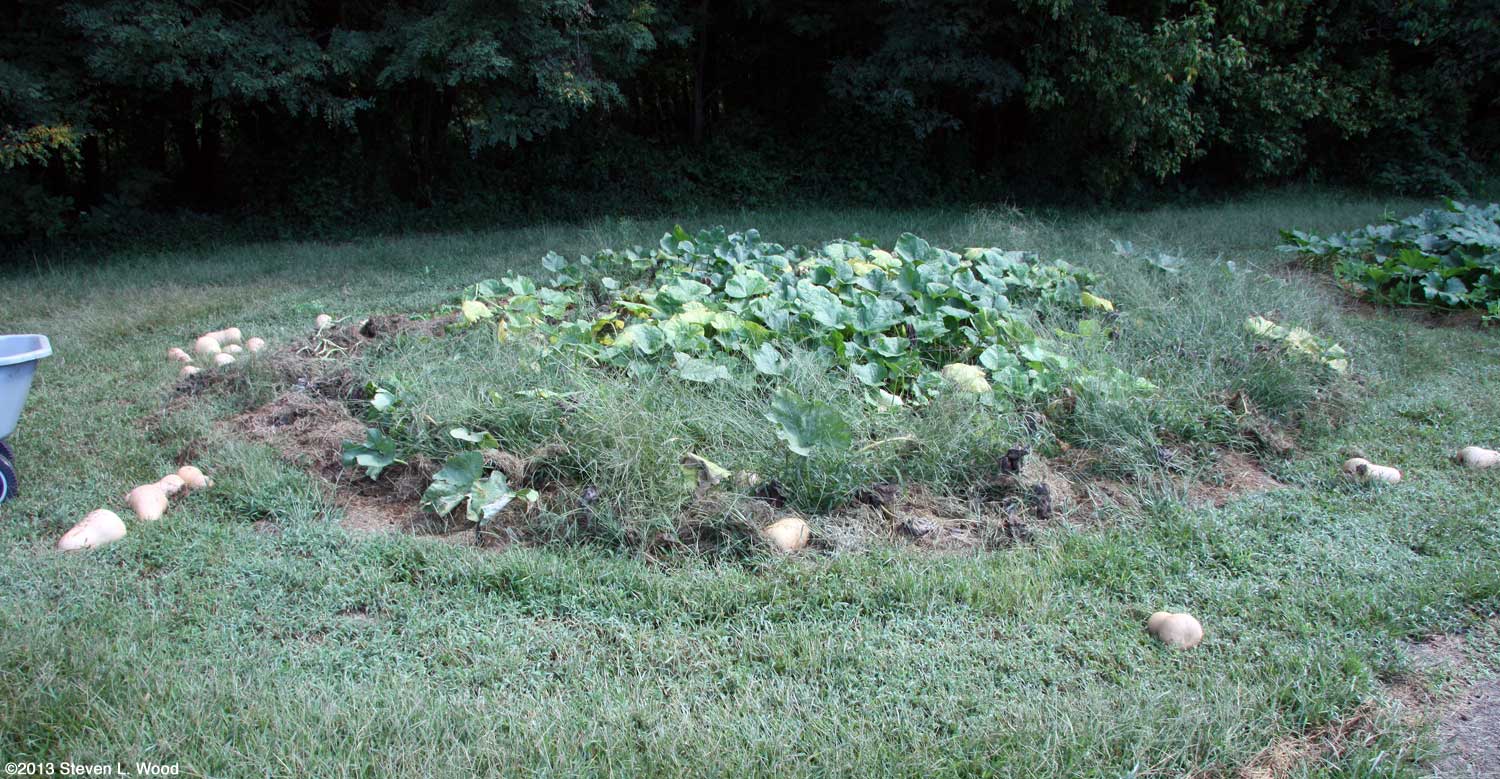
The Waltham Butternut Squash were transplanted onto the site of a previous compost pile. That, along with deep planting hole backfilled with lots of peat moss and a little fertilizer, ensured they would have all the soil nutrients they needed. I made our first picking of butternuts today from what has become a rather weedy planting. Lots of squash were fully mature and ready to be cleaned, cured just a bit, and stored for winter use. I used pruning shears to remove the heavy butternut stems from the vines, circling the patch and just rolling the harvested squash out to the side. I later rinsed off the squash with a hose and dried them in the sun. I'll let them sit several days before bagging them in burlap potato sacks and storing them in the basement.
I didn't get our pumpkins transplanted until late July, as I needed to turn and move a compost pile to make room for them. Knowing I was close to the date when we'd not make a crop, I went ahead and stuck the plants in the ground since I had the transplants and the space. Both butternut squash and pumpkins are pretty easy crops for us to grow, with qualifications. We give them lots of help with deep planting holes backfilled with either peat moss or compost, and use grass clipping mulch around them for weed control and moisture retention. Two things we have to watch out for with these crops are powdery mildew and squash bugs. Growing resistent varieties and planting in full sunlight are the best precautions one can take to prevent powdery mildew. Since we do neither, as our planting area for them is heavily shaded until mid-morning, we end up spraying with fungicides a good bit. Squash bugs are something we know we'll see every season we grow crops the bugs like. While squash bugs regularly appear on some of our other crops, they don't seem to do the damage there they can do to squash and pumpkins. Left untreated, squash bugs can decimate a pumpkin or squash plant in just days. Over the years I've tried many organic controls for squash bugs, but sadly have found that I need to rely on a strong insecticide once the bugs appear. Corn Stalks Down and Potatoes Rescued I chopped out and composted the rest of the stalks from our sweet corn patch this week. I mowed the remaining corn trash and weeds today with our mower deck set as high as it would go. After several passes, the sweet corn patch was covered with an agreeable, heavy layer of weed mulch.
While chopping, I kept a sharp eye out for any signs of corn smut on the stalks. Possibly because of the dry weather of late, I didn't see any. Had I run into a smut infested stalk, I would have carefully bagged it to go out with our regular trash pickup.
The potato vines look pretty sickly after the abuse I dealt out sorting the vines, but may bounce back in a couple of days. If not, it will be time to dig potatoes. At this point, the sweet potato vines are nearly indestructible. While messing with the potatoes, I pulled back the mulch around the base of a couple of plants and saw lots of small to medium sized potatoes there. When leaving the East Garden after finishing my chores and grabbing some photos, I snapped a few shots of our row of zinnias that border our melon patch on the west side. Since I've saved zinnia seed for several years, and zinnias are prolific seed producers, I had plenty of seed this spring to heavily seed the 45' boundary line between our yard and the melon patch. I did include one somewhat expensive packet of commercial zinnia seed in the planting, but haven't seen a single bloom matching the new variety. As I work to clean up our East Garden and get it ready for next year's garden, the zinnia row will probably be the last thing that gets cut and composted (after, of course, saving more zinnia seed). Saturday, September 14, 2013 - What a Difference!
The roofers survived the heat and finished up our new main roof yesterday. We'll still have carpenters and guttering folks visiting next week, but the bulk of the work we needed done has been completed (roof, new attic windows, siding repair). With the welcome cool weather, growing habits in our garden will change a bit. Tomatoes and peppers will take a bit longer to mature. But crops such as our fall spinach and lettuce, fall brassicas, and even carrots will thrive in the cooler temperatures. Of course, our lawn will need to be mowed much more often, especially after we get a good rain. We're still stuck in a mini-drought, but it's an absolutely gorgeous day today. Good Eclipse Seed
To confirm our numbers and allow for the possibility of improvement, I began another germination test today after treating a new 25 seed sample with captan to slow seed rot. The first test sample had several seeds that appeared to have begun to germinate before rot set in. They didn't get counted, of course, but I hope to see results somewhere above 80% germination with the treated seed sample. Eighty percent is sort of a threshold for acceptability for me. But since we're trying to preserve a pea variety that is in danger of extinction, any viable seed would have been saved and used next spring. The September newsletter from Annie's Heirloom Seeds came in as I was writing about our Eclipse pea germination test. It's sub-headline immediately caught my eye: Cows And Garlic Don't Mix! It turns out that one of their garlic suppliers had a disaster with his garlic sets. His cows got into the drying shed and ate them! As Scott Slezak, owner of Annie's wrote, "I sure hope those aren't milk cows, or that is going to be some really stinky milk!" Annie's is currently taking orders for replacements for the garlic varieties ingested by the cows and/or giving credits to customers who pre-ordered the Kettle River and Applegate Giant garlic varieties. Scott also related that they've moved their family, farm, and business to Beaver Island in the middle of Lake Michigan. He sounded terribly excited about the move to an area he described as "cooler in the summer, warmer in the winter, no commercial farming and therefore no GMOs... perfect!" Annie's Heirloom Seeds isn't a sponsor or affiliate advertiser for Senior Gardening. We only order a few items from Annie's each year, but our track record with them has been good enough that we include them as one of our trusted seed suppliers. Wednesday, September 18, 2013 - New Windows
While the carpenters finished up the new windows and some siding and window repair on the west side of the house on Monday, I made a large batch of Portuguese Kale Soup. We make the delicious soup from a recipe start that first appeared in Crockett's Victory Garden (1977):
The timing of our soup making days is driven by when we have enough of the ingredients ready or already canned or frozen from our garden. This year we had fresh tomatoes, garlic, onion, leek, carrots, green beans, peas, and of course, kale from our garden to use in the soup. The chicken stock we use is what we've saved from times when we buy bone-in, skin-on chicken breasts, filet and freeze the breast meat, and cook down and bone the rest. Obviously not from our garden is the smoked sausage. And we also used canned kidney beans, as the Senior Gardener is absolutely lousy at growing them!
This batch of kale soup differed from previous ones in that it had three types of kale included. I'm not really sure I found any difference in taste, but stripping the stems from the leaves was a bit different for each type of kale. We ended up with seven quarts and eight pints canned, with enough left over for dinner last night. Our recipe, not much different from Crockett's, appears at the end of Portuguese Kale Soup. Earlirouge Tomatoes - Mohon Pole Beans
I've really been pleased by the production of one of our Earlirouge tomato plants. This is the first time I've grown out the variety in twenty-five years, using some seed I saved and froze in 1988! While both of our Earlirouge plants have been productive, one has produced an amazing amount of tomatoes ranging from slicing size to canning size. All of the Earlirouge tomatoes have deep red cores, much like their cousin varieties we grow, Moira and Quinte. Our planting of some pole bean seed that Kentucky gardener Dennis Mohon shared with us a year or so ago appears that it may just make it before frost. I didn't have a place for the delicious, family heirloom beans early in the season, but followed some cucumbers on the barn trellis with the pole beans. Buckwheat Our cover/smother crop of buckwheat is ready to cut and turn under. The only problem is that I really like seeing buckwheat in bloom and lack the heart to cut it so early!
I still have a few days to enjoy viewing the buckwheat. It's still putting on vegetative growth which will help the soil when turned under. But after that, the buckwheat will put its energy into setting seed, something we're really not interested in. Friday, September 20, 2013 - Dry, but Rain on the Way
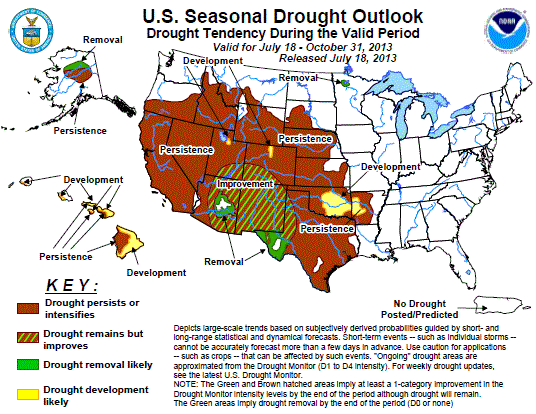
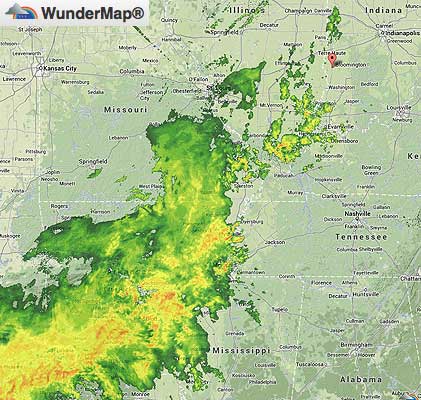
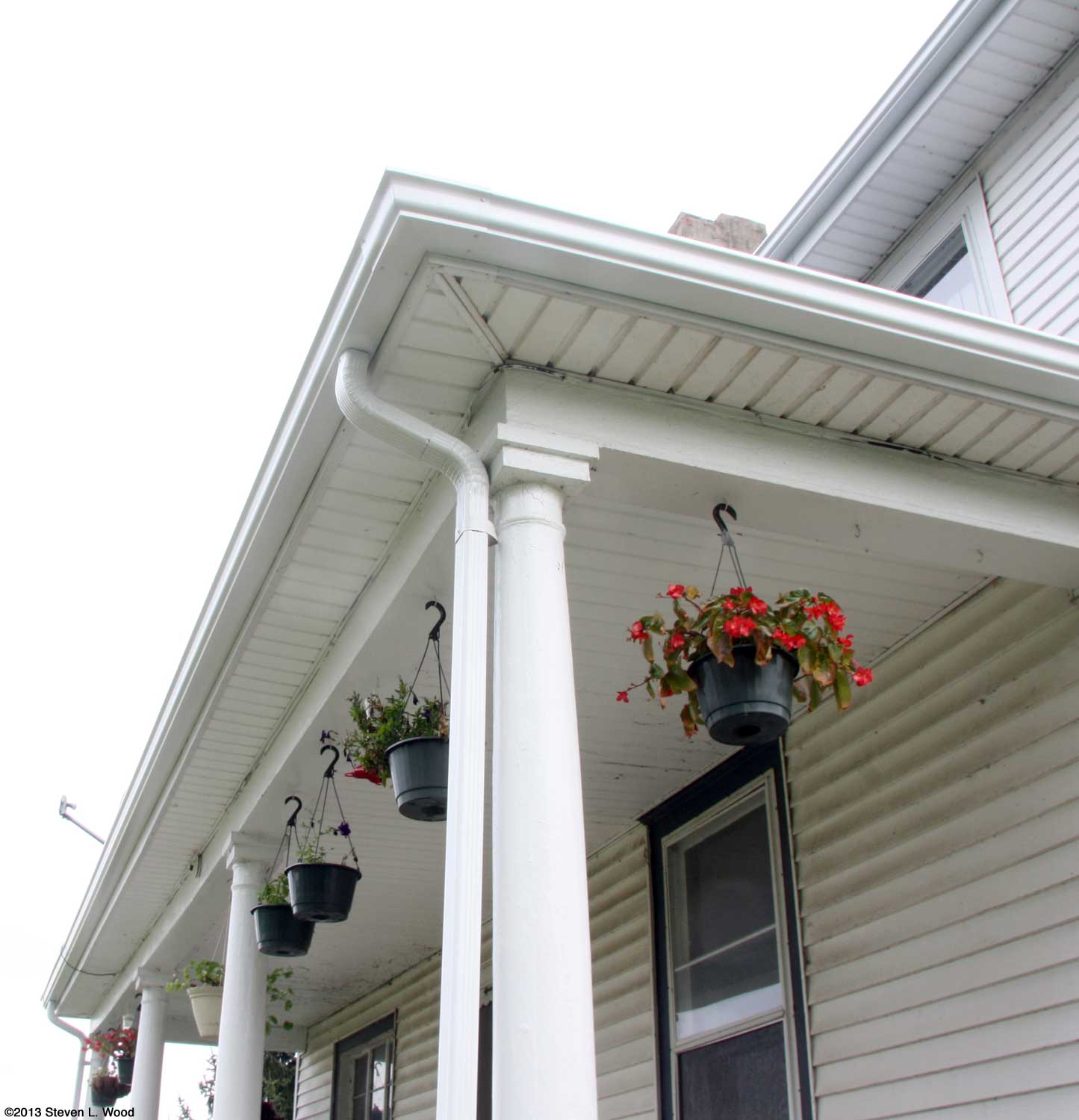
When the guttering crew was finished and ready to leave late yesterday afternoon, one of the guys laughed and said that maybe we'd get to test the new guttering on the house and garage very soon. He was referring to a weather service prediction of an 80% chance of rain for today. A good rain is just what we need, not just because we have a new roof and guttering, but because things are really, really dry here now. The U.S. Drought Monitor report issued yesterday moved our area into the "abnormally dry" classification. That's certainly nowhere near the drought conditions we experienced last year, but the dry spell has definitely ended the growing season early for several of our crops. Our vining crops, melons, peas, and cucumbers, seem most seriously affected by the mini-drought. Vines have just dried up and died over the last six weeks. But we still have a couple of hills of cantaloupe putting on blooms. And speaking of blooms, let me share a shot I took yesterday of the row of zinnias in our East Garden with our patch of buckwheat in full bloom.
Maybe I'll just sit on the back porch today while it rains and admire how well our new guttering works. I'll also enjoy the stillness of not having workmen hammering, dropping bundles of shingles, and such. I should add a note and plug here for the guys who did the work on our house the last two weeks. We contracted the whole job of roofing, window replacement, siding repair, and guttering through Paitson & Son Home Improvement out of Brazil, Indiana. Paitson subcontracted the guttering to Corky's Seamless Guttering Systems. All of the work crews were professional and polite. The roofers worked through the hottest days we've had this summer. I worried a bit about them getting cooked feet and/or knees on the hot roof. And our contact at Paitson, Eli Kirby, did an excellent job of coordinating the work crews, keeping me informed of what was going to happen when, and addressing the few concerns I had as the project progressed. Time will tell, but it appears they did some excellent work at a very fair price. We use Angie's List Saturday, September 21, 2013 - A Bit of Rain
The weather forecast for the next five to seven days in our area doesn't include much chance of additional precipitation, but also calls for mostly clear skies and fairly moderate temperatures with daily highs in the 70s and 80s. While it's still pretty early for it here, we'll begin keeping an eye on predicted overnight low temperatures. We generally don't see our first frost until sometime in October. But overnight lows in the upper 40s will make for some very pleasant, cool morning gardening conditions for the next week or so. Hornworms If you grow tomatoes long enough, you're sure at some point to have your plants attacked by hornworms.
For control of hornworms, I just pick them off and squash them. If you haven't let things get out of hand, there should be only a few hornworms. Today, I had my camera with me when I spied hornworms on a couple of our Moira tomato plants. Other than for photographic purposes, I didn't mess with these hornworms, as they were infected with parasitic wasps, a natural control of both tomato and tobacco hornworms. Talk about your bad day, the poor hornworm at right is being eaten to death by the larva of a parasitic wasp that laid its eggs in the hornworm! There are actually two kinds of worms commonly called hornworms. For most gardeners, differentiating between the tobacco hornworm and tomato hornworm really isn't necessary. Both worms like to eat your tomatoes. Both can be parasitized. And both can usually be controlled in the garden, if not parasitized, by simply picking them off and killing them. The Hum of Bees I noticed the hornworms when I was out in our East Garden harvesting the last of our Eclipse peas for seed. The trellis for the peas had buckwheat plants leaning into to it in places. As I harvested the peas, I was serenaded by the gentle hum of hundreds of bees visiting the buckwheat blooms.
Note: The hornworm photo above has been available for use as a desktop image (yuck!) for some time on our Desktop Photos page. I added the bee on the buckwheat photo today to our Cutting Room Floor page of outtakes and images waiting for a space on Desktop Photos. As always, all photos on this page are copyrighted, but may be used for desktop photos without permission or payment. All other use requires prior consent, massive royalty payments, your left pinkie finger... (Actually, I'm a pretty soft touch on non-commercial use of my photos. Just , please.)
Tuesday, September 24, 2013 - Cleaning Up I have to admit that I really enjoy spring gardening a whole lot more than fall gardening. Transplanting and direct seeding crops with the promise of a new season is a whole lot more fun than hauling dead vines and such to the compost heap. But with another gorgeous, cool morning today, I finished cleaning up a good bit of our large East Garden plot.
I began clearing weeds and dead vines from the patch this morning. Removing the vines may help prevent disease carryover in future years, but also helps with fall tilling. The wiry vines tend to tangle in the tines of the tiller. There were also lots of grass weeds going to seed, a definite no brainer for removal. I left a few hills of melons that were still alive along the perimeter of the melon patch. Once I had vines cleared, I moved on to tilling under our stand of buckwheat that I'd mowed yesterday. I then moved on to till both the area where we'd grown sweet corn and the cleared portion of the melon patch. I was pleased that our pull-type tiller was able to handle the heavy layer of buckwheat.
Fall garden cleanup also includes preparation for the next year's crop. Hopefully, the buckwheat turned under today will add some nutrients to the soil. More importantly, it will add some much needed organic matter to the heavy clay soil. Once the bell peppers, tomatoes, yellow squash, eggplant, remaining melons, potatoes and sweet potatoes are cleared from the East Garden, I'll test for soil pH and lime if necessary. I'll also be adding sulfur to the area where our potatoes will go next year, once I get that figured out, to lower the soil pH there to help prevent potato scab. It's getting a bit late for it, but I'd still like to seed at least the part of the East Garden to be rotated out of production next year to alfalfa. We've had mixed luck with our spring plantings of alfalfa, but it's definitely worth a try. I have seed on hand, and if the planting takes, alfalfa puts down deep roots that can help break up soil compaction. The part of the garden that will be in production next season may or may not get planted to alfalfa. Even if I don't plant it, the ground weeds over pretty quickly with various grasses, so the soil won't sit bare all winter. Using grass clipping mulch in the garden can be a mixed blessing. Most of the mulch for the East Garden comes from the old farm field around it. It often gets mowed, raked, and used as mulch when at least some of the grass is going to seed. While the mulch initially suppresses weed growth, it also adds what grass and weed seed is in it to the soil.
On the whole, we got some nice Yukon Gold potatoes from a previous dig and a good number of Sangre today. But our Kennebecs which dried out early this month didn't produce much. I still have about seven more feet to dig of Rio Grande and Kennebec and almost the whole row of Nancy Hall sweet potatoes. When I tried digging the sweet potatoes today, I found that I couldn't penetrate the soil in that row deeper than three or four inches with a garden fork! Oh, my!
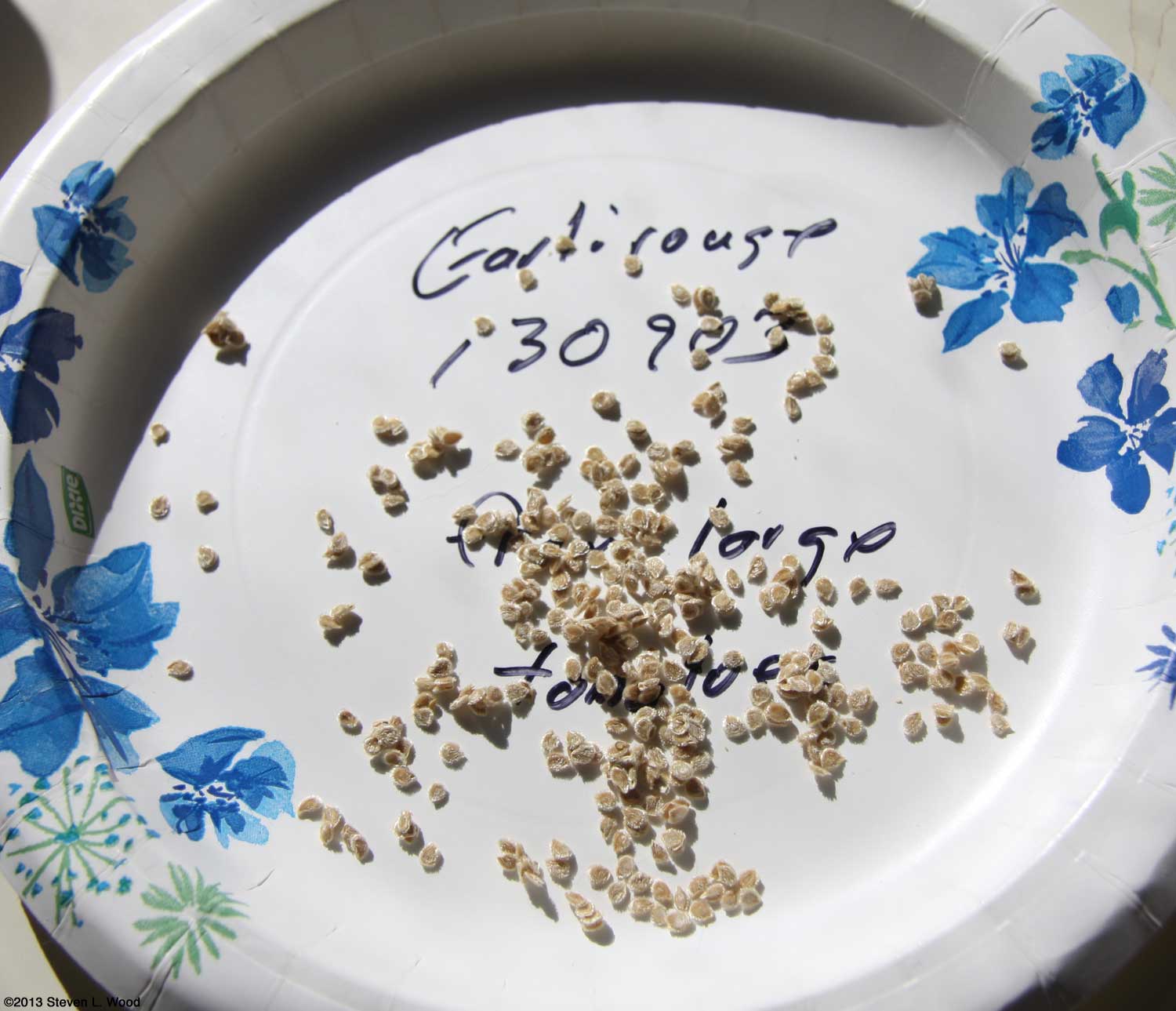
I somehow missed doing a germination test on a batch of Earlirouge tomato seed I'd saved early this month, so I started a test a few days ago. The tomatoes I saved the seed from were especially large ones for the variety, making this seed sample possibly something special. When I "read" the test today, I was pleased to see that all ten of the seeds in the test had sprouted. One doesn't often get 100% germination in these tests, even with a very small seed sample. Because this batch of seed seemed especially clumpy when air dried and because we've had our air conditioning off for several days (raising the relative humidity in the house a bit), I decided to do an extra drying step with it.
I keep a small canning jar and plastic lid on a kitchen shelf for just such special drying. It has a scrap of an old T-shirt in it. I place the seed to be dried in the jar, lay the T-shirt over the top, add a teaspoon of dry, powdered milk, and seal the jar with the lid. I'd leave the seed in the jar to dry for several days before sealing the seed in an aluminum foil pouch and freezing it for long term storage. While I have no proof that this process really helps dry down seed below ambient room humidity, it seems to make sense that it would. At least I've read that several places online (1, 2, 3). We've already frozen a couple of pouches of Earlirouge tomato seed this season, but this batch came from the largest, ripest, reddest Earlirouge tomatoes we've grown and saved seed from this year. Coupled with its high germination rate, this will be the batch of seed we use for sharing with other Seed Savers Exchange members. A Few Words About the Earlirouge Tomato Variety About a year ago, I got the notion that I wanted to try the Earlirouge tomato variety. We've worked to save and share the related Moira tomato variety for years and just a year or so ago added the related Quinte variety to our seed collection. Both tomato varieties have excellent, old-time tomato flavor with fruit with the reddest interiors you may have ever seen. Earlirouge (not the same as the Early Rouge variety) was commercially the most successful tomato variety released by Jack Metcalf and the Smithfield Experimental Farm in Trenton, Ottawa, in the 1970s and 80s. It was part of a string of related releases that included the Moira and Quinte varieties which we first grew in the late 70s and early 80s. In the last thirty years, almost all of Metcalf's open pollinated tomato releases have disappeared from seed catalogs. Some, such as the Earlirouge variety, are not even available from seed banks such as the USDA Agricultural Research Service's Germplasm Resources Information Network (GRIN) from which we received our start of Quinte seeds. So when I began searching for sources for Earlirouge tomato seed last fall, it's not surprising that I came up empty. I tried GRIN and the Seed Savers Exchange without success and did many web searches for the seed. I even bought a packet of Early Rouge tomato seed, only later realizing that it was a much older, but totally unrelated variety to the similarly named Earlirouge.
Of course, simply having a packet of old seed doesn't mean one will get anything out of it when planted. I started a pot of Earlirouge tomatoes in mid-March, a bit earlier than I usually start our tomato transplants. Since my saved seed packet had hundreds of seeds in it, I sprinkled far more seed in the pot that I would usually do. Since this was twenty-five year old seed, it's germination rate, if any, had to be pretty low. Right?
I didn't get around to transplanting our Earlirouge plants until early June. I only had room and enough tomato cages to set out two of them this year. The plants had the good fortune of going into some not-so-nasty soil near the barn towards the back of the property we use to isolate them from potential cross-pollination with other tomato varieties. Most of the field they're in (and our East Garden as well) is some of the nastiest, burnt-out clay soil I've run across in my years of farming and gardening. Each Earlirouge plant got a deluxe planting hole a foot wide and eighteen inches deep, backfilled with a mixture of peat moss, a touch of lime to prevent blossom end rot, some 5-24-24 commercial fertilizer, mixed with the native soil and a thorough drenching with very dilute starter fertilizer. The planting was then mulched with grass clippings that were regularly refreshed throughout the season (usually, each time I mowed). We got our first, ripe Earlirouge tomatoes on August 13, four pitifully small examples of tomatoes. I immediately popped one in my mouth and was gratified to find the flavor was excellent. As the season wore on, the plants began bearing much larger fruit in volume, one day producing ten pounds of tomatoes from just one plant! As determinate plants (or really, semi-determinate, as I believe Earlirouge and the rest of the Metcalf series to be), the Earlirouge plants produced a concentrated heavy harvest over a few weeks. Unlike most determinates, though, they seemed to rest a bit and then put out another heavy harvest of ripe fruit. Compared to our old favorite and related variety, Moira, the Earlirouge plants appear to have a much more compact and efficient growth habit. Of course, they went into the ground nearly a month after the Moiras were transplanted. But it seems that the Earlirouge variety has some real advantages over Moiras while retaining their excellent flavor and deep red interior coloring.
Before calling it a day, I dug just a few more feet of sweet potatoes. For whatever reason, the soil under the sweet potato vines is rock hard, preventing digging much below four to six inches deep. Fortunately, the sweet potatoes were near the surface, some just under the grass clipping mulch. While I really didn't get any good sweet potatoes when I dug just a bit on Wednesday, I did get several nice ones today. Despite small potatoes and rock hard soil, it was a really nice day today to be working outside.
We enjoyed watching a lovely cover/smother crop of buckwheat grow and bloom in our East Garden before turning it under to improve the soil there. Our efforts in raising a seed crop of the endangered Eclipse pea variety were successful far beyond my expectations. We didn't harvest any of the supersweet peas for table use this year, but we harvested enough good seed that we should be able to enjoy eating a few supersweet peas next year, along with growing out another seed crop and sharing seed with other Seed Savers Exchange members. Our planting of Earlirouge tomato plants grown out from seed that had been in our freezer since 1988 produced lots of great tomatoes, and of course, fresh seed for future crops and sharing via the Seed Savers Exchange Annual Yearbook. The excellent quality of the Earlirouge tomatoes was a very pleasant surprise. In the midst of all of our gardening efforts, we had contractors here on and off for two weeks. They replaced our high, steeply pitched main roof, installed some new attic windows, and installed guttering. With the extended dry spell, most of our vining crops were done producing early in the month and got cleared and composted. The dry weather also seriously reduced our potato harvest. And my attempt at growing a late crop of Sugar Snap peas was a bust. The tall vines first blew off their trellis and then quickly browned out from the dry soil conditions. Although we're rapidly running out of gardening season, we will begin picking lettuce this week. We also have mature fall carrots to dig. If our first frost holds off long enough, we may harvest several varieties of paprika peppers for drying and grinding. Our plantings of fall brassicas and pumpkins are real longshots on beating a frost, but there's a chance we may get some. And of course, we'll continue enjoying fresh tomatoes and bell peppers until frost takes the plants. A half inch of rain yesterday should help keep things going. While it's been a very dry month, September has also been a very productive month in the Senior Garden. From Steve, the at Senior Gardening |
|||||||||||||||||||||||||||||||||||||||||||||||||||||||||||||||||||||||||||||||||||||||||||||||||||||||


 Sunday, September 1, 2013 - Wow! Where has the time gone!







 . Last September, granddaughter Katherine and I used it to
  suggests a water bath canning time of 30 minutes for pints of purée, far more than what is required for whole tomatoes or juice.




 and a quart









 Despite being a very dry month, September proved to be a month of bountiful harvests for us in the Senior Garden. We
 | Affiliated Advertisers |
©2013 Senior-Gardening.com