One of the Joys of Maturity |
|

| Affiliated Advertisers |
Clicking through one of our banner ads or some of our text links and making a purchase will produce a small commission for us from the sale. The Old Guy's Garden Record
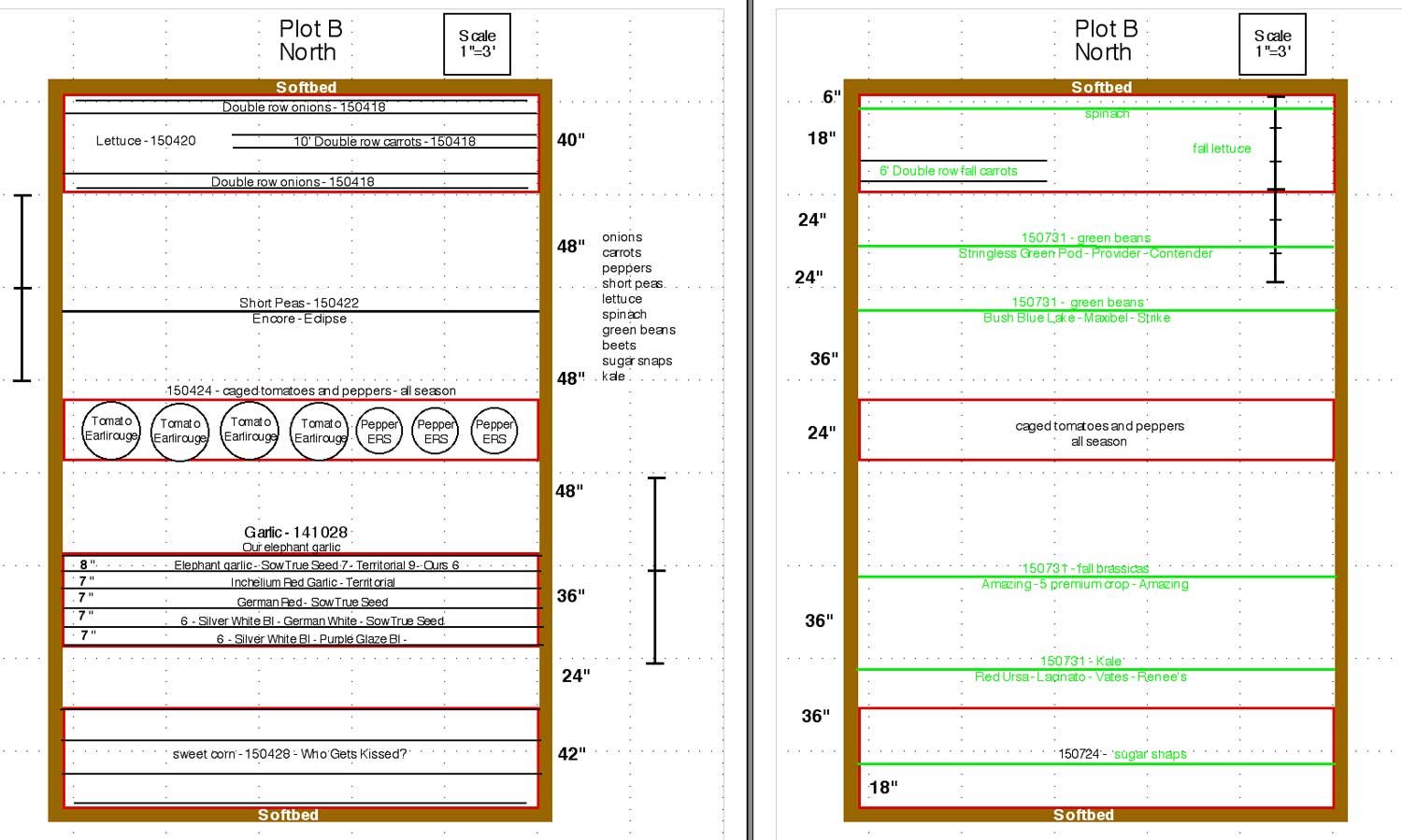
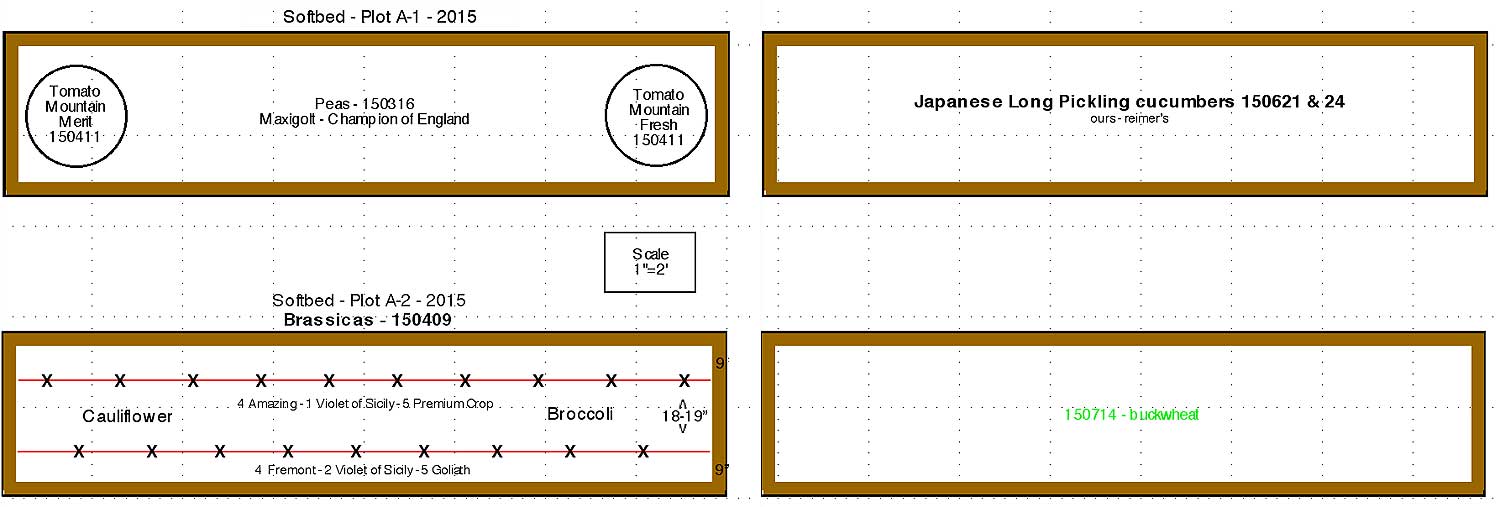
Our fall garden is pretty well planted now. One of my most important jobs will be watering new plantings of brassicas and beans until they're well established. A good rain would certainly help, but that's not something we often see during our usual late July through August dry spell. But we'll make the best of it. We have thirteen quarts of whole tomatoes canned, far below what we did when we had kids home, but certainly enough for just Annie and I through the winter. We froze lots of peas, broccoli, and cauliflower in June, so we're covered there. And our onion and garlic crops are now safely stored in our basement. I still need to get our fall spinach and carrots seeded. Spinach is always a short term crop for us, easier to grow in the fall than in the spring. We love fresh spinach salad and spinach in various alfredo-type dishes, so it's worth the effort. Since our spring carrot crop wasn't all that great, it would be nice to put a few more carrots into storage for the winter. Our fall lettuce starts are still under the plant lights in the basement and need to go to our back porch soon to harden off before going into the garden. Garden Planning When planting our kale yesterday, I used up the last of our Red Ursa kale seed. That reminded me that I needed to get started listing items on our garden orders spreadsheet that we've run out of or just want for next season. With a much smaller garden this year, we didn't exhaust much of our seed, but did finish off a packet here and there. I also started recording some ideas that had been buzzing around in my head about crop placement or rotations for next season. With our large, main raised garden bed and two narrow raised beds, it's not too awfully difficult to make sure I don't grow the same or a similar crop in the same space two years in a row. While I keep our garden records on computer, my desk in the office is littered with scraps of paper with ideas and drawings that later end up being recorded on our garden maps and plans.
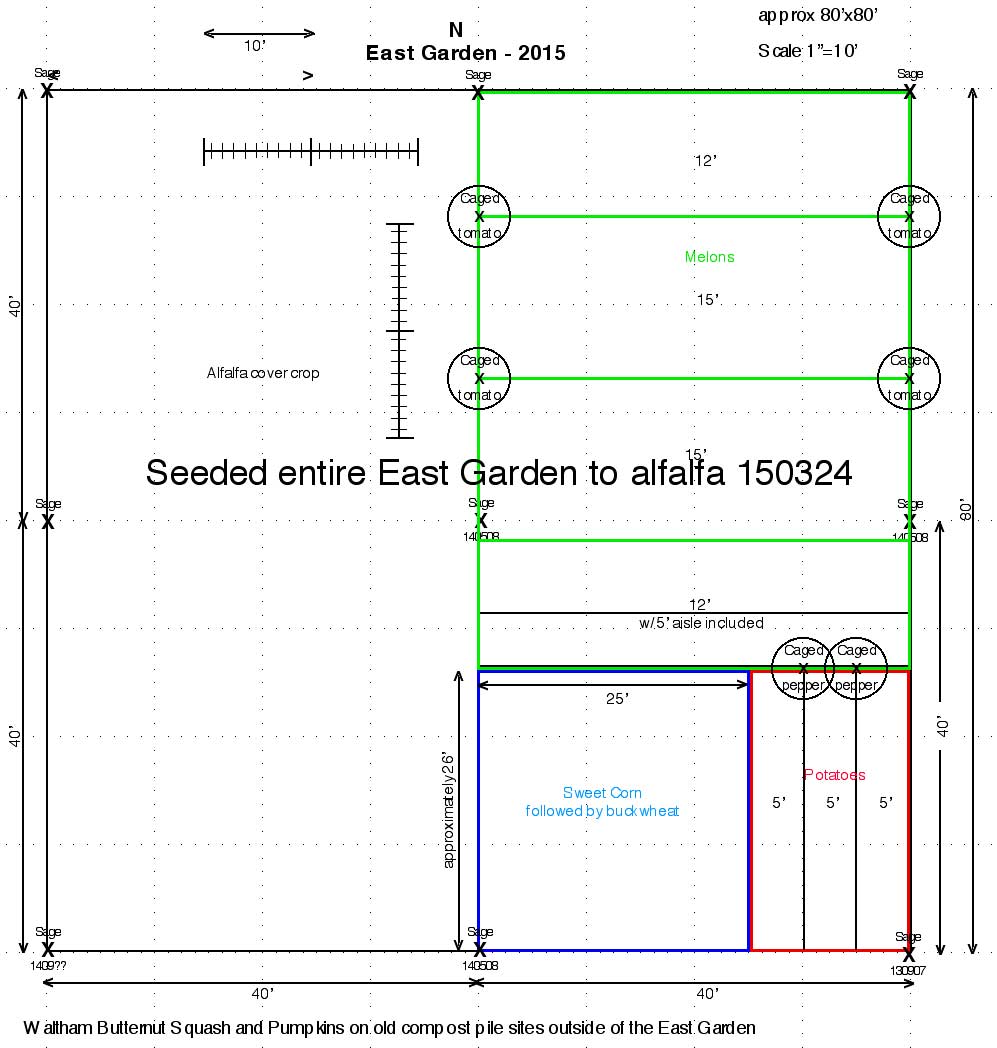
Our East Garden plan for next year should be pretty easy, as I can just use the plan for this year that we didn't get to use. I'm wondering now if I should, and if I physically can, fall till the East Garden plot or just wait until next spring to turn the alfalfa and grass mix under. Turning it soon will make for easier planting next spring, but it also will leave the soil bare and subject to wind erosion over the winter. Of course, if I turn it early enough, we're certain to get a bunch of grass and weeds germinating in it that will supply some winter cover. The various outlying plots that we've used to isolate crops for seed production were all allowed to return to grass (and weeds) this season. Two of the three isolation plots have really lousy soil and possibly should be left to grass. But it is nice to have places to isolate seed crops well away from anything that could cross pollinate with them. I'm still trying to get a good crop of Paprika Supreme peppers for seed, but haven't had much success with that project. While we've been able to grow good peppers for drying and grinding, saved seed from them is invariably sterile or almost so. And we use a lot of ground paprika browning and seasoning chicken.
|


|
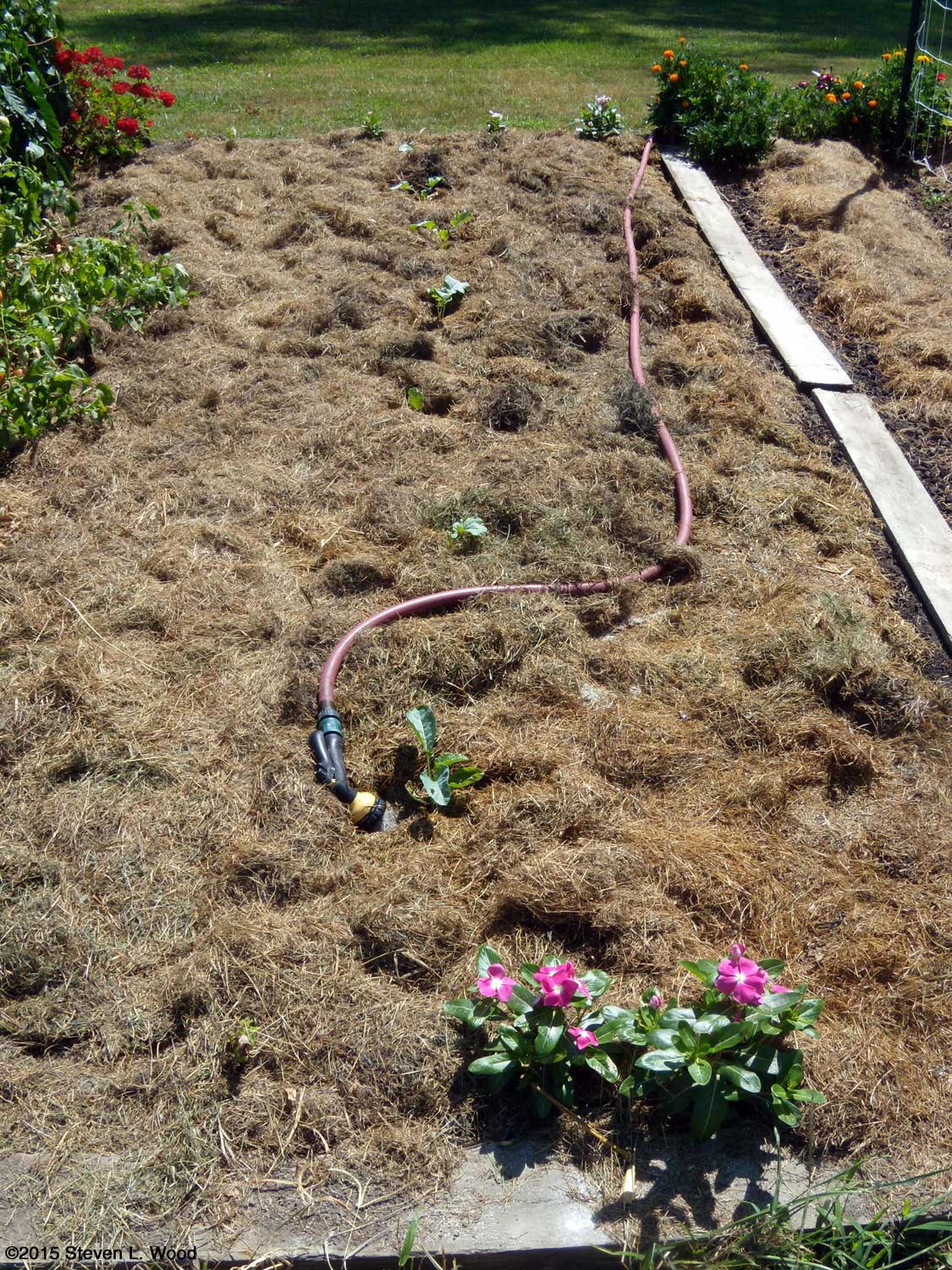
While the brassicas soaked up the needed water, I started mulching our rows of green beans that I seeded on Saturday. I had to re-string the rows so I could effectively bring the grass clipping mulch right up to the edge of each planted row. After applying the mulch, I thought I watered the bean rows pretty heavily. But when I scratched the soil a bit with my finger, the soil was wet only a half to an inch down! So I watered some more. We really need a good rain. And, we have a 58% chance of it tonight, the best we've seen for some time. While I was watering the bean rows, I was entertained by what I later identified as a zebra swallowtail butterfly that seed determined to get watered as well. It's just barely visible in the image below, although I got a slightly better shot of just it later on.
Too Much Red?
I'm not really complaining, just evaluating.
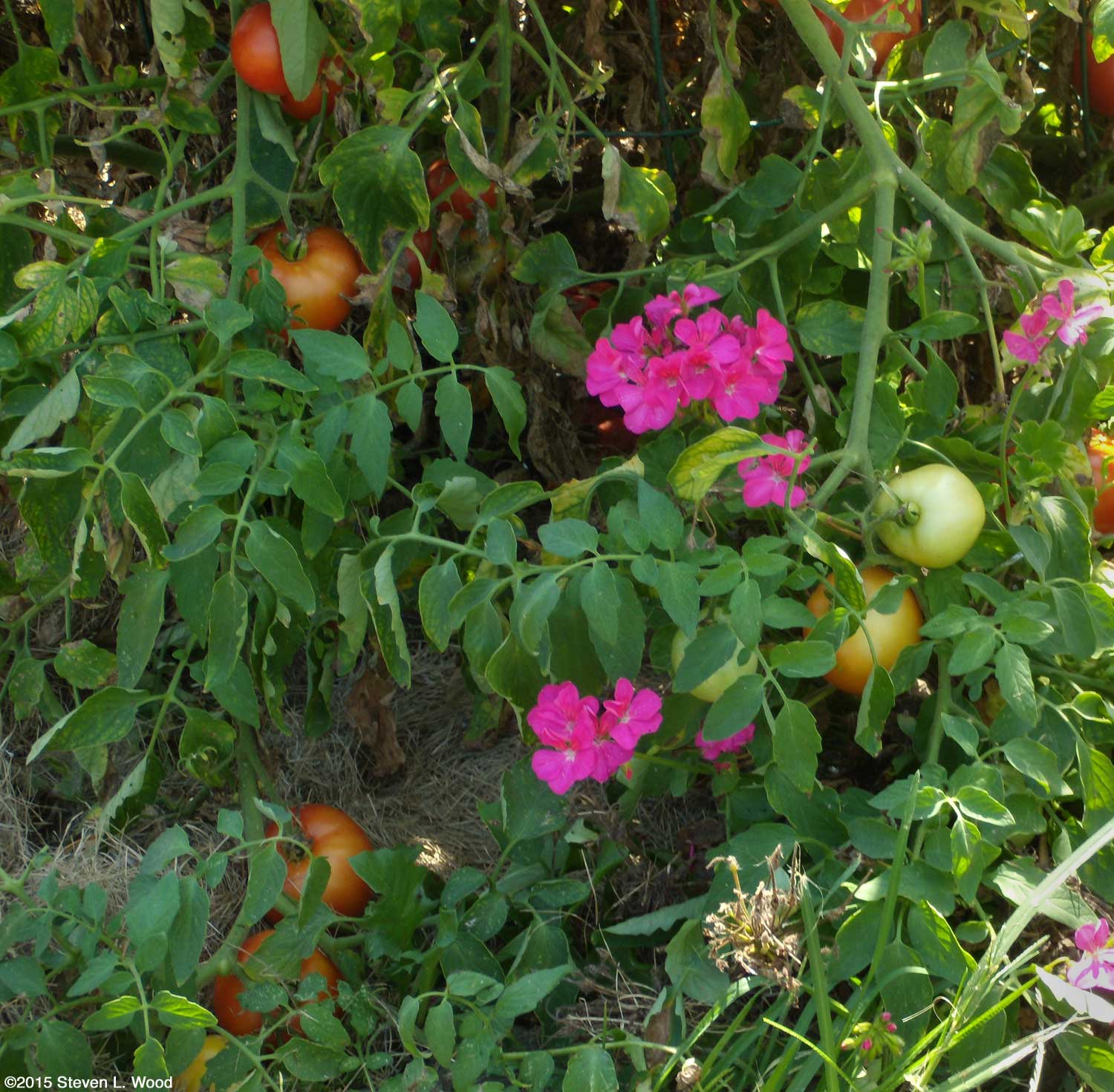
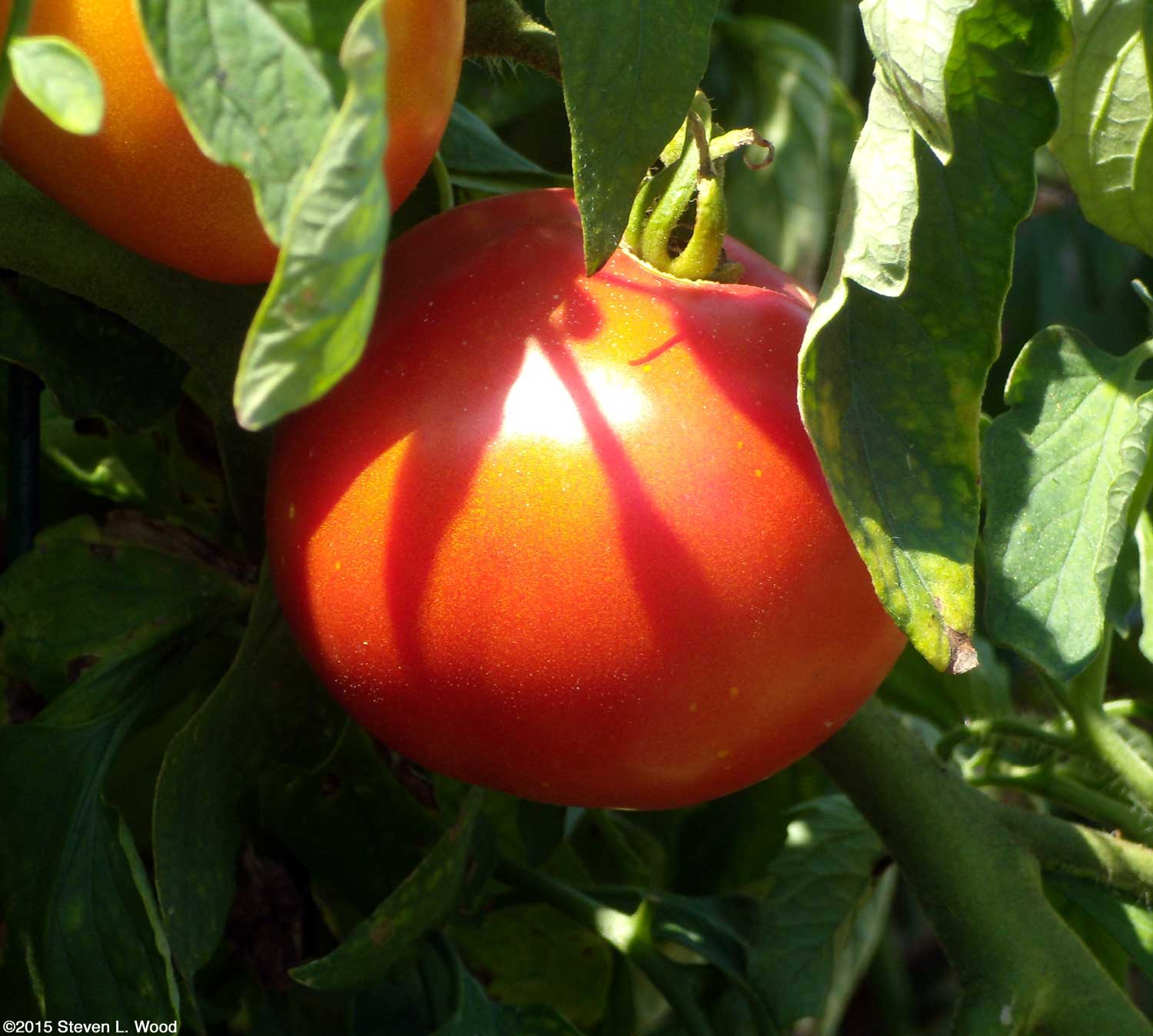
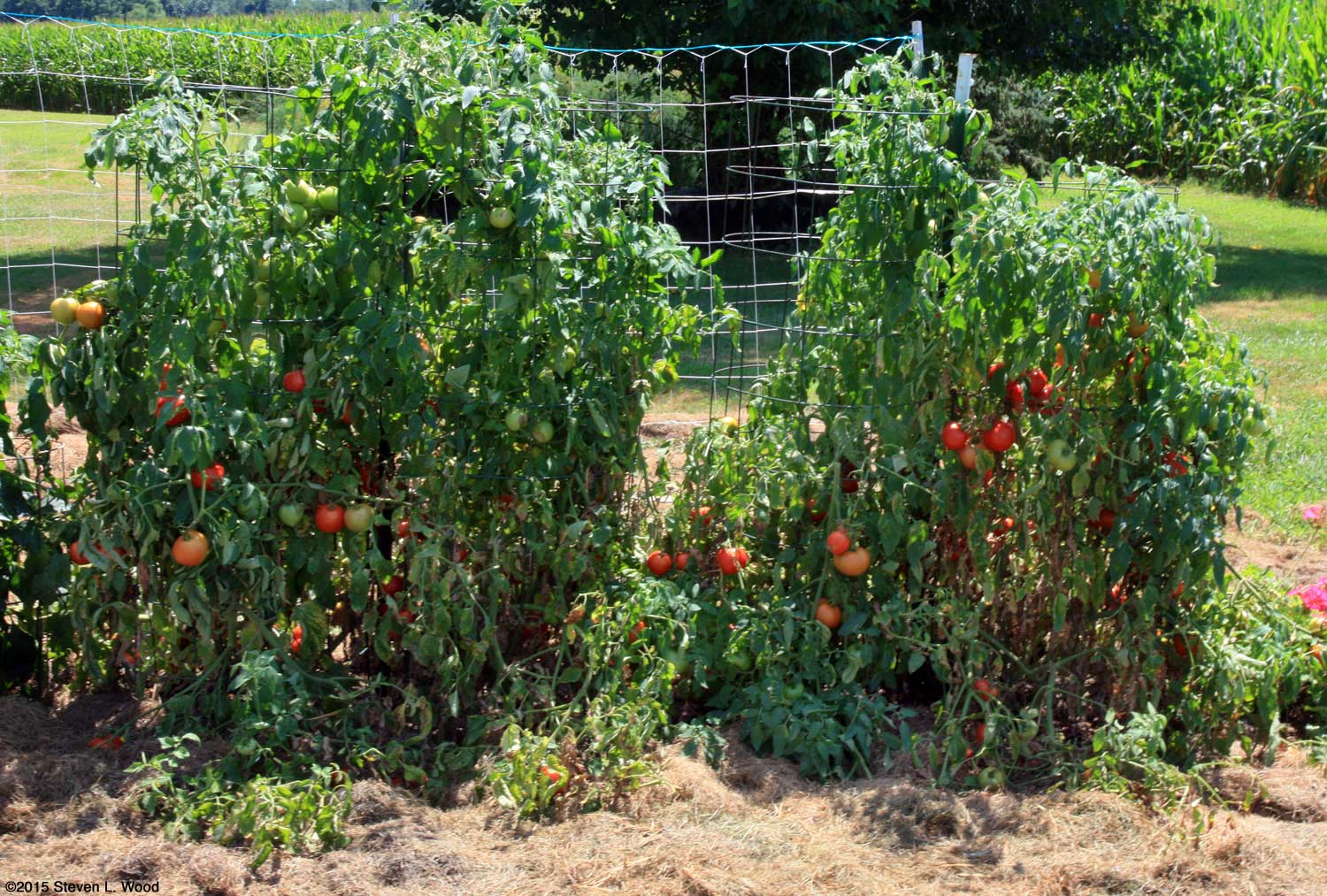
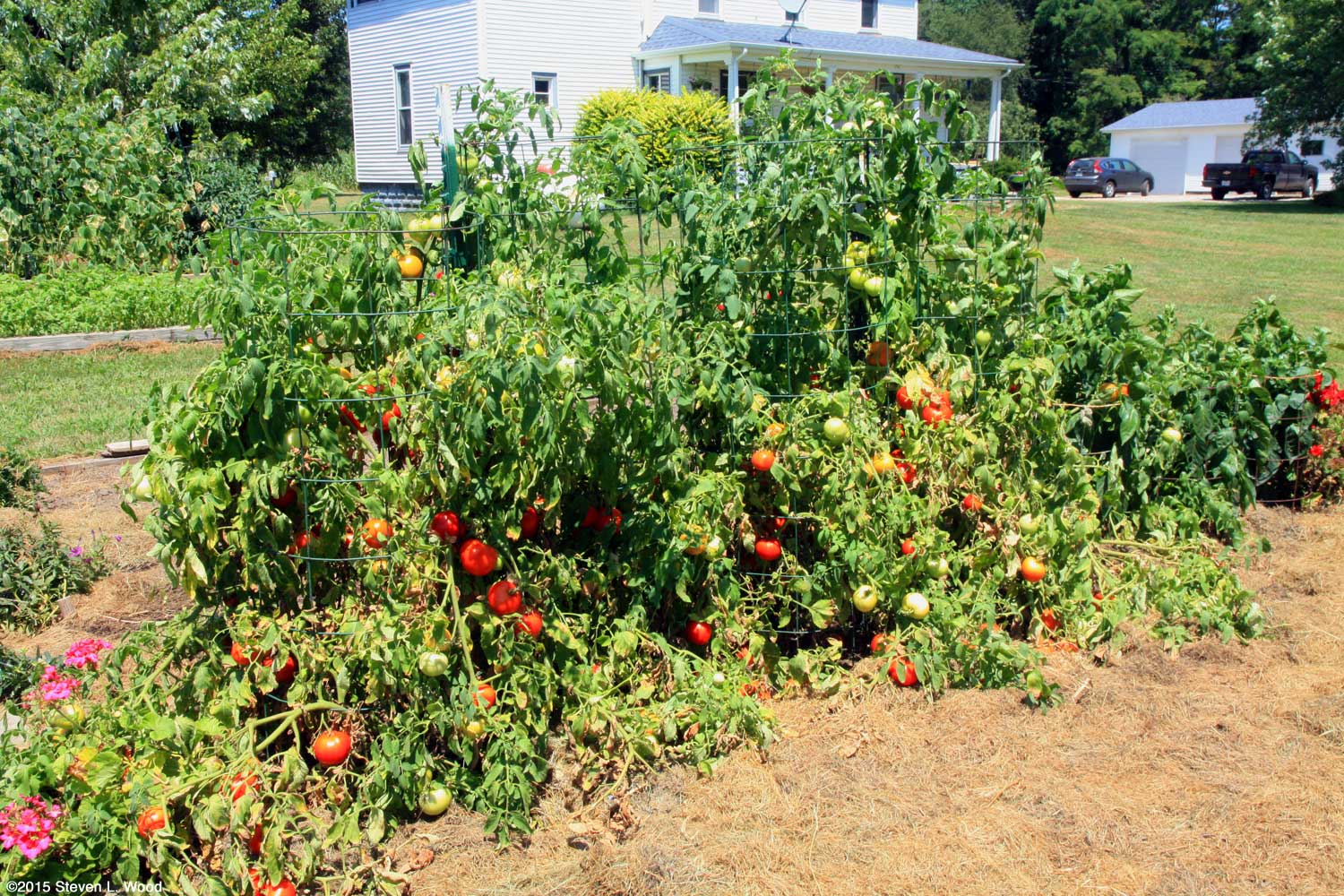
One red in our garden I certainly won't complain about is the abundance of deep red Earlirouge tomatoes we're enjoying.
We started growing the Earlirouge tomato variety a couple of years ago. We'd previously grown and liked the related Moira and Quinte tomato varieties developed by Jack Metcalf in the 1970s. Earlirouge was the most commercially successful variety of the series of the canning/slicing tomatoes with deep red interiors. I hunted high and low for Earlirouge seed for almost a year before discovering I had some we'd saved during our last year on the farm. The vintage 1988 seed had remained viable through 25 years of frozen storage! We now share Earlirouge tomato seed via the Seed Savers Exchange. When I first listed the variety in the fall of 2013, I was pleased to see that the Seed Savers Exchange also had the variety in their storage vault. While it might sound cool to be the only one growing, saving, and offering seed for a vegetable variety, that also puts a lot of pressure on one to make sure nothing goes wrong.
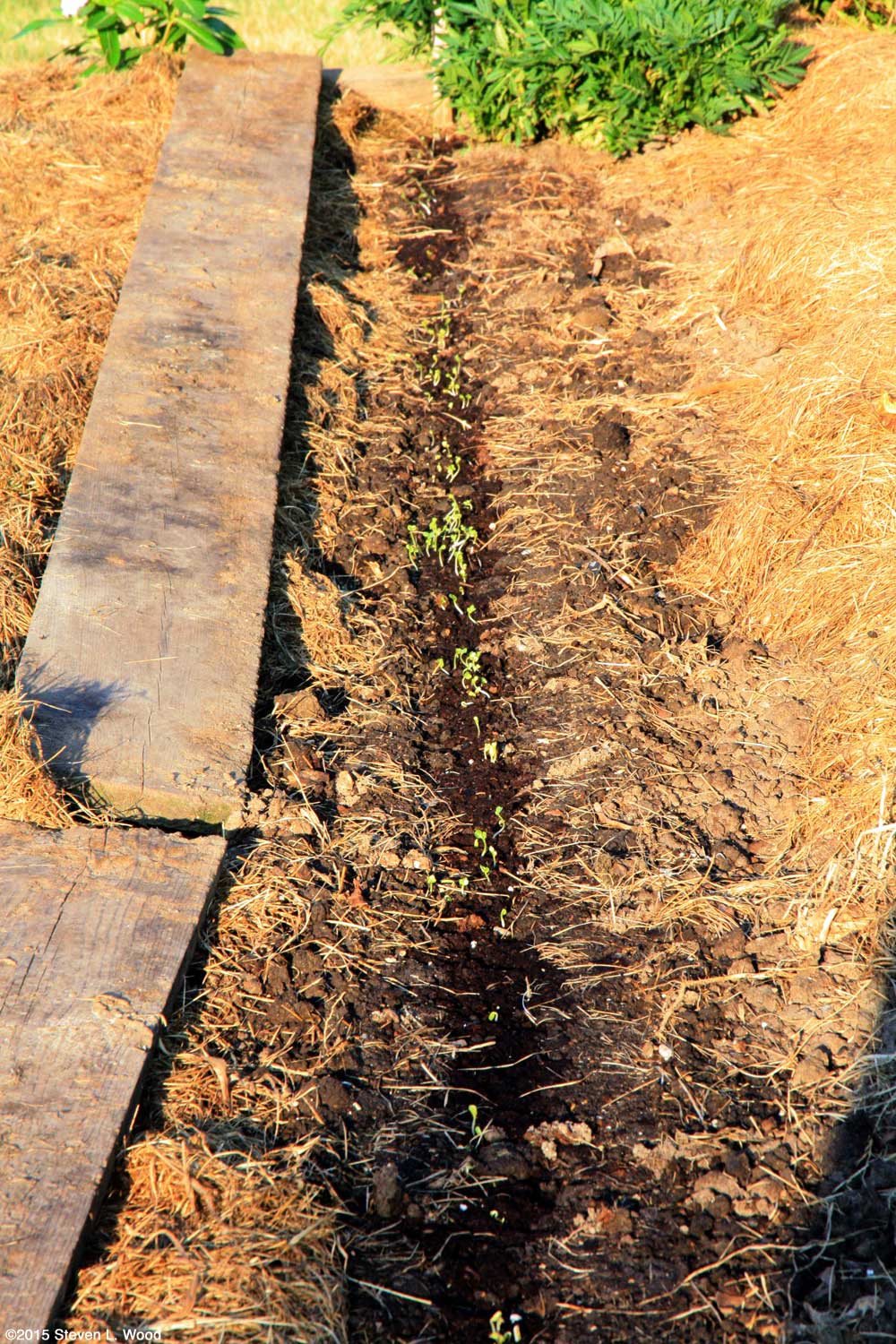
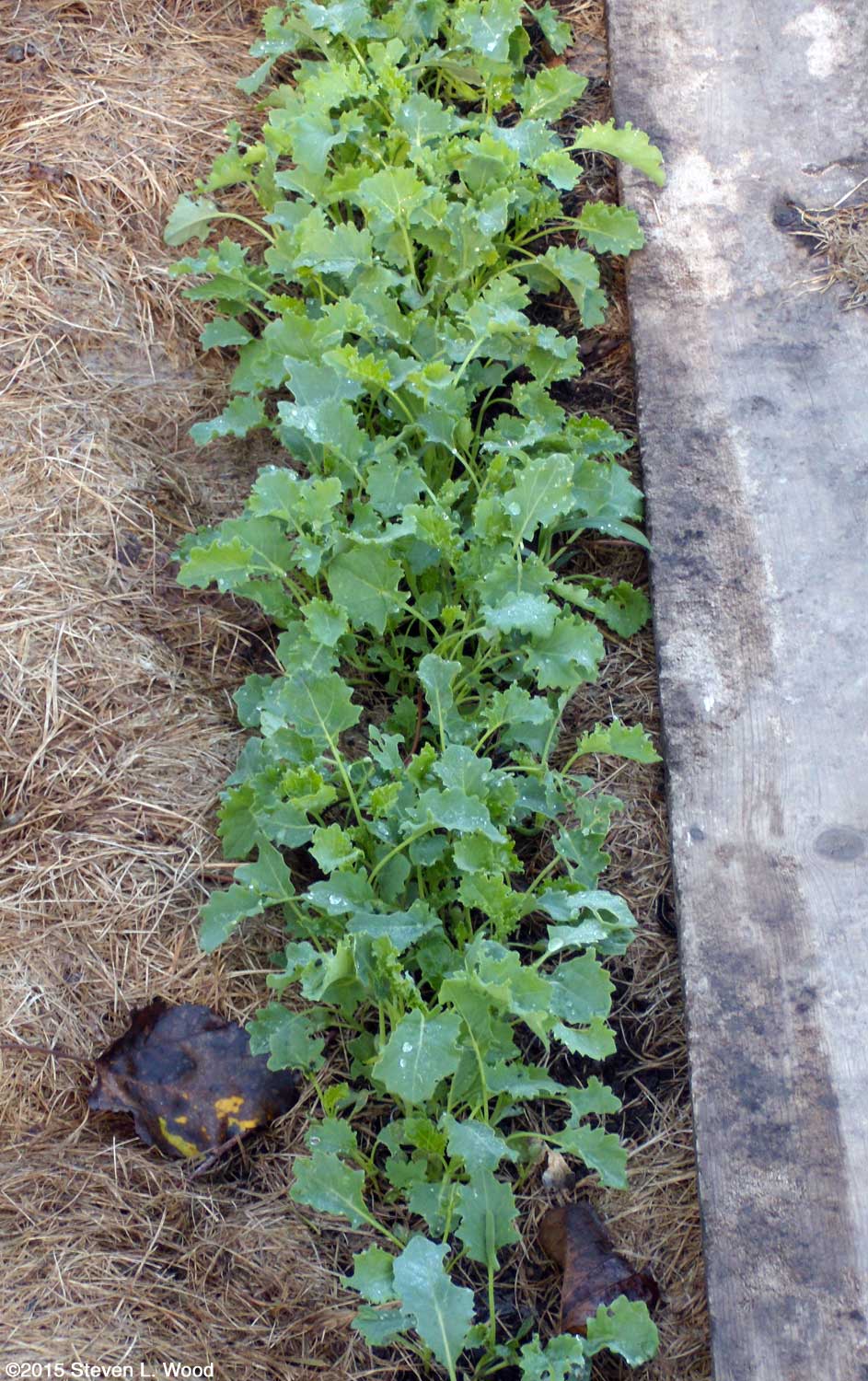
The kale in the row is a bit spotty right now, as I got way too much seed in some areas and had other areas where the seed hasn't yet germinated. But since one wants kale plants space about eight inches apart, we should be okay if the sun doesn't burn up the newly emerged kale plants. We're still without any rain since mid-July. We got missed again last night, and the next predicted rainy period may come later this week. The leaves on our cucumber vines and our stand of buckwheat wilt some during the heat of the day each day. I'm hoping both can survive until the next rainfall, as watering our newly planted crops is about all the watering our well will support at this time of year. Hot Water Treatment of Tomato Seed
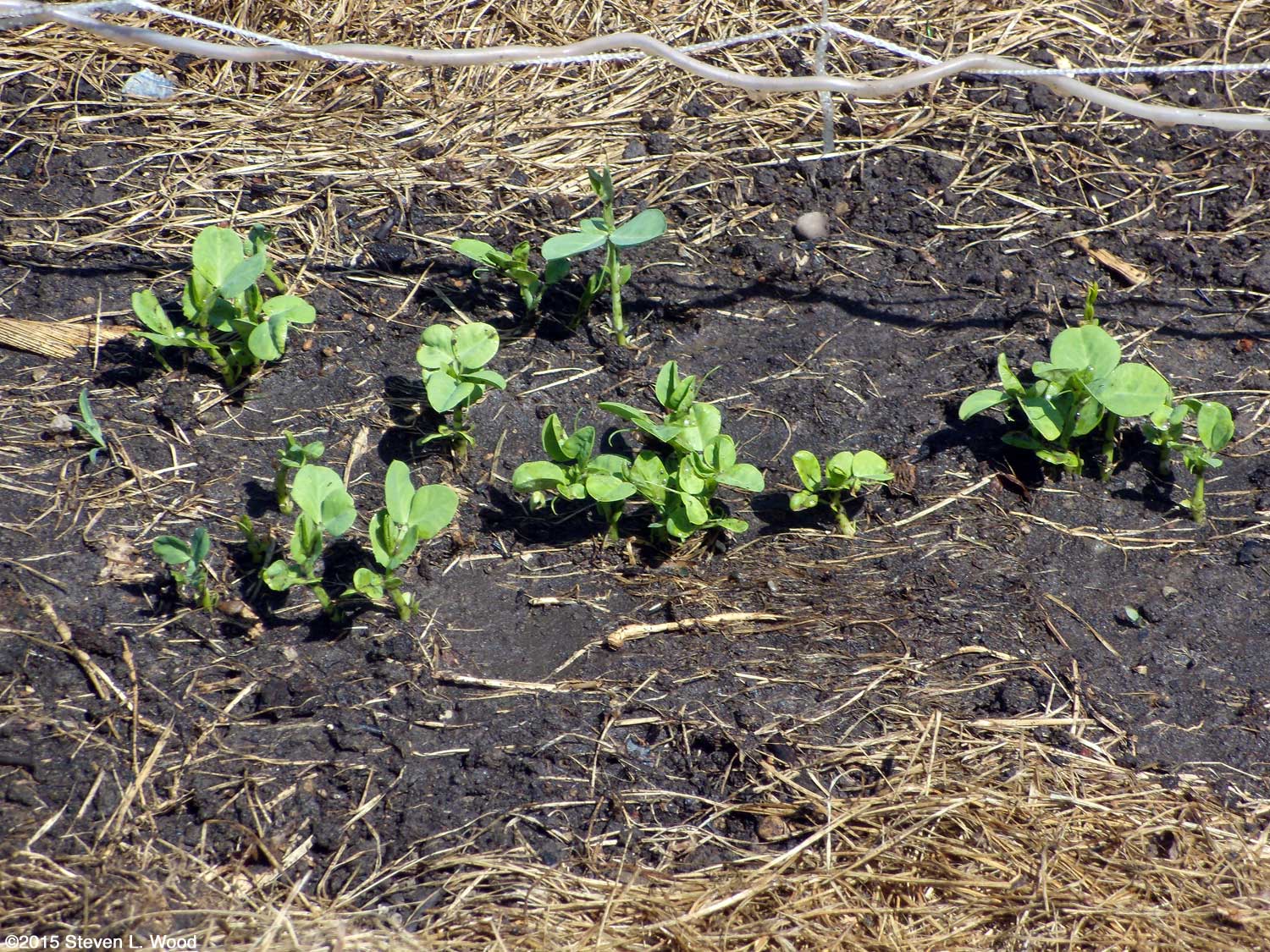
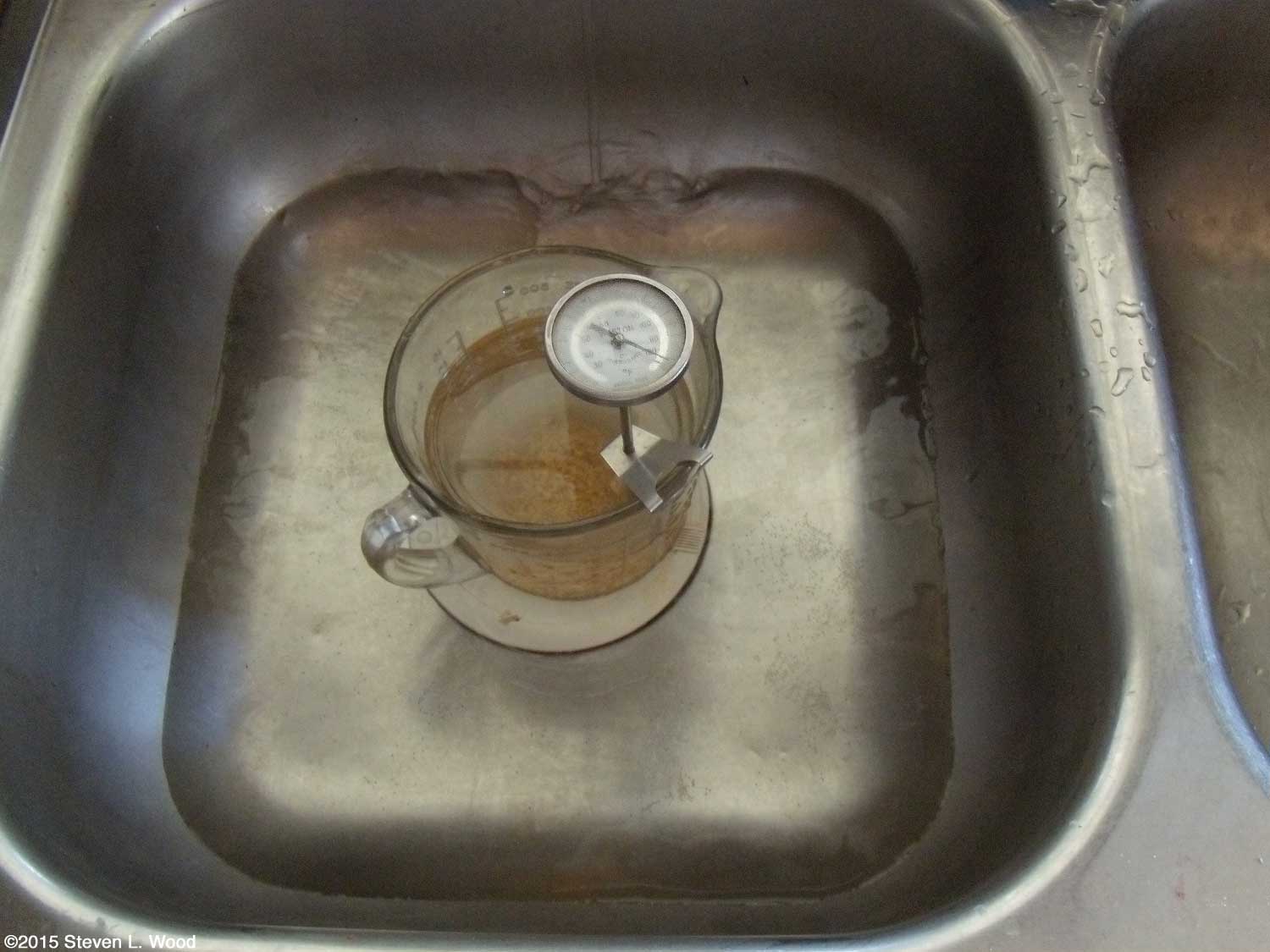
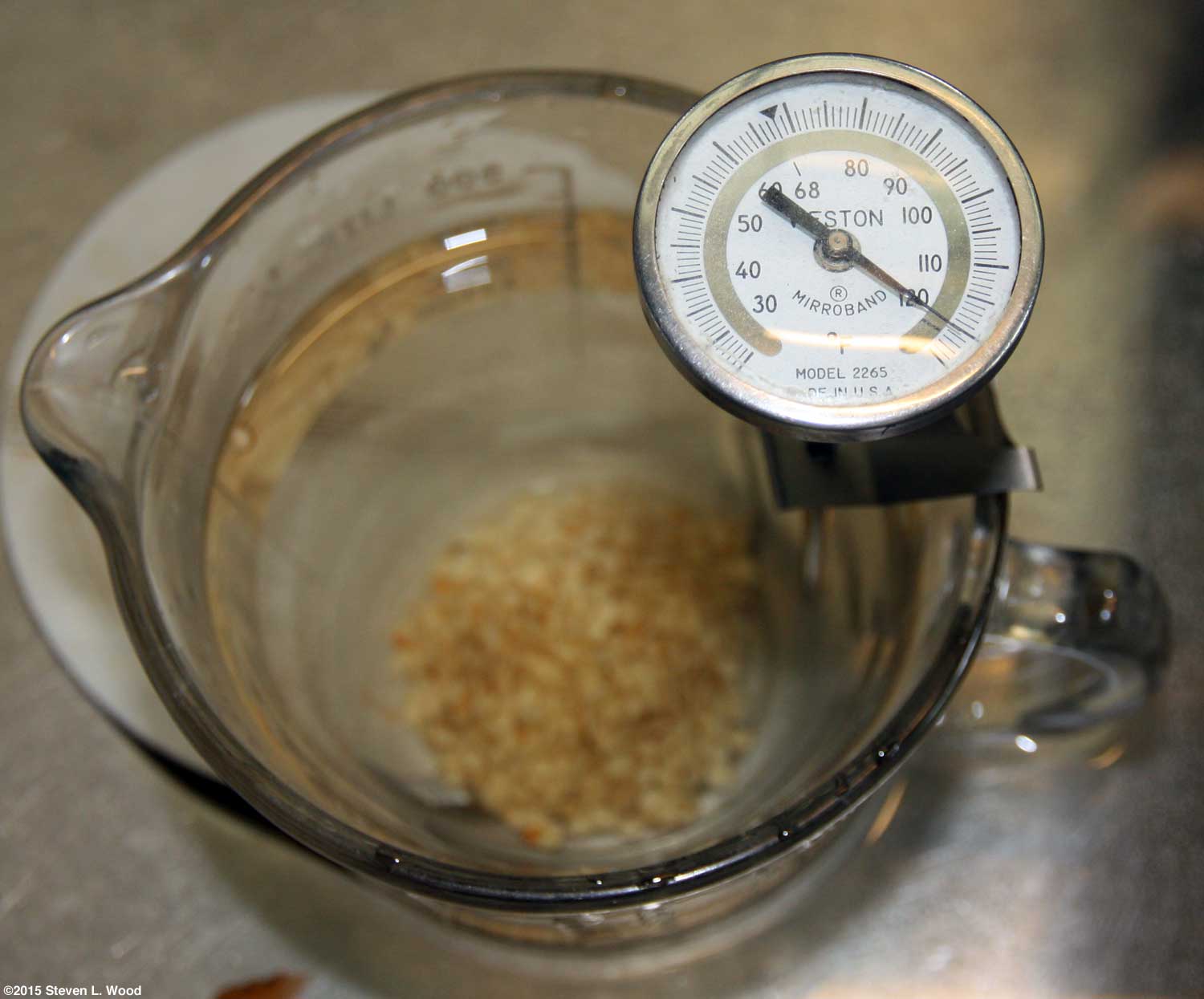
Hot water treating tomato seed involves keeping the seed in 122° F water for 25 minutes. The only special equipment required for the process is a thermometer that is accurate in the 120-125° F range. I use an old darkroom thermometer that I've had for years. I fully describe the process of hot water treatment of seeds and have lots of links on the subject in our feature story, Saving Tomato Seed. I'm enthused with our fall garden so far. We have peas, kale, and one row of green beans up along with our transplanted broccoli and cauliflower. I seeded our fall spinach and carrots this morning. We still have a bit of open space in our main raised garden bed that is reserved for lettuce transplants, which are hardening off on the back porch.
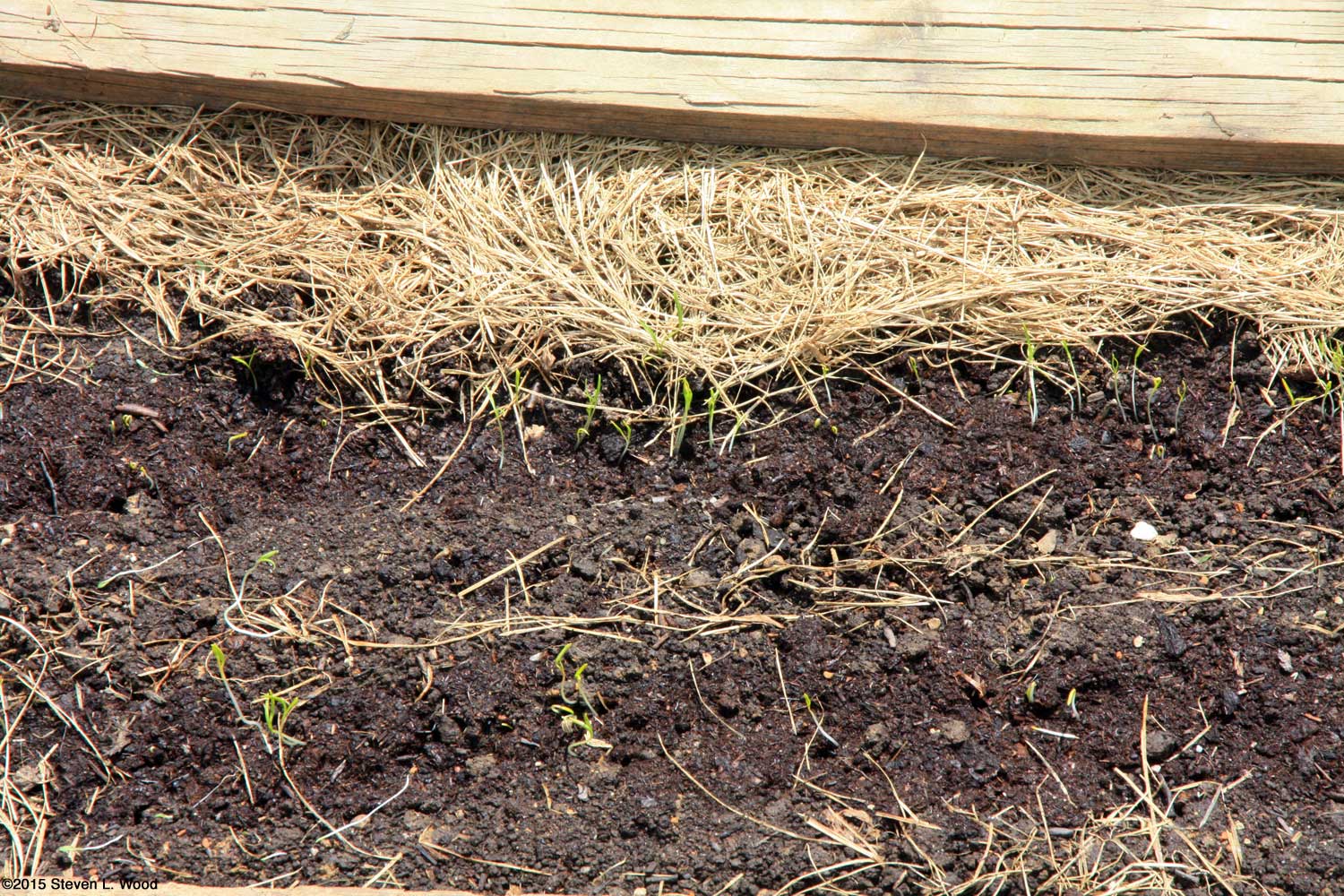
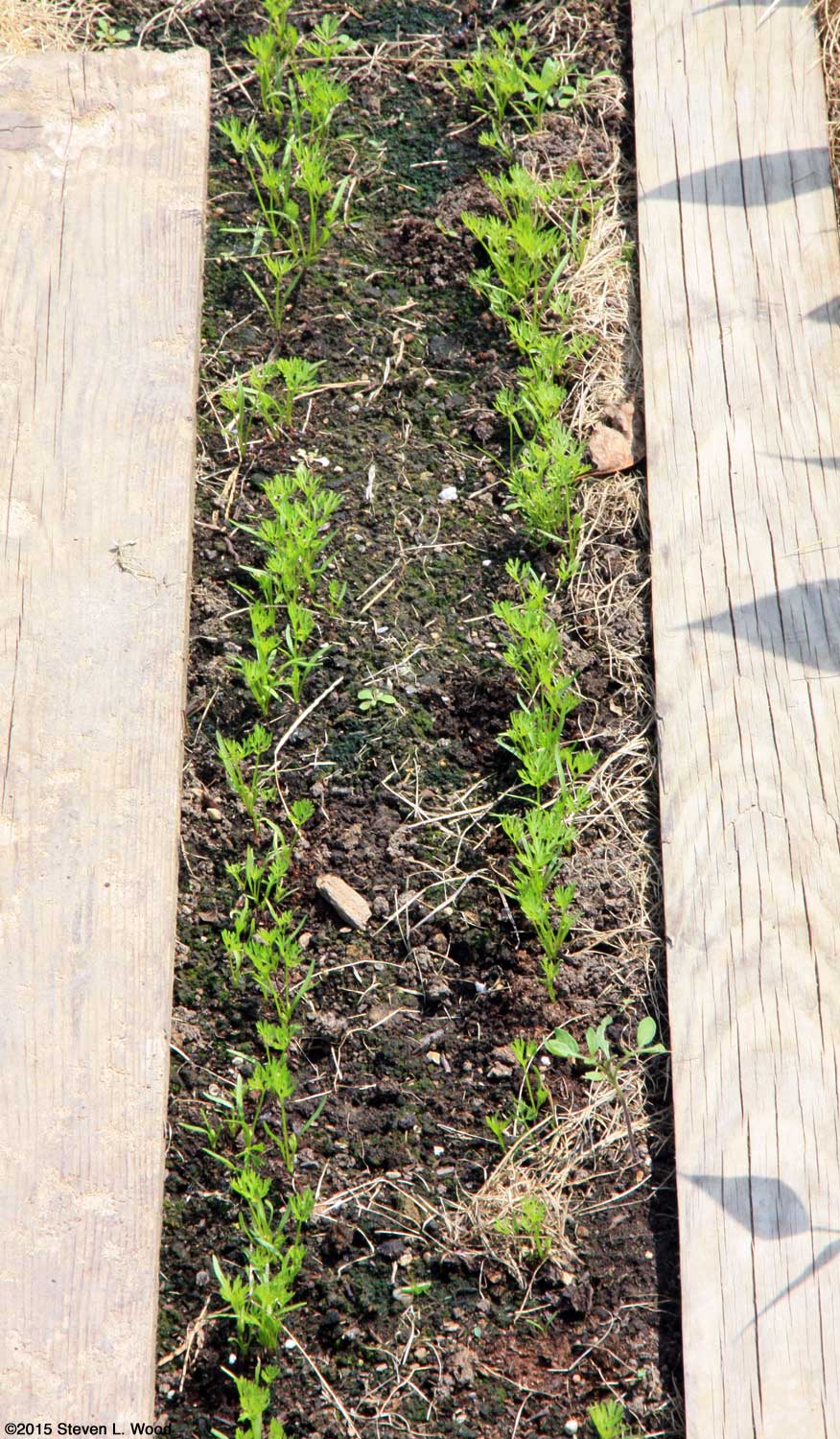
I again used damp peat moss to cover the tiny seed I sowed this morning. The carrot rows also got covered with walking boards to help hold in moisture until the slow germinating carrots come up. As I seeded, watered, and mulched this morning, I also popped in a few flower transplants in bare spots to brighten up the border of our main raised garden bed.
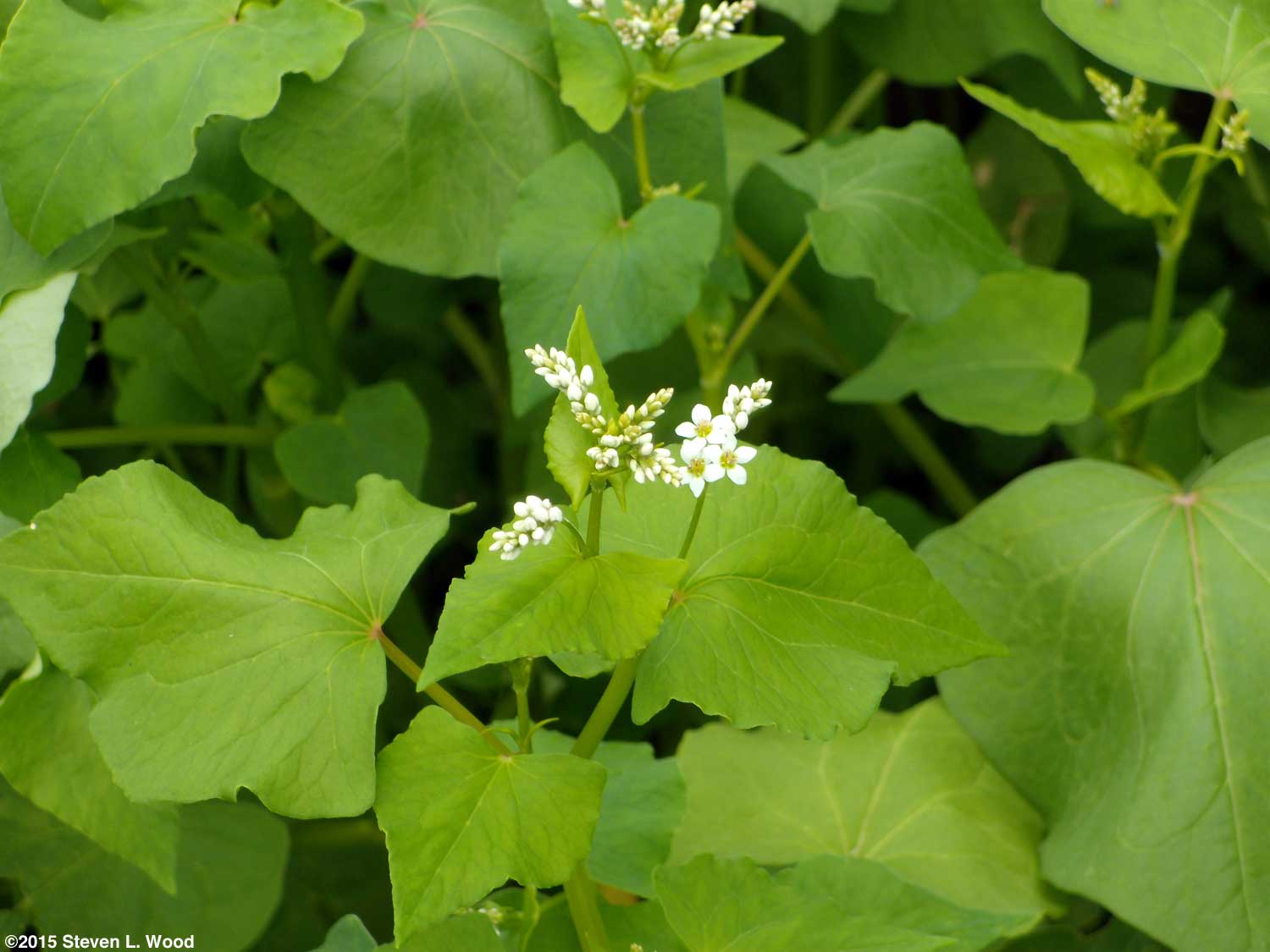
Some of the buckwheat seeded into a narrow raised bed on July 14 is beginning to bloom! While buckwheat is a quick cover crop, three weeks to bloom is pretty amazing. Of course, the bulk of the buckwheat won't come into bloom for another week or so. At about five to six weeks, I'll use a garden fork to turn the buckwheat under, adding lots of organic matter and nutrition to the bed.
The seed saving process will take several days to a week, depending on how long I let the ripe/overripe cukes sit before processing them for seed. I described that process in some detail last year in a posting. We do it much the same way as we do when saving tomato seed, including the hot water treatment, something not generally recommended for cucumber seed. By harvesting our overripe cucumbers today, I hope to be able to harvest a nice crop of thinner, green cucumbers to make a nice batch of bread and butter pickles later this month. Leaving the overripe fruit on the vines any longer might discourage the vines from blooming and setting new cucumbers, so it was time to harvest the cucumbers for seed. Also, with rain possibly on the way tonight and/or tomorrow, that should invigorate the cucumber vines some.
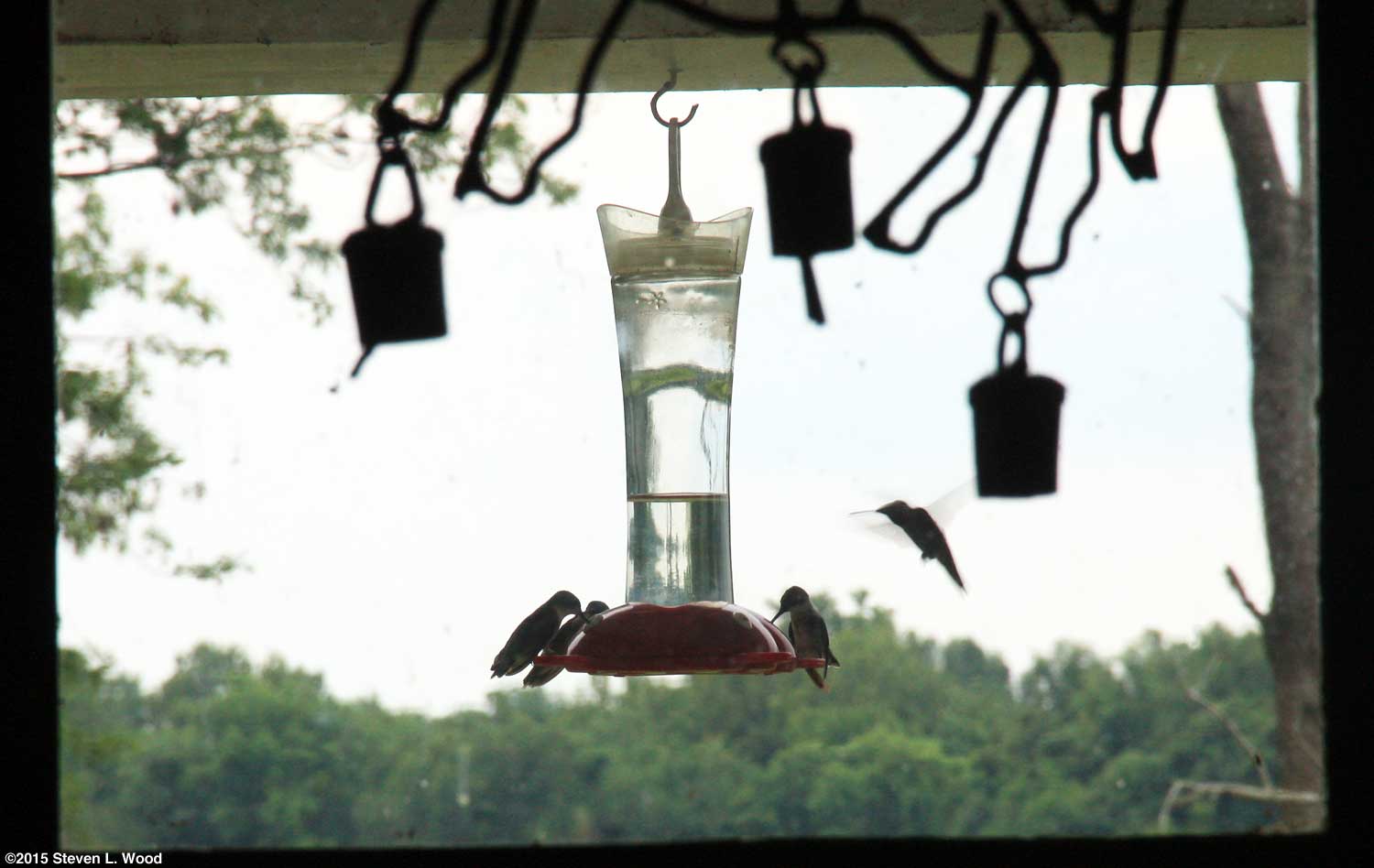
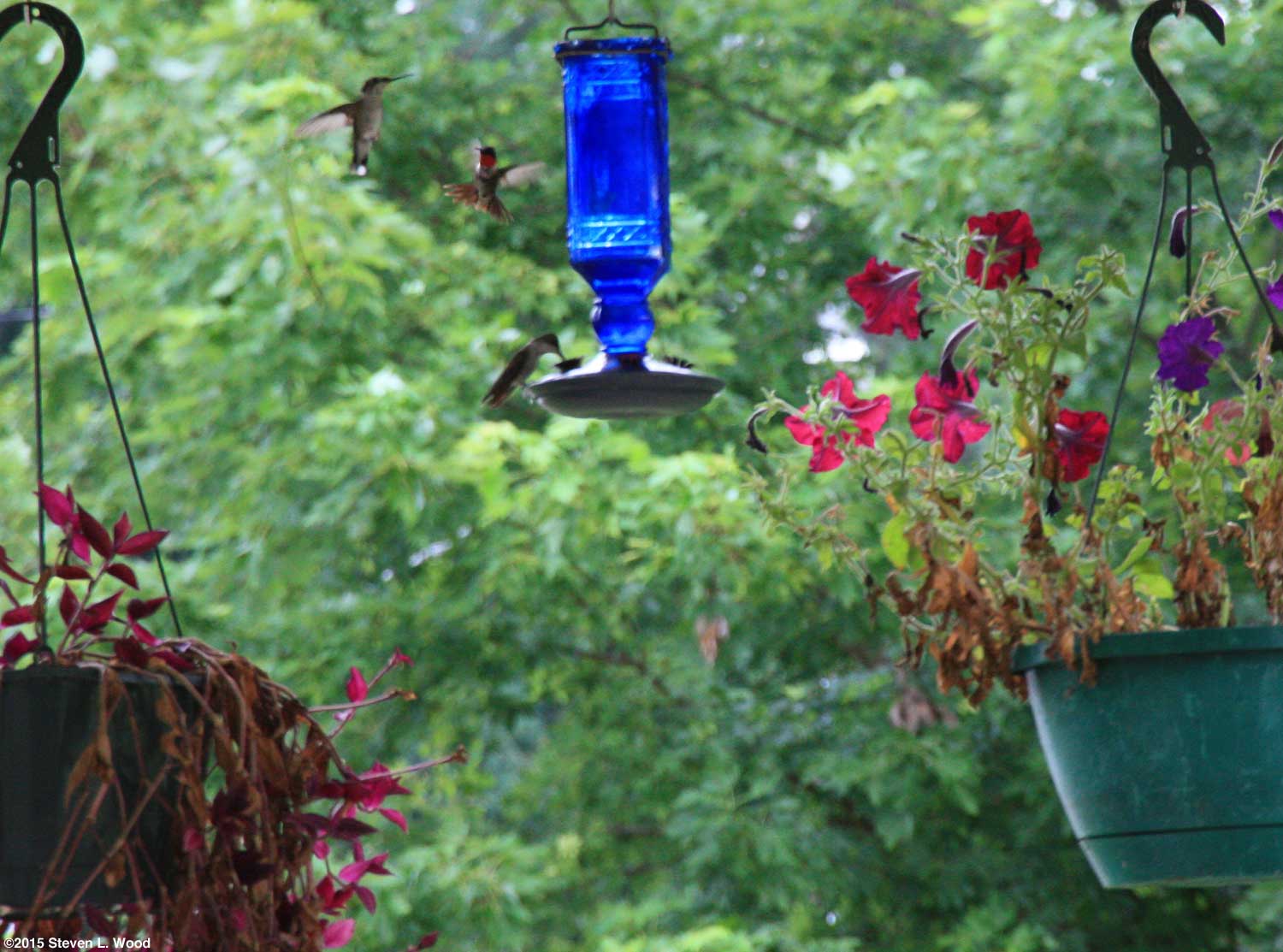
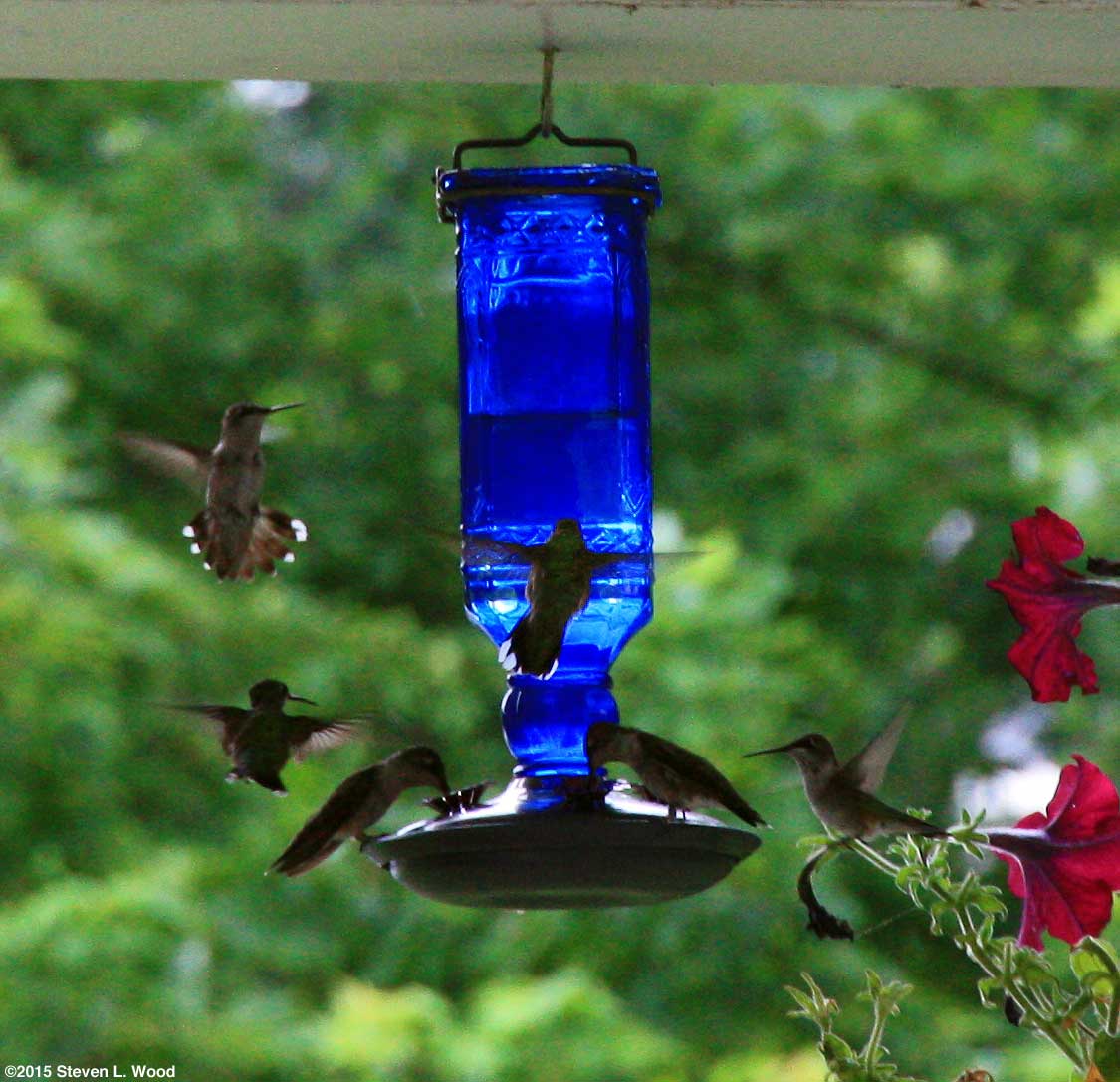
I wondered for just a moment about what was going on. Then I realized that the increased action and number of birds around the feeders must mean that the hummingbirds' second clutch of babies must have left the nest. We'll be going through a lot of granulated sugar over the next few weeks feeding the hummingbirds. But sometime towards the end of the month or early next month, most of them will just disappear as they begin their fall migration. Until then, they'll be a lot of fun to watch. Thursday, August 6, 2015 - Rain at Last!
The traffic at our hummingbird feeders and the rate of nectar consumption increased again today. It would seem that more baby birds are leaving their nests and heading straight for our feeders.
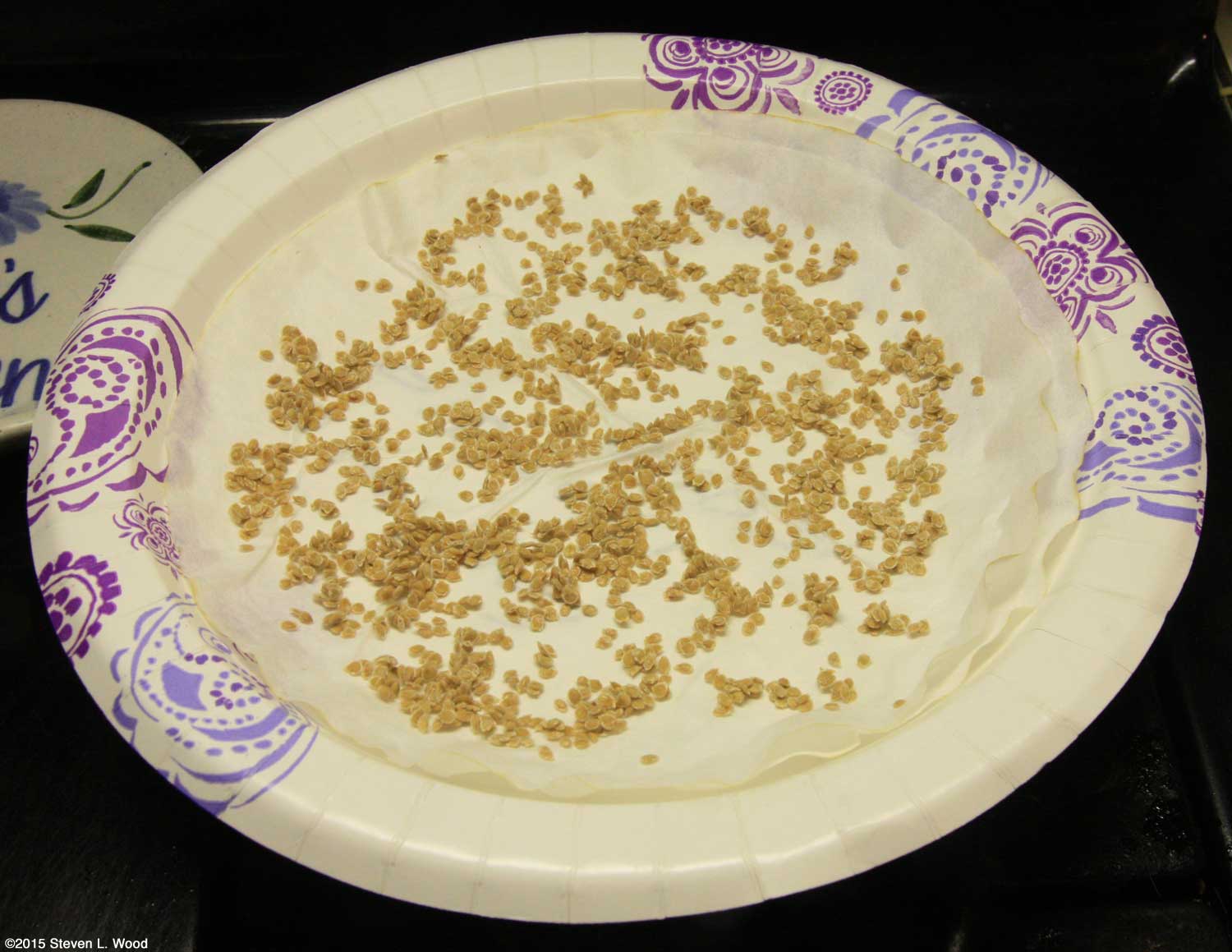
After each hot water treatment was done, I started a germination test with a very small seed sample of the tomatoes and peppers. Just ten seeds of each will tell me if I have bad seed or if I got things too hot during the hot water treatment and killed the seed. If done right, hot water treatment should not significantly affect the germination rate of seed. Sadly, I got the temperature a bit high and low at times today, as I was trying to do several things at once (hot water treat seed, collect trash around the house, process pictures, etc.). My go to articles on hot water treating seed are still the two I list in our feature story, Saving Tomato Seed:
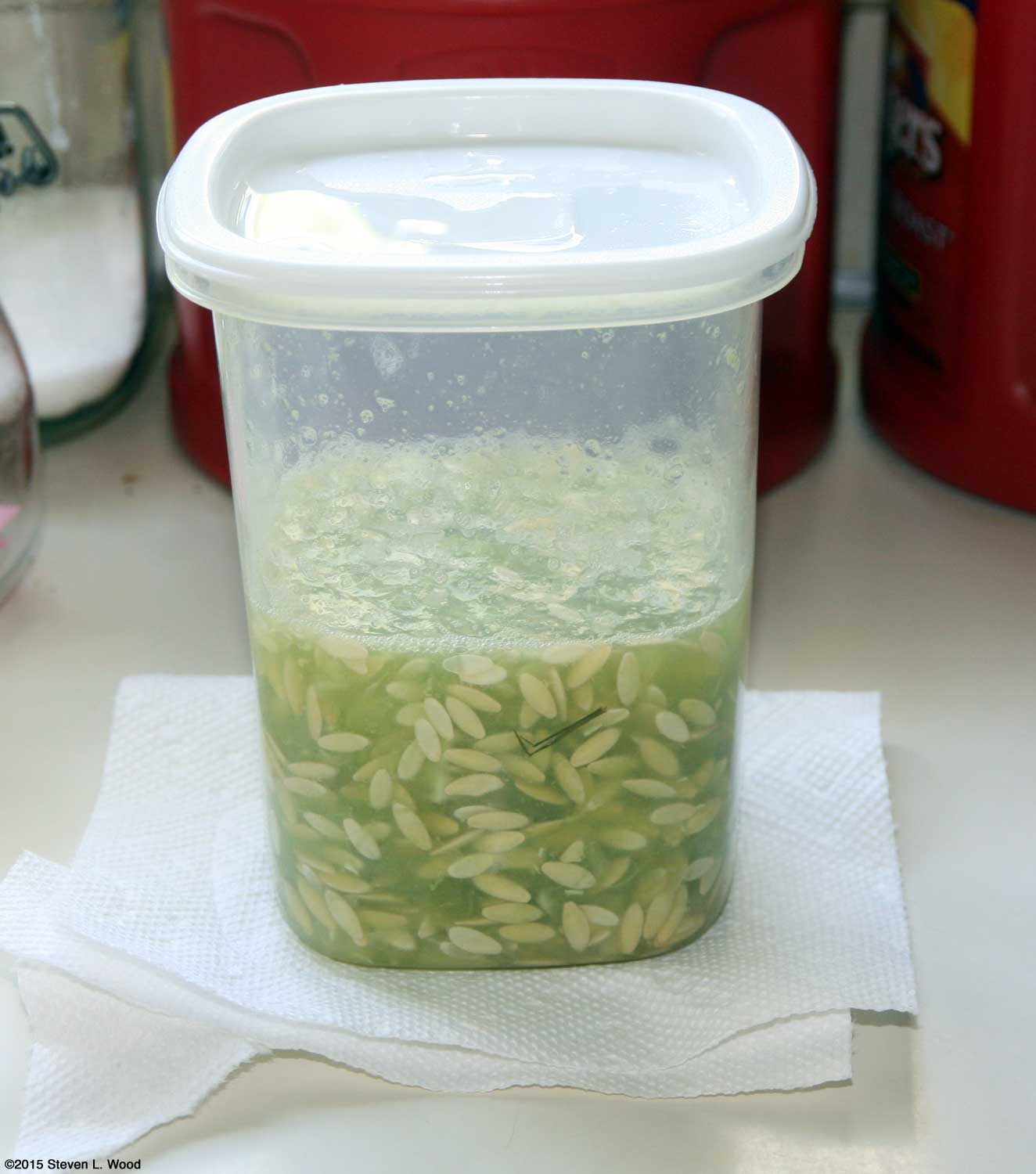
With our kitchen compost buckets almost ready to empty, I decided to finish filling them with cucumber cuttings by harvesting the seed from six Japanese Long Pickling cucumbers. While one can simply dig the seed out of the cukes, rinse off the slime and let them dry before storage, we prefer to let the seed ferment in its juices to help reduce the threat of seed borne diseases. So while scraping the seed out of the cucumbers, I also get as much of the gel around the seeds as possible, as it is what ferments well. We experienced an outbreak of bacterial rind necrosis in our melons and cucumbers several years ago. Treating the vines with fungicides helped, but we also began hot water treating our cucumber (and some melon) seed to help ward off the disease. Whether it was the fungicides, hot water treatment of the seed, or just plain dumb luck, we've not had another outbreak of the disease in the last several years. Note that hot water treatment of larger seeds such as cucumbers and melons can seriously downgrade the germination rate of the seed. And while there wasn't a lot to do in the garden today, I did have to fill our two hummingbird feeders four times. At this writing after the tiny birds have gone to bed, the feeders are empty again and will need to be refilled with homemade nectar before morning. Other than the lettuce transplants that are hardening off on our back porch, our main raised bed is planted and mulched for the fall season.
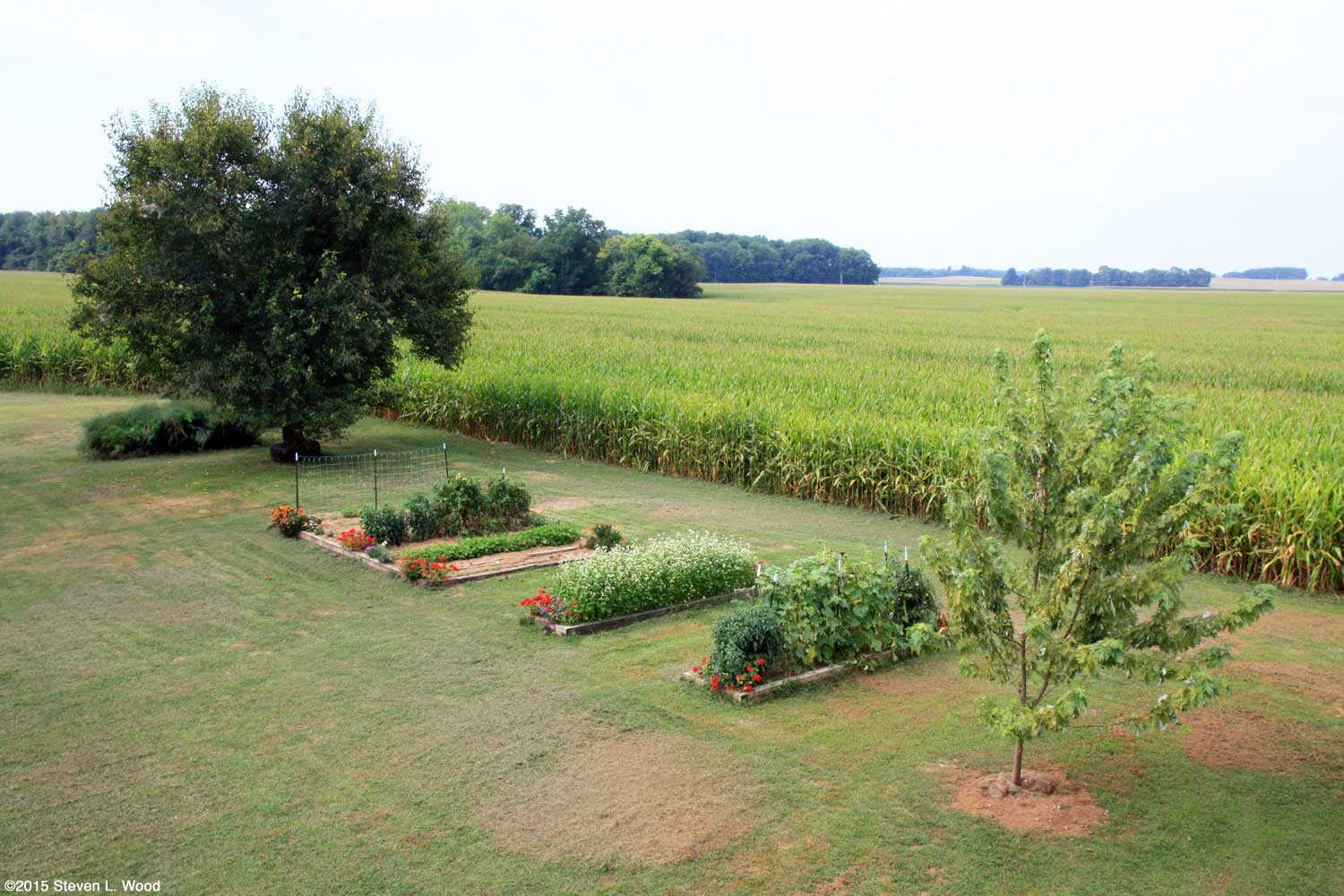
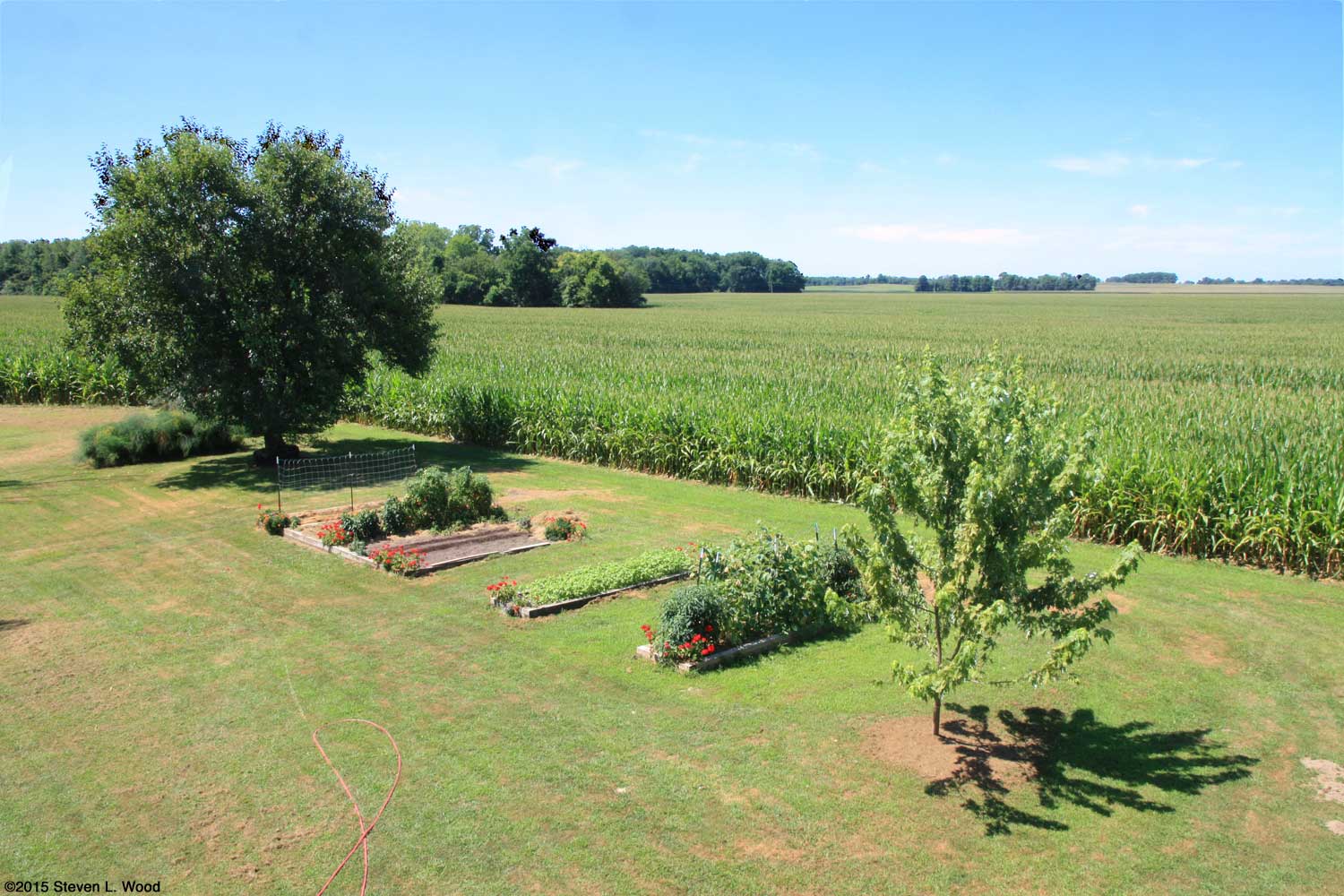
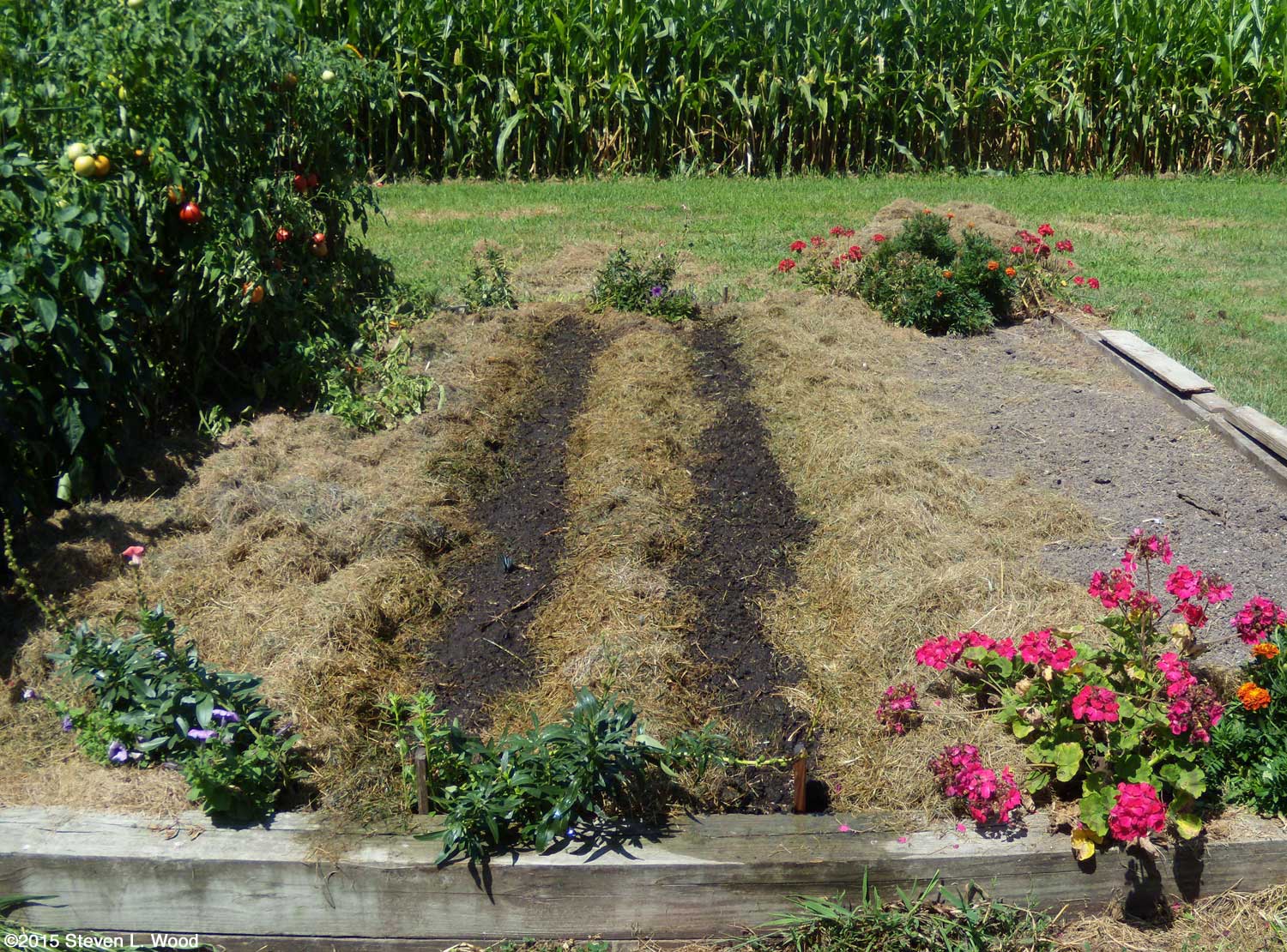
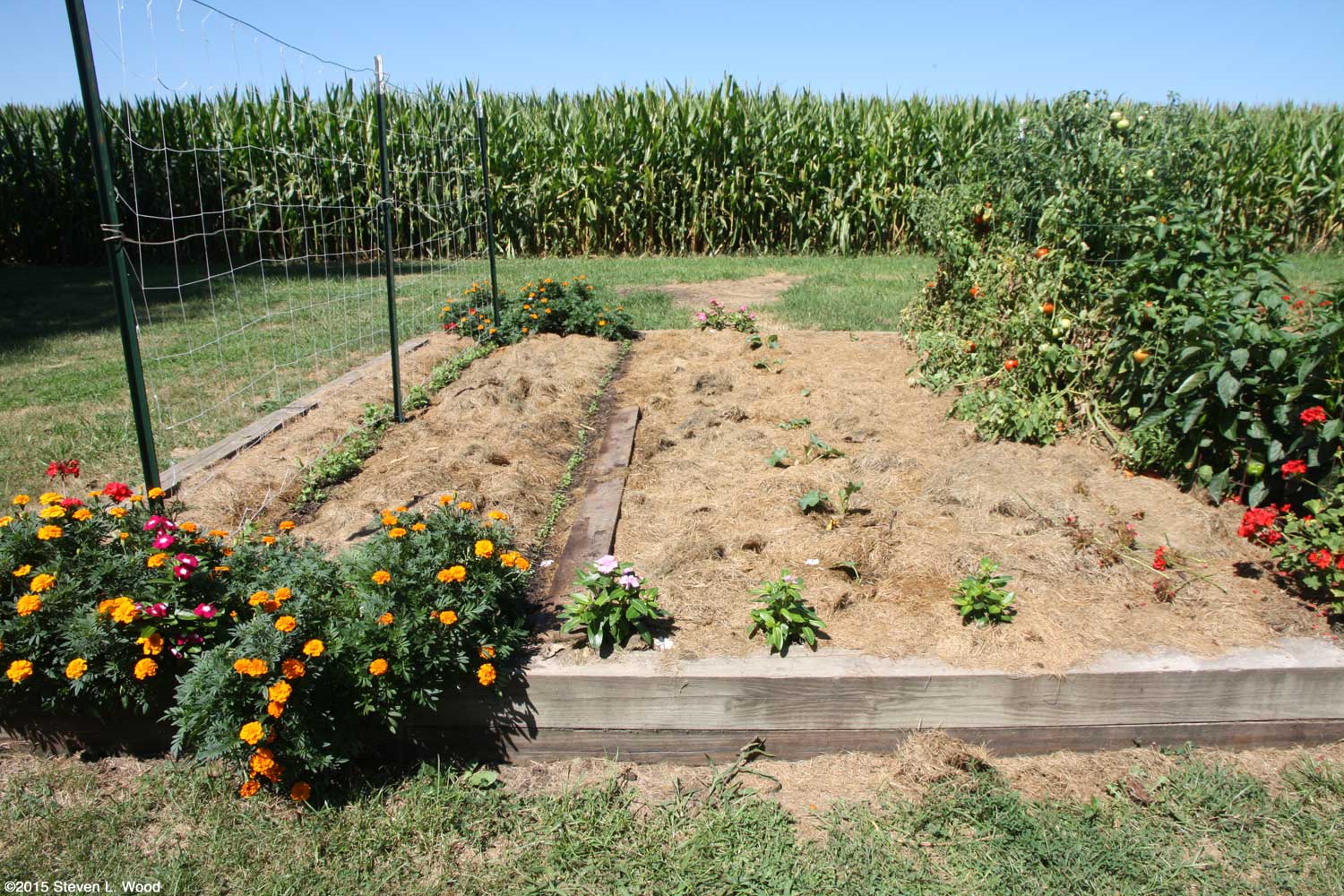
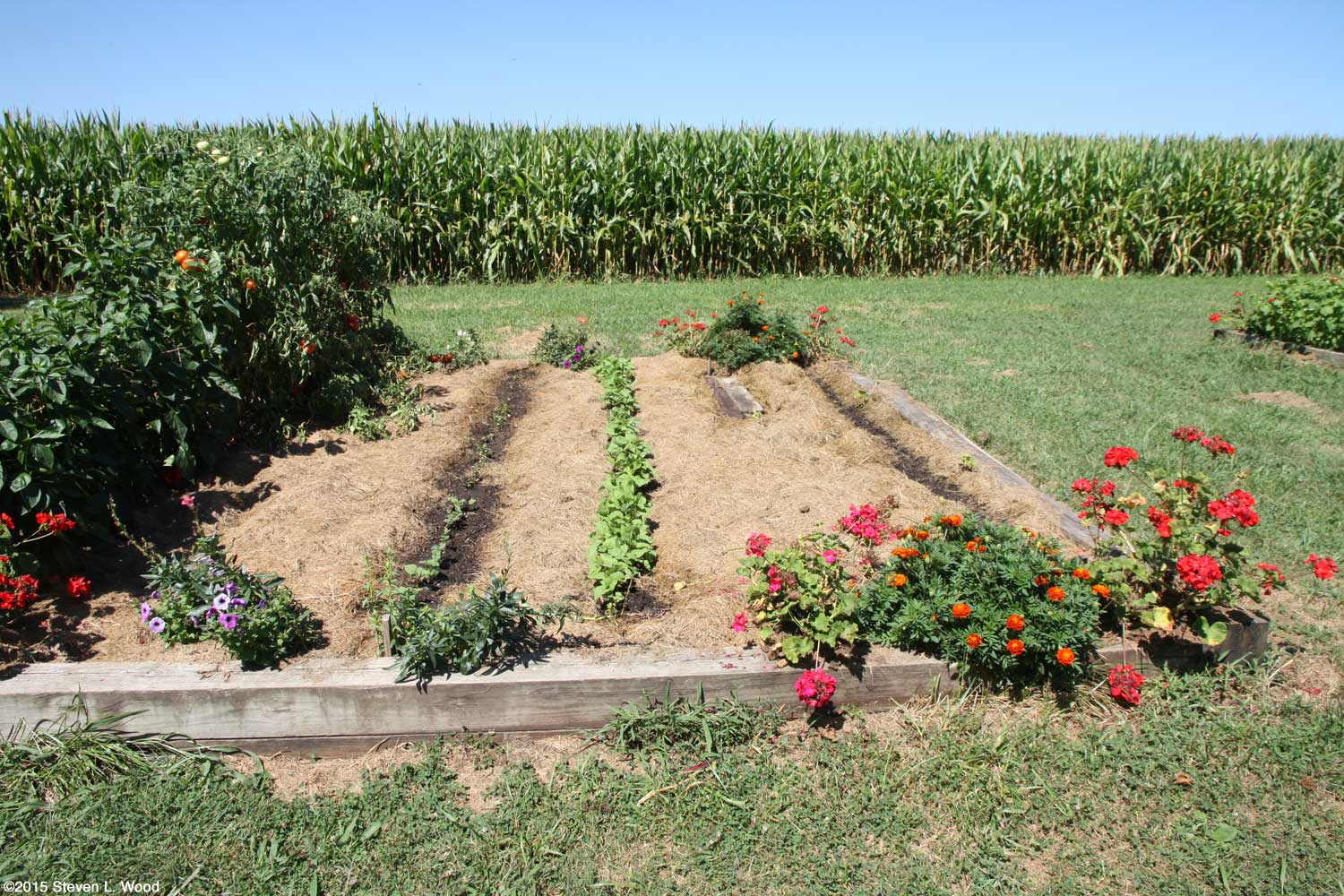
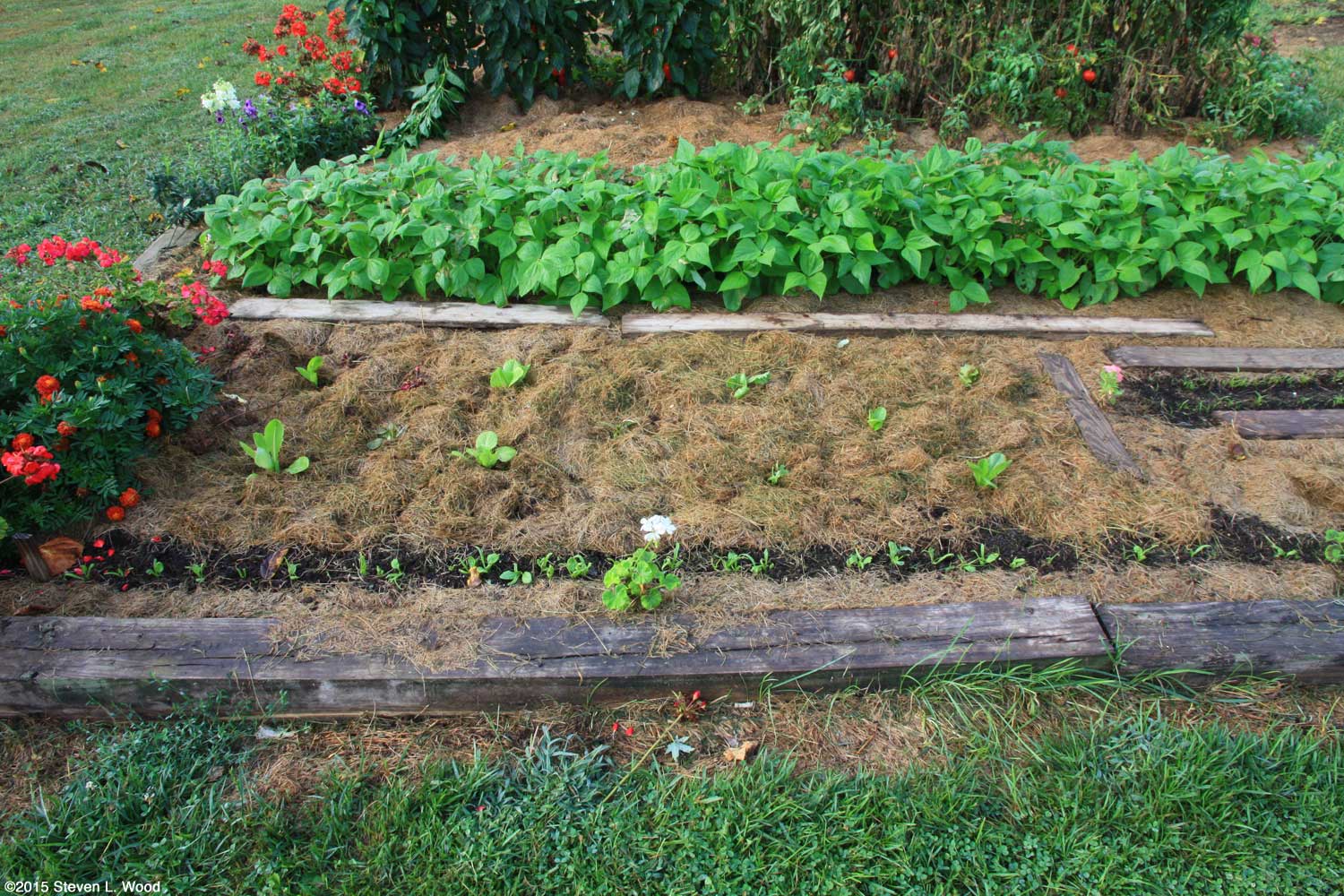
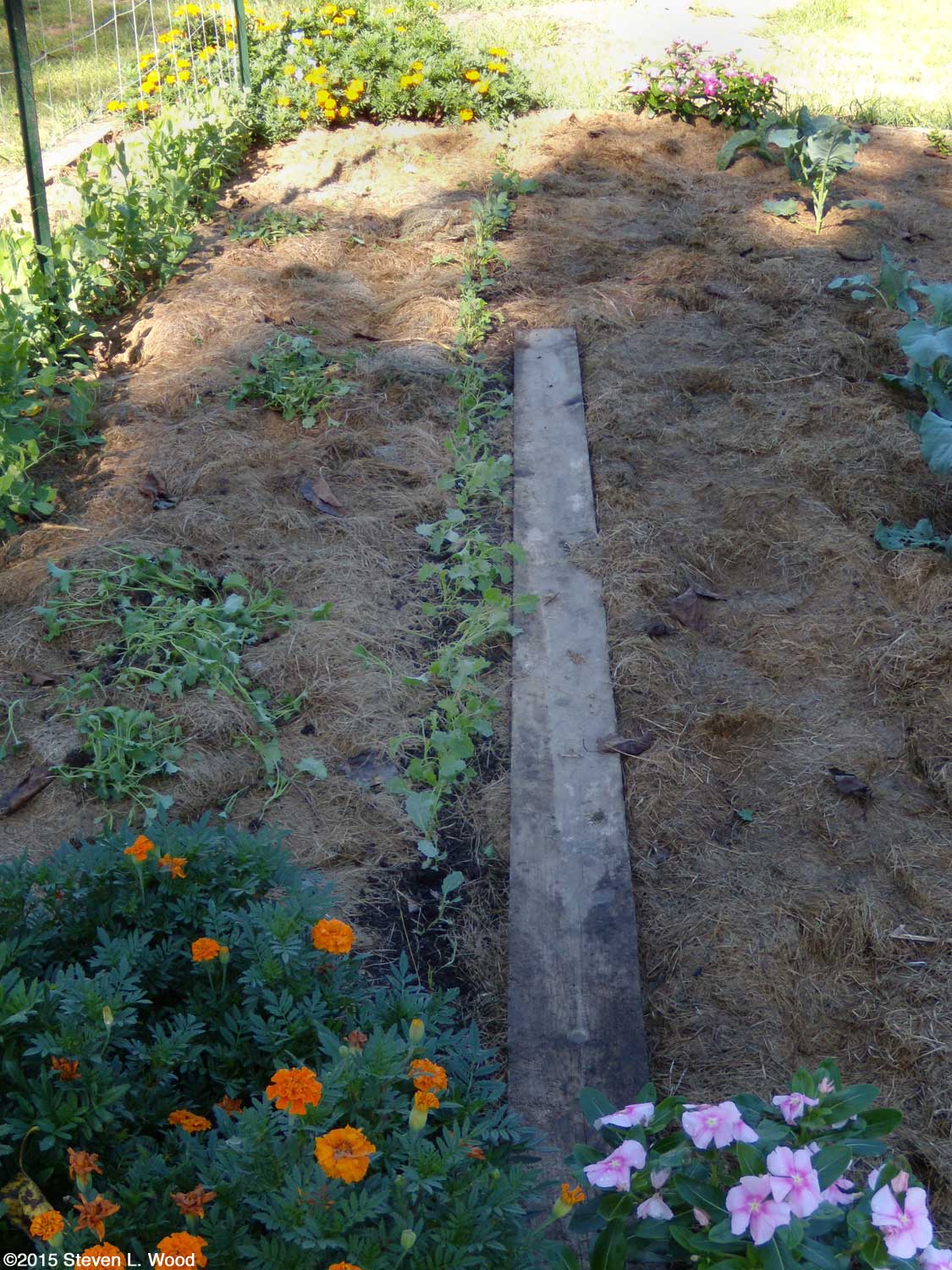
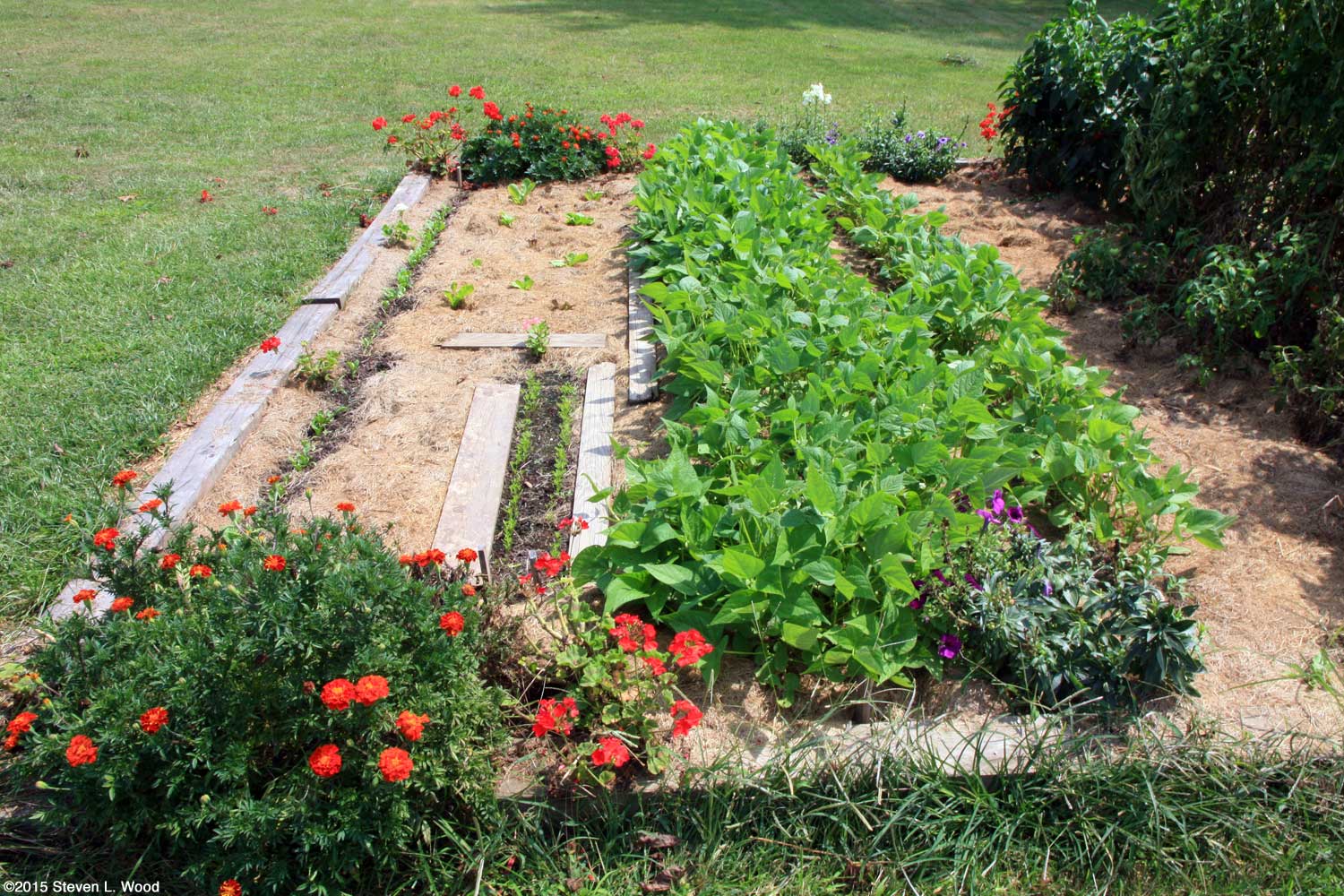
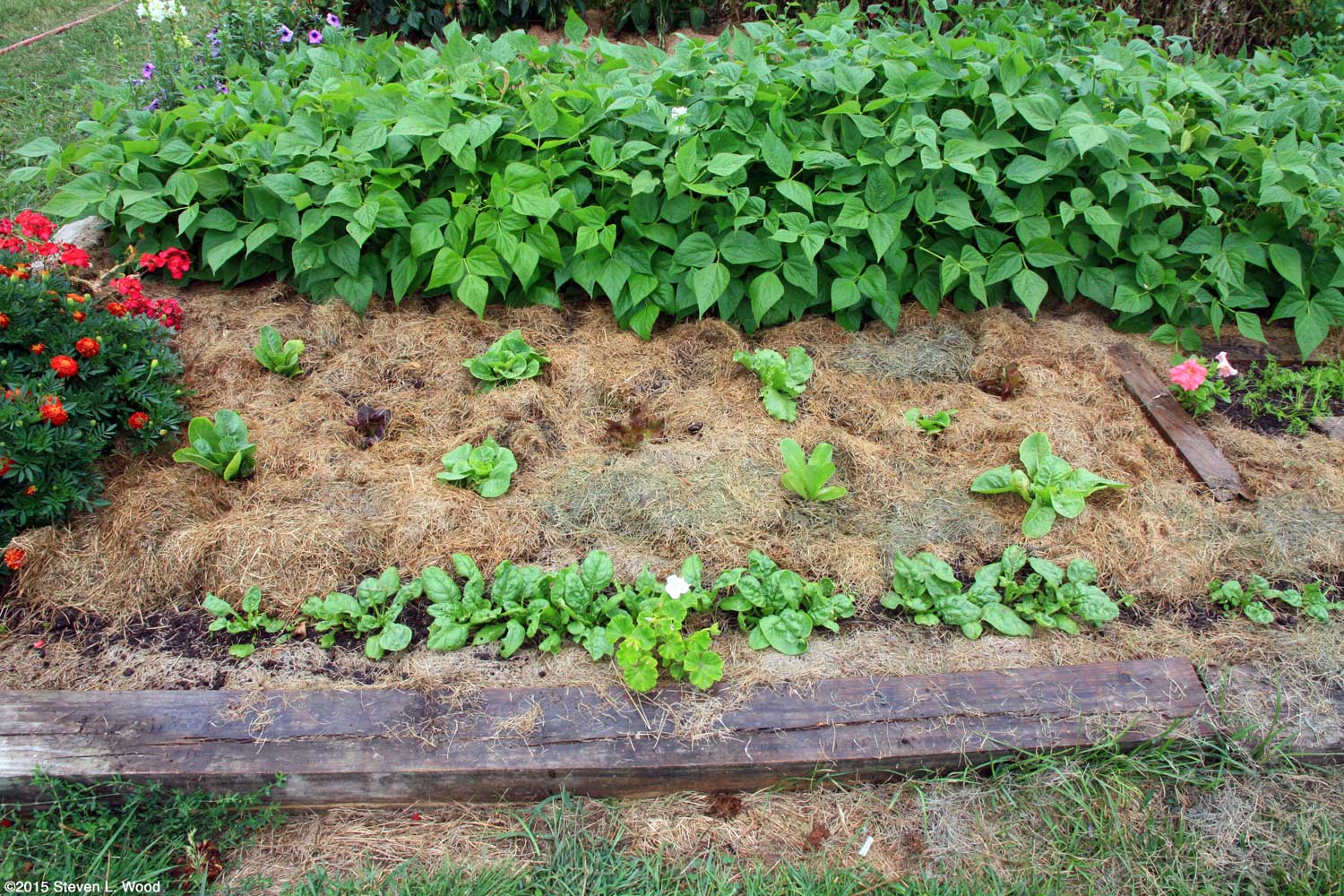
We have, from left to right, Sugar Snap peas, kale, a mixed row of broccoli and cauliflower, and our all season row of tomato and pepper plants. Beyond them, we have two rows of green beans, two very short rows of carrots with room for the lettuce transplants, and a long row of spinach. At this time a year ago, we were hustling to harvest and freeze sweet corn, dig potatoes, and bring in what melons we had. While I miss having those crops, I definitely don't miss the effort in growing and bringing them in. I am today at the twelve week mark since having total hip replacement surgery. I still walk with a cane, although I inadvertently wander off from it at times, possibly a good sign. A checkup with my orthopaedic surgeon on Tuesday confirmed that I'm doing well in my recovery and rehabilitation, although he noted that I was definitely pushing the envelope with some of my gardening activities. Bending, such as when I mulch crops, seems to be one of the most difficult things for me to do at this point. Today wasn't one of my better days, as I had to rely on painkillers and go easy on activity. I finally realized that I'd done a lot of walking without the cane yesterday, employing some muscles that weren't used to such exertion. And the day before, I'd seeded and mulched a lot. On balance, I think I'd rather be hurting just a bit from gardening than from working out in a gym. Gardening is a whole lot more fun than formal workouts. Tuesday, August 11, 2015 - Tomato Purée
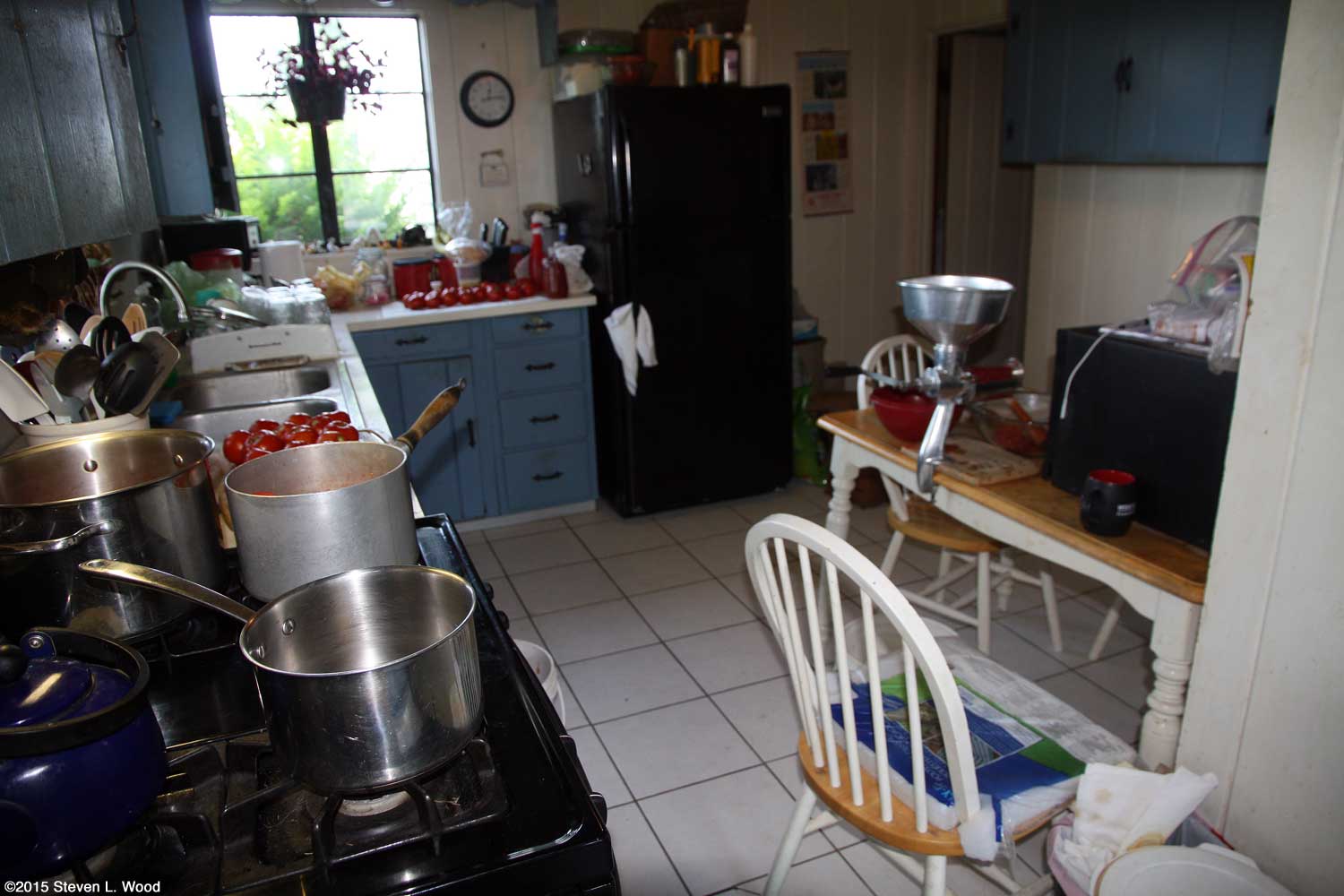
We should have plenty of tomatoes for table use the rest of the summer. But our four Earlirouge tomato plants appear to have matured their last concentrated fruit set of the season. I used our old and somewhat leaky Squeezo Strainer to separate pulp and juice from tomato skins and seeds. I heated the tomatoes before running them through the Squeezo, as that seems to produce more juice and pulp for canning. I also saved seed from five more perfect Earlirouge tomatoes, so we should have plenty of that seed to share with other gardeners. As I write today, I'm thickening the tomato juice, hoping to get it boiled down to purée without burning it. Late Update:
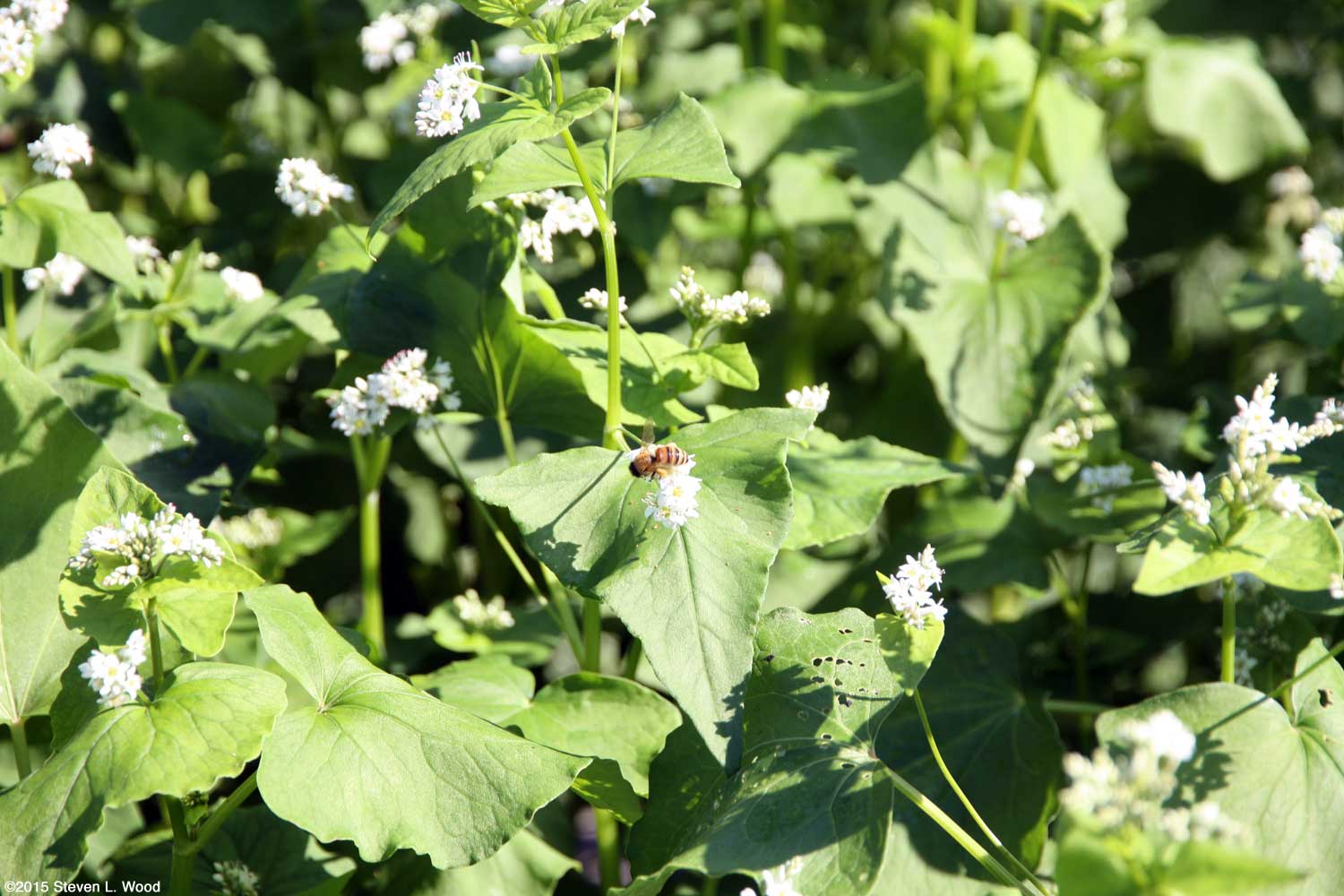
On Starting a New Garden Other than watering and a few other chores, I pretty well took the weekend off from gardening. We had a wonderful family gathering on Saturday in Bloomington, Indiana, with two of our daughters, Samantha and Jennifer. We were celebrating Jen's thirty-sixth birthday. Sam and family just moved back to Indiana from California. She is the daughter who inspired our feature story, Some Thoughts on Where to Put a Vegetable Garden. She found a spot on their heavily wooded property that receives the necessary minimum of six hours of direct sunlight a day. And she's already researched setting up a gated area for her prospective raised beds! With all the deer and rabbits around her house, a fenced and gated area for her garden should save a lot of problems with critter damage to her future crops. Buckwheat and Bees As our buckwheat came into bloom in one of our narrow raised beds, I'd been watching it for bee activity. I hadn't seen much until this morning, when there were quite a few honeybees visiting the blooms. Often when things are in bloom here, it's mostly bumblebees that are hunting nectar and pollen. So I was pleased to see the honeybees in volume, as bee populations are still down across the country. Interestingly, by afternoon, no bees of any kind were visible on the buckwheat.
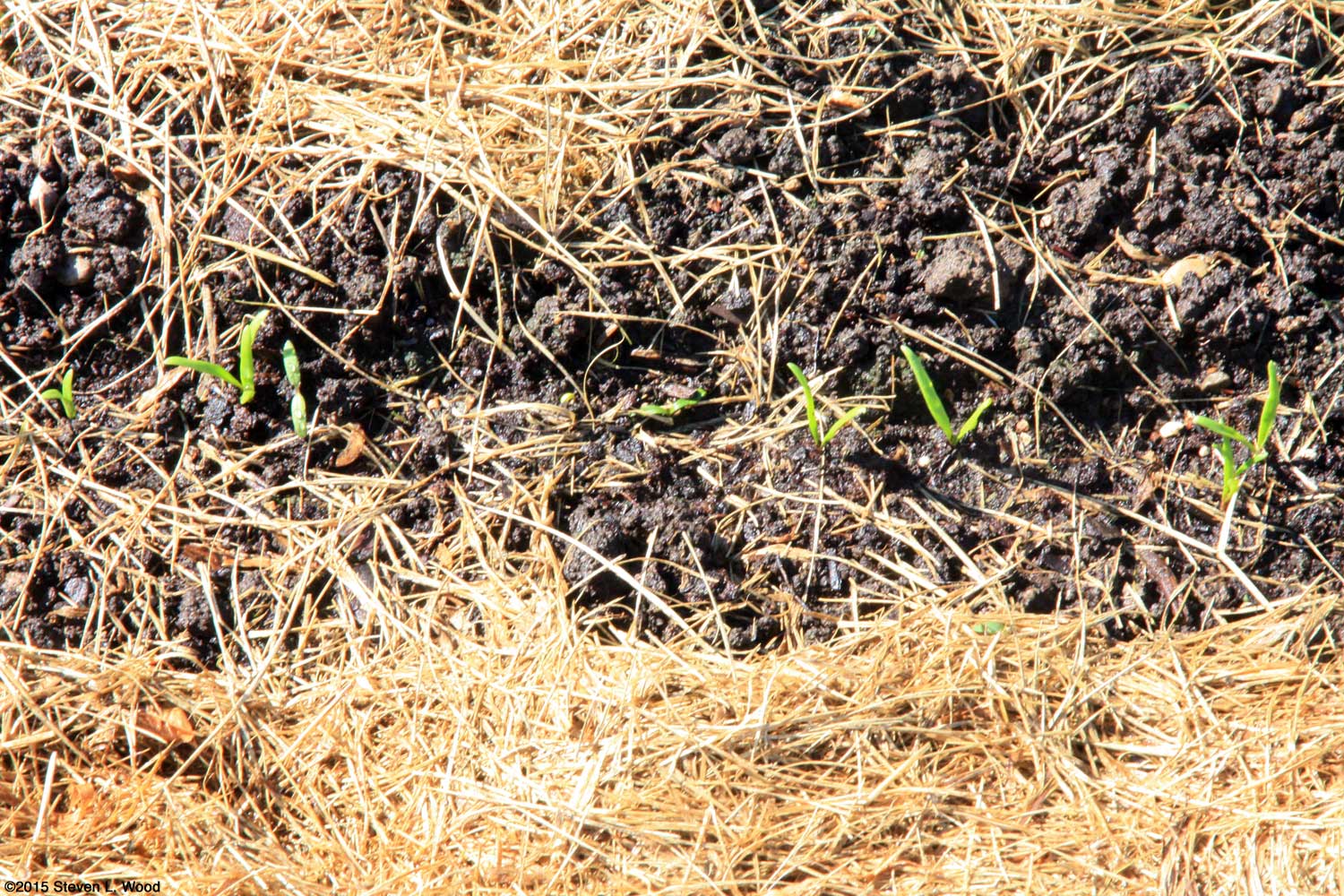
Thinning Lettuce Transplants One chore I'd forgotten to get done sorta came due on Sunday. I was thinking about transplanting lettuce, but realized that I had neglected to thin the fourpacks of lettuce I'd started to just one plant per cell. So instead of transplanting, I thinned the lettuce, moving some of the plants to other fourpacks. That will set back moving most of the lettuce into the garden for about another week or so, but we were early with these starts anyway. In this area, lettuce bolts pretty quickly in our normal hot, dry, August conditions. Carrots and Spinach Up I took the walking boards off our short carrot rows this morning and was pleased to see that the carrots were beginning to germinate. Likewise, our spinach is also coming up. As dry as things have been of late, I'm quite pleased we've been able to get each of our direct seeded fall plantings going. I've watered more than I usually do, but I also think soaking the planting furrows before seeding has helped with seed germination. I also soaked our Sugar Snap pea seed and one row of our green bean seed before planting. A second row of green beans didn't get the seed soaked, and it took several days more to germinate, but it still came up pretty well.
We did get a little, a very little rain yesterday. I was standing at the front door when it began to really pour. I walked to the back door to look out from the porch, and the rain stopped. Perseids If you haven't read about it on the news, the Perseid Meteor Shower should peak Wednesday night and Thursday morning. It's one of the better meteor showers of the year and has the big advantage of occurring during warm weather. Looking straight up or to the northeast a bit should allow you to see some shooting stars. Slate's Phil Plait has a good article on How to Watch This Week’s Perseid Meteor Shower.
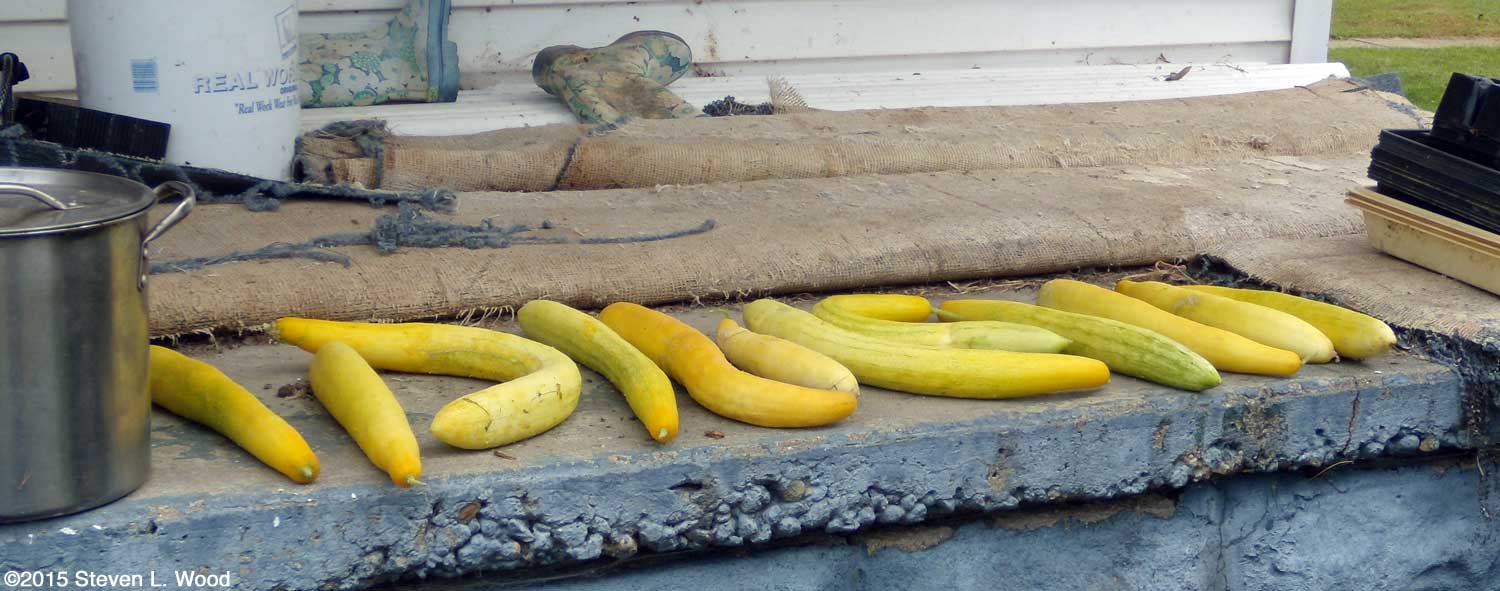
We're still caught in our annual July-August dry spell which requires watering newly direct seeded crops each morning. Fortunately, we're also experiencing some cooler mornings which make working in the garden then quite enjoyable. I'd sorta let our Japanese Long Pickling cucumbers get away from me in the last week or so. I picked them back yesterday, bringing in lots of overripe cucumbers for seed saving and many ripe JLPs that should be good for fresh use or canning as pickles. (The nice cukes are going to my wife's co-workers, as I'm not quite ready to do a batch of pickles yet.)
Buckwheat Our small planting of buckwheat is ready to be turned under as green manure. Most sources recommend turning under buckwheat grown as a green manure crop as soon as it starts blooming. But I really enjoy seeing the buckwheat in bloom and the many bees that visit the blooms. So I'm going to let the buckwheat stand for a few more days. When I went out to water our freshly emerged carrots and spinach this morning, I also enjoyed the hum of hundreds of bees visiting the buckwheat blooms.
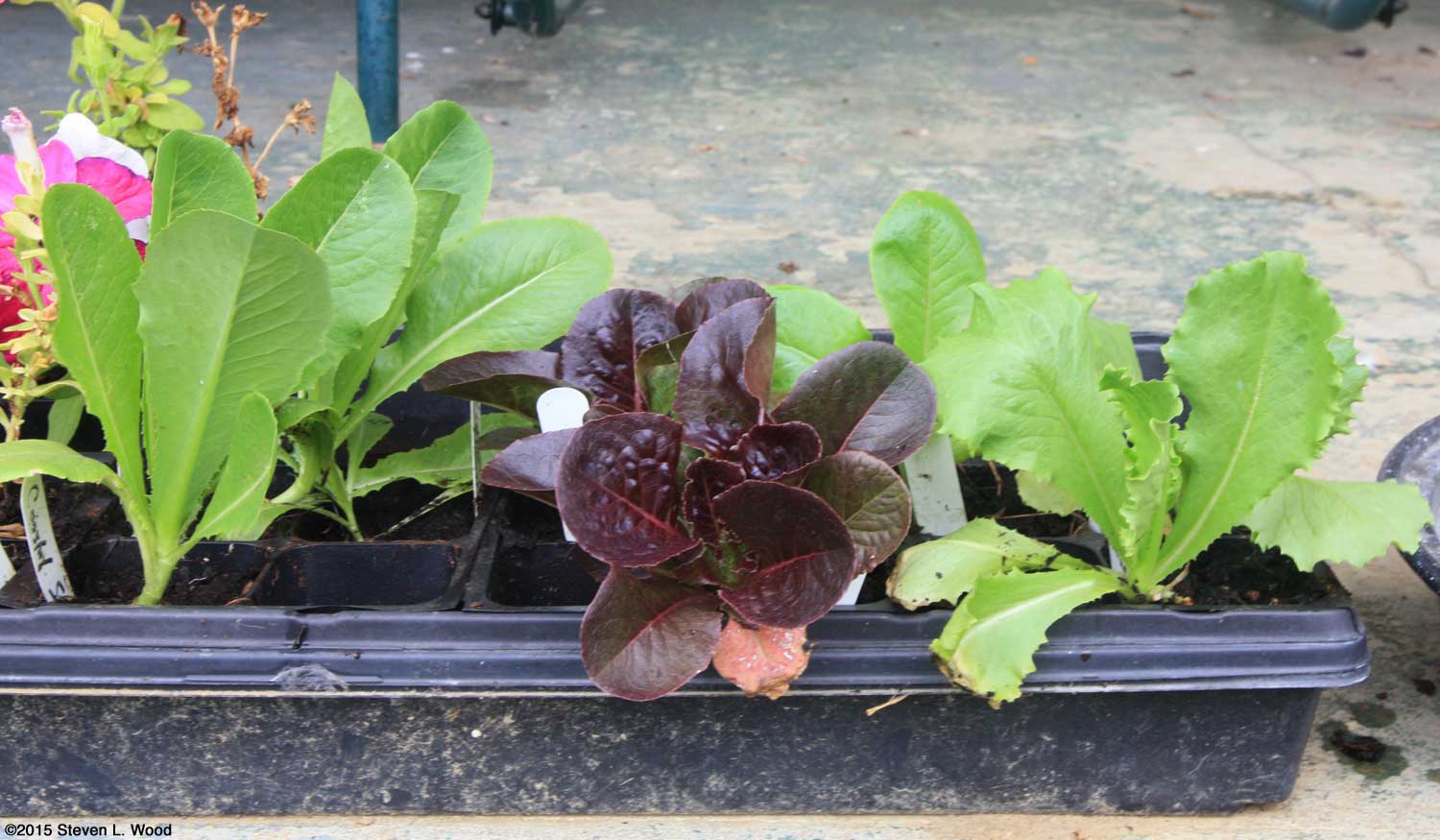
While it's really nice to look at our bed of buckwheat in full bloom, I'm wondering what to do with this raised bed for the rest of the season. The buckwheat matured far more quickly than I'd anticipated. The bed is scheduled for early peas next year in our garden plan, so I can't use it for any crop that would extend far into the fall. I may just turn under the buckwheat and reseed the area with more buckwheat to improve the already good soil structure of the bed. Cooking Garlic Scapes A reader wrote to me this week about cooking garlic scapes. I'd never heard of it, but when I searched online, I found that scapes are considered to be quite a treat. Christina Chaey's aptly titled article on Bon Appétit, 10 Things to Do With Garlic Scapes, the Best Veg You're Not Cooking Yet, tells the tale. Tuesday, August 18, 2015 - A Bit of Rain We had a thundershower pass through yesterday afternoon that dropped 0.38 inches of very welcome rain. Over the last few days, we've seen lightning and heard thunder both north and south of us, but didn't get more than a few drops of rain. While just over a third of an inch of rain won't do all that much good, it's a start. We have a good chance for more rain tomorrow. Lettuce Transplanted Encouraged by the rain, I got out after supper and transplanted lettuce until just after sundown. I put in many of our favorites, including two Defender and three Winter Density romaines, two Crispino icebergs, and two Skyphos butterheads. We'd tried the Coastal Star heat resistant romaine last year without much success, but I put in two of them, as they were the strongest transplants of the bunch. I also put in one Pandero purple romaine.
Since I'd already mulched the area for the lettuce, I just pulled back the mulch, dug a hole and watered it before squeezing soil around the transplant and returning the mulch. I was pleasantly surprised to find pretty good soil moisture under the mulch. The third plus inch of rain we received yesterday wouldn't have wet the soil much more than an inch down, so I assume the watering I'd been doing had done some good. (The lettuce area has been getting some water each day when I water our spinach and carrots.) I finished the planting by sprinkling some Shot-Gun Repels-All Animal Repellent granules around the new transplants. We haven't had any rabbit damage so far this year, and I'd like to keep it that way. Even though we're getting towards the end of our growing season, I'll be starting a little more lettuce later today. We may employ floating row covers and/or cold frames to extend our growing season a bit for the lettuce. Flowerbeds
Dianthus can be biennials or true perennials. Our strain seem to be biennial in nature, although some of our plants do well into a third year before fading out. Even though we've saved seed repeatedly over the years, we still get some bi-colored blooms along with a lot of lovely red, pink, and white blooms from the plants. After mulching the beds, I put down a layer of animal repellent. This time the repellent was to discourage our dogs from laying on the soft mulch.
Wednesday, August 19, 2015 - Buckwheat Cut
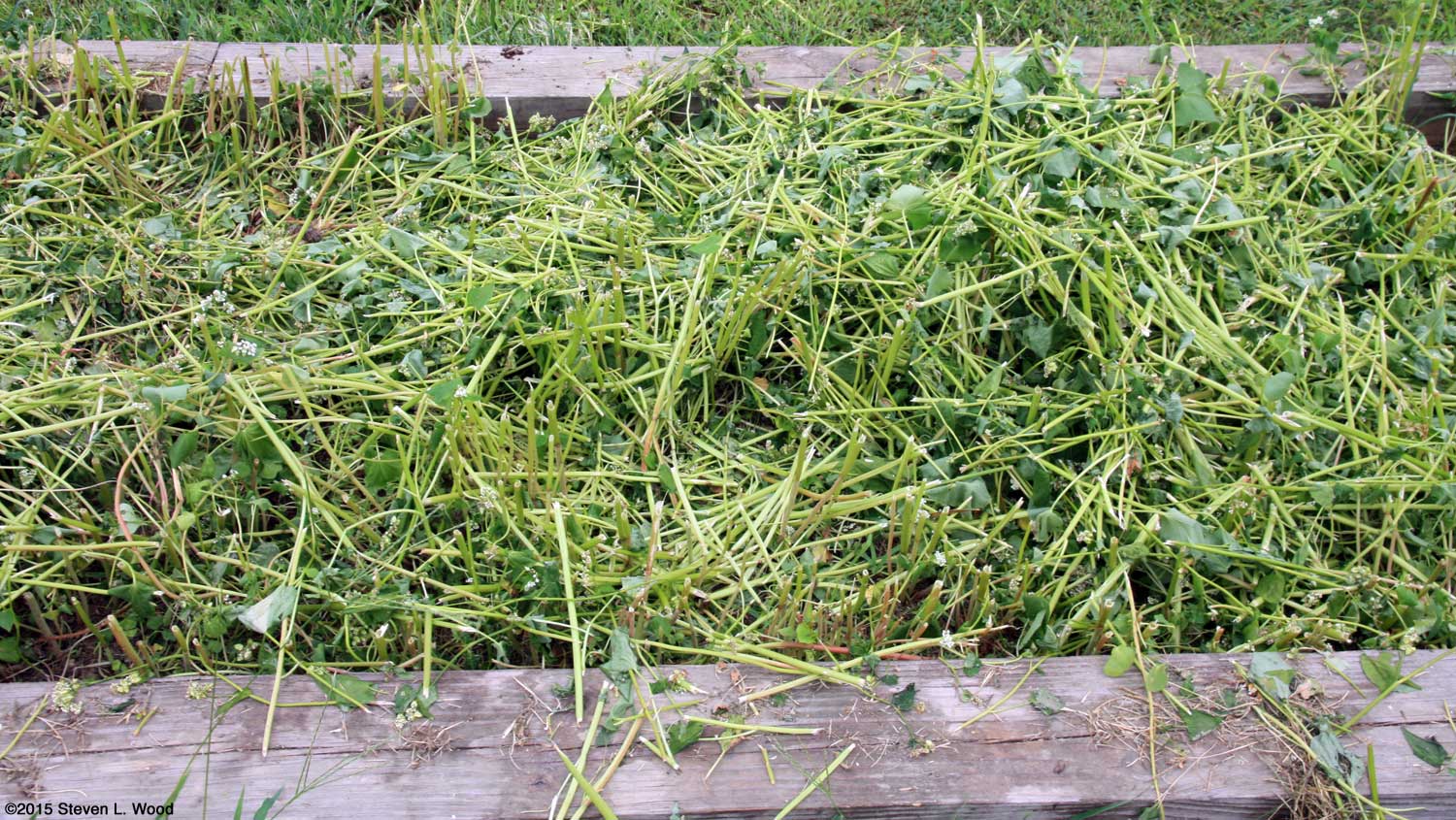
I used an electric hedge trimmer to cut our buckwheat yesterday afternoon. I made several passes over the buckwheat with the trimmer, first trimming the tops and then working my way down. I wanted to chop the rather tall buckwheat stalks as much as possible to make tilling them under a bit easier. The height of the buckwheat was a result of my letting it stand a few extra days for bee forage and also, probably, because it was growing in good soil. Normally, our plantings of buckwheat are on poor soil, and the buckwheat doesn't get as tall as it did this time around. I'm going to let the buckwheat "trash" sit and dry for a few days before turning it under. A Few More Transplants I started a few more lettuce transplants to fill in spots where we take baby lettuce, hopefully, in just a few weeks. While seeding, I also started some sage plants. The ones I had marking some of the corners of our East Garden all got mowed down this summer. As late in the season as it is, I may end up not using any of the new transplants, but it only took a couple of minutes and a bit of sterile potting soil to get them started. Rain We received a quarter inch of rain this afternoon. Again, that's not really what we need, but any rain at this time of year is welcome. Today's rain brings our August total to 1.75 inches. Thursday, August 20, 2015 - A Delightful Morning
The cool temperature plus some morning shade made thinning our row of kale pleasant work. Not having to wear my usual sun protective clothing seemed to make the thinning go fast. I pulled some of the extra kale plants and used a good pair of kitchen shears to trim others. I was trying to thin the plants to a one inch spacing. I'll need to go back and thin again to about six to eight inches between plants, but for now, an inch spacing is good until I know the plants are well established. While the thinned plants today weren't big enough to save for table use, the next thinning might produce enough leaf for us to make a batch of kale chips, a favorite of one of our granddaughters. After that, most of our kale gets used for our annual batches of Portuguese Kale Soup. A threat to the kale (and our broccoli and cauliflower) quickly became apparent. I found a number of small moth worms on the ground under the kale plants and signs of their feeding. I mixed some Thuricide
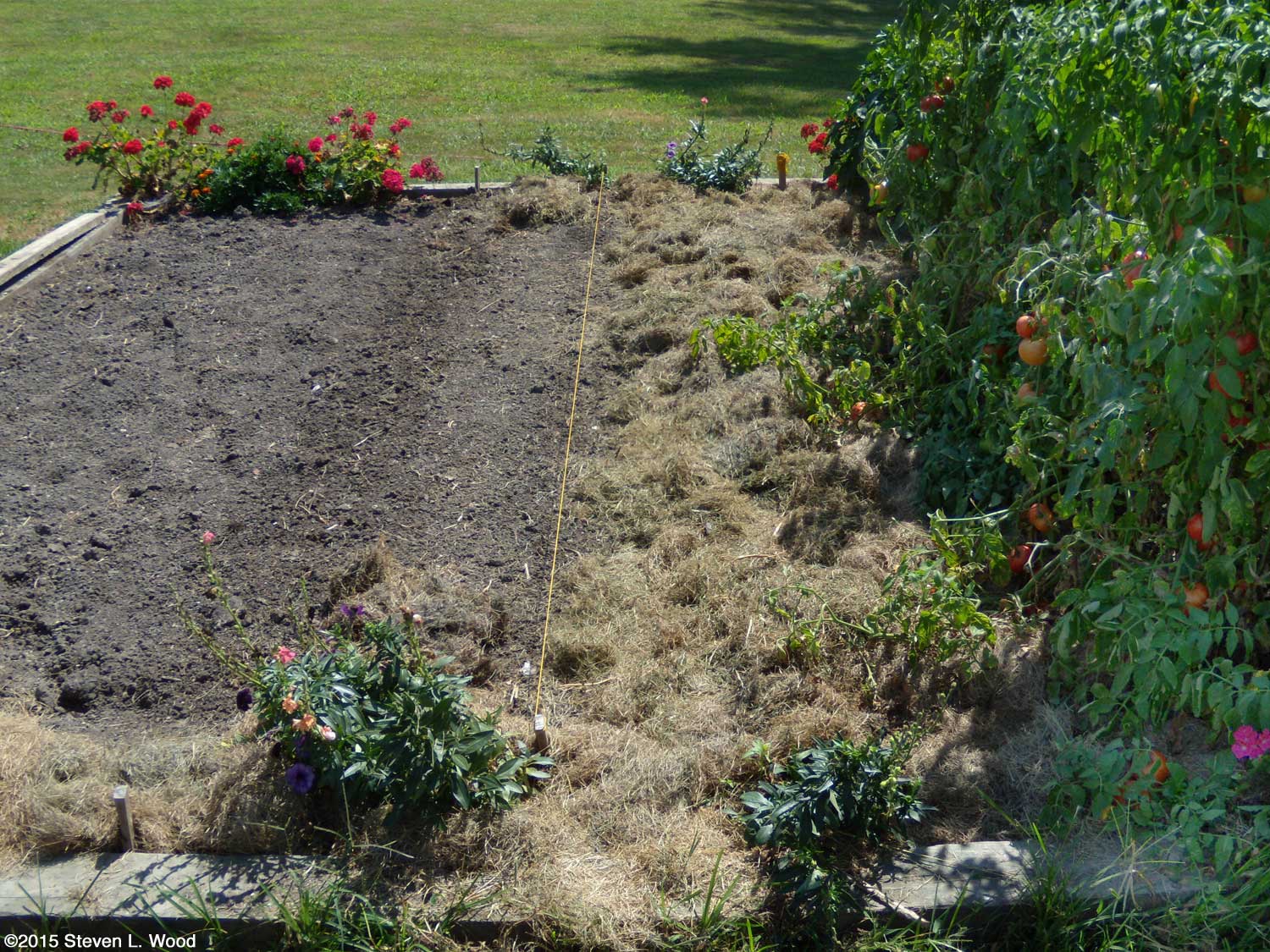
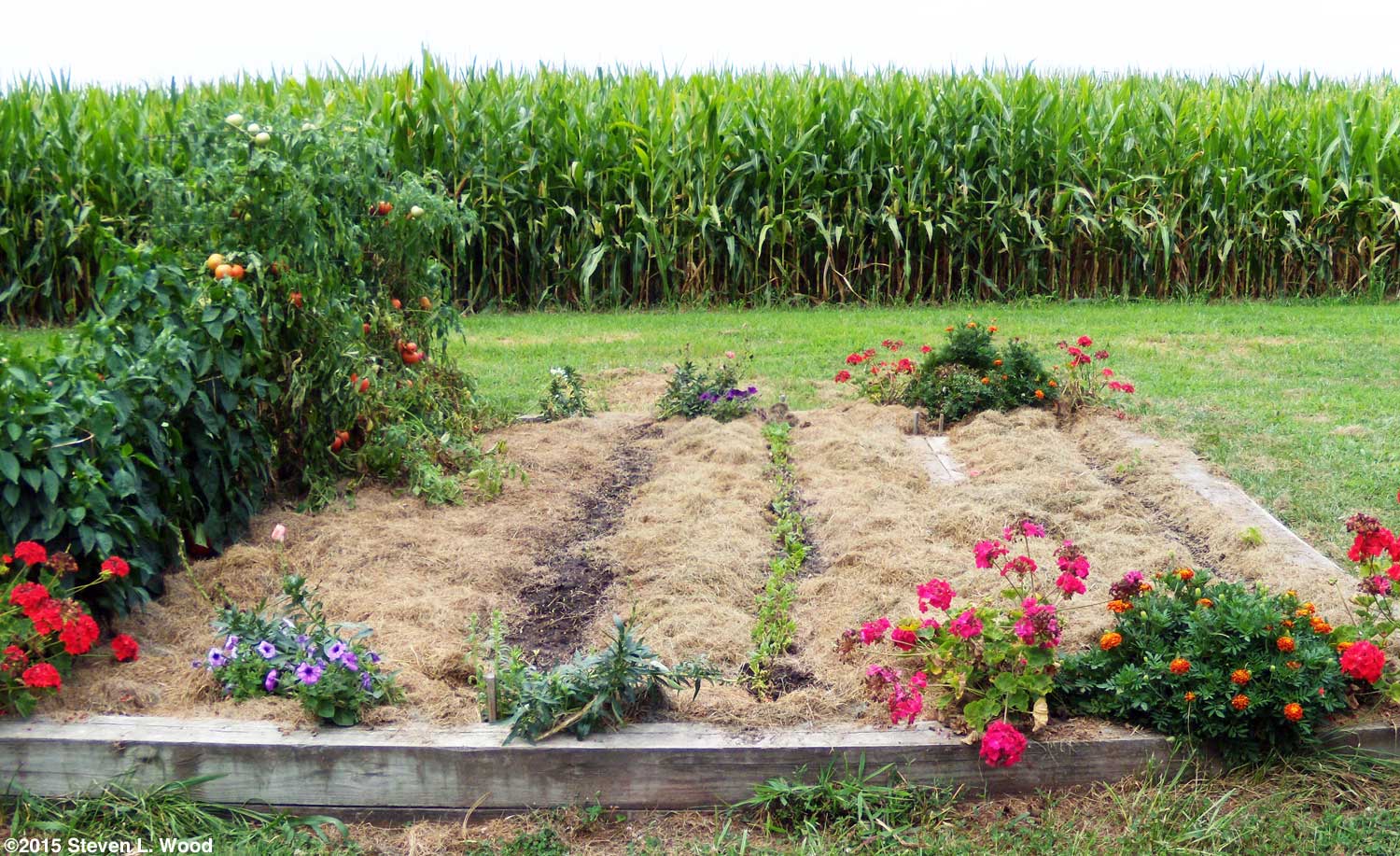
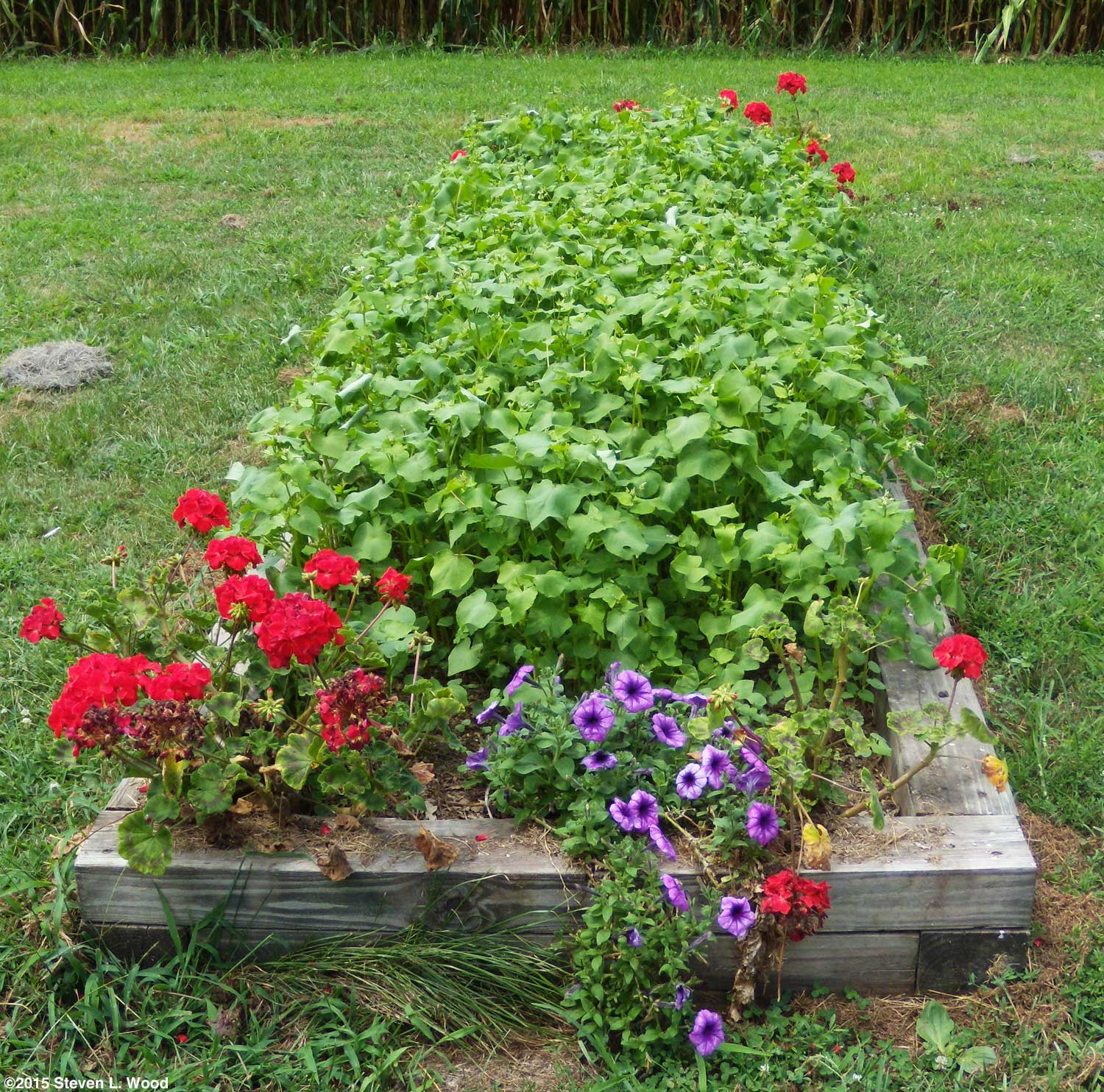
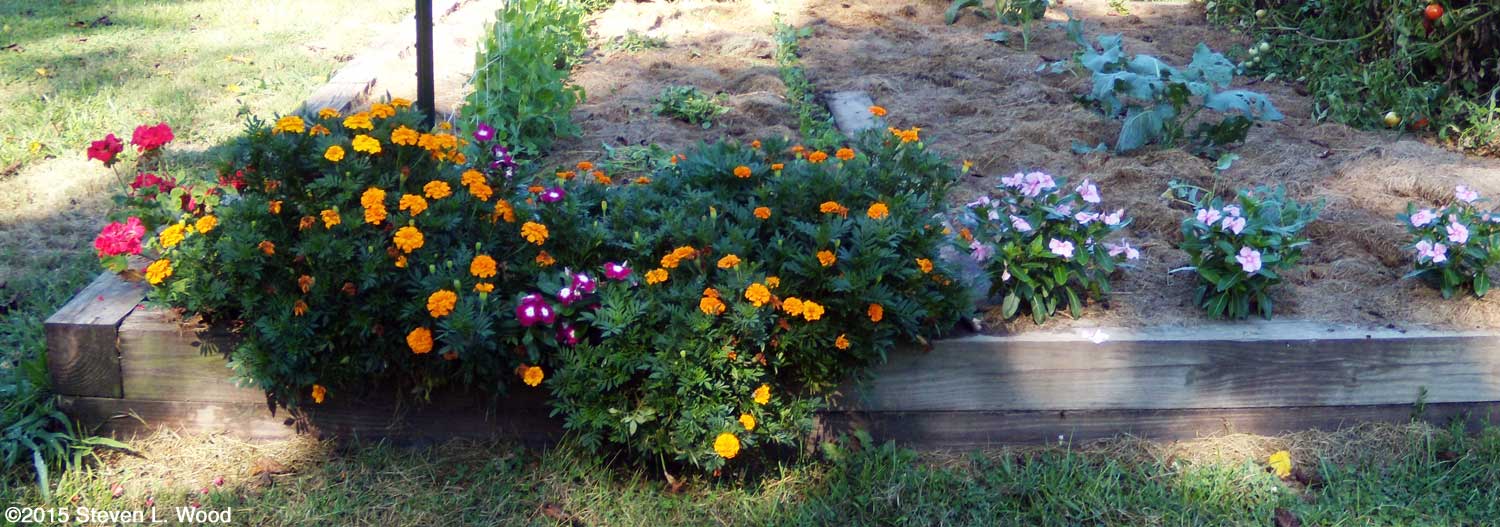
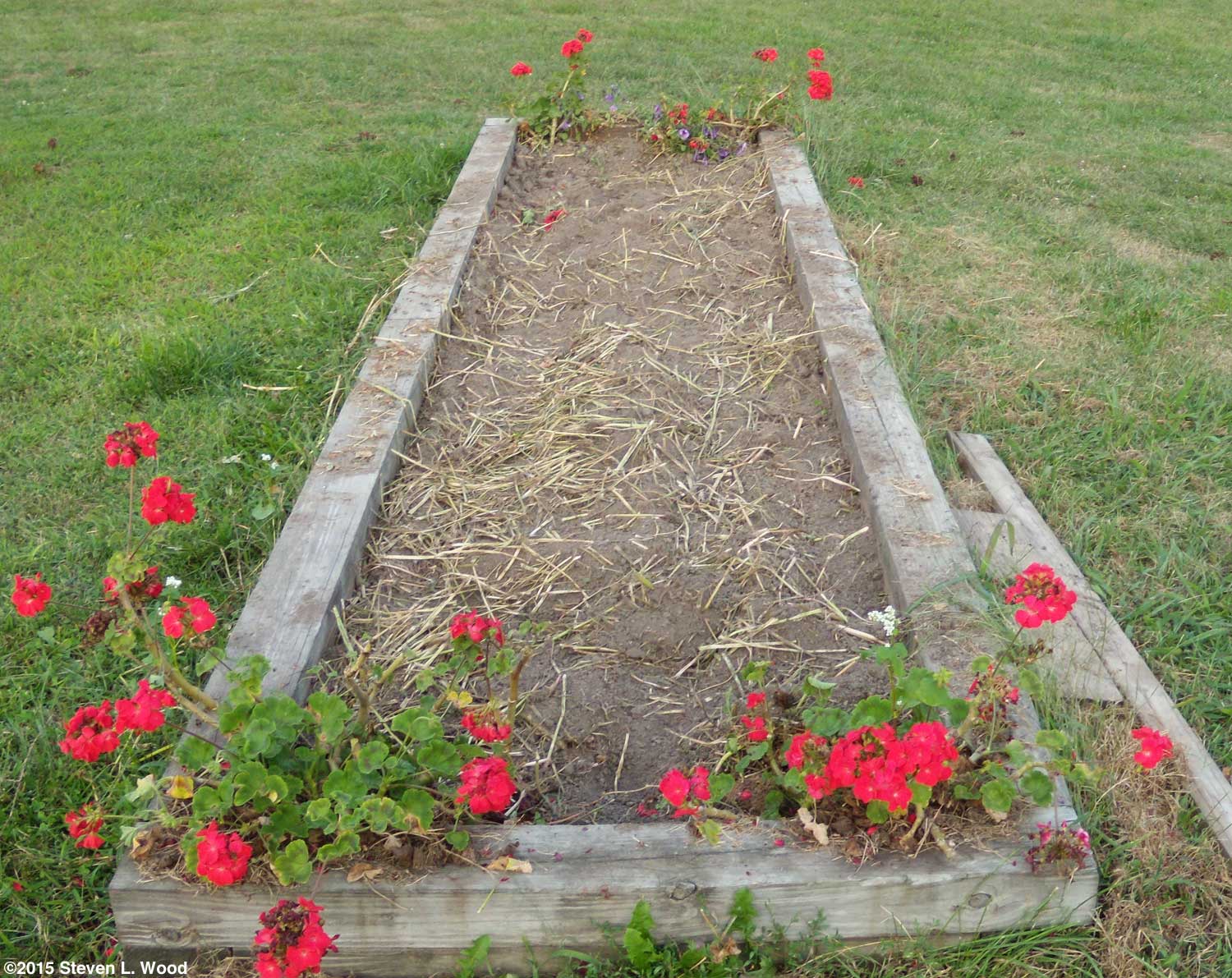
The flowers I edge our garden with each year have matured now and are making quite a pleasant display. While many of our vegetable crops come and go with succession plantings, most of our flowers are there for the season. I try to stay up with snapping spent bloom spikes off the geraniums we use at the corners of our raised beds. That seems to stimulate them to produce more flower spikes. The marigolds above are about to crowd out a geranium and a vinca (which I rescued by pinching back the marigolds a few weeks ago). The vincas at the right in the photo above went in late after I'd harvested our garlic which was planted right up to the edges of the raised bed.
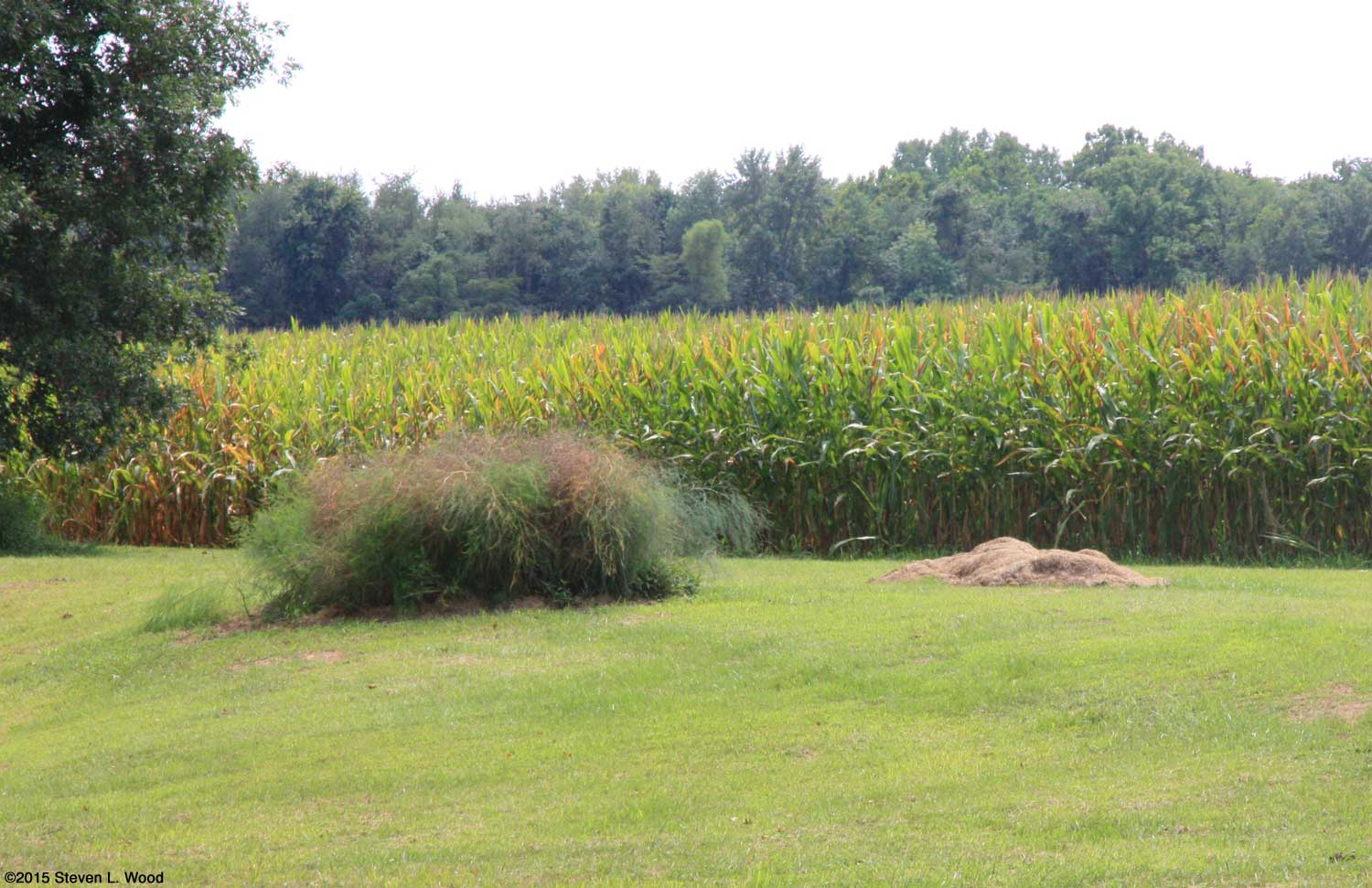
Shirking all of my daily responsibilities, I did stir my aching bones enough to grab my good camera and take a garden walk, shooting pictures as I went. My first shots were of our two patches of asparagus which often get ignored at this time of year. Our raised bed of asparagus looks quite healthy. It got several inches of compost applied this spring. Bonnie's Asparagus, however, hasn't had much care this year. I'd planned to use the rest of our finished compost on it, but after my hip replacement surgery, never got around to it. The finished compost pile is now growing weeds and volunteer tomato and yellow squash plants, along with a lot of grass weeds. I'll need to sprinkle some commercial fertilizer into the asparagus patch sometime soon. Beside Bonnie's Asparagus in the photo at left is a pile of grass clippings. Since we have more grass clippings than we need for mulch right now, I piled them on one of our currently unused isolation patches. This particular patch of soil is the worst soil we garden, so the decaying clippings may help it a bit. I suspect our other two unused isolation patches could use some similar treatment.
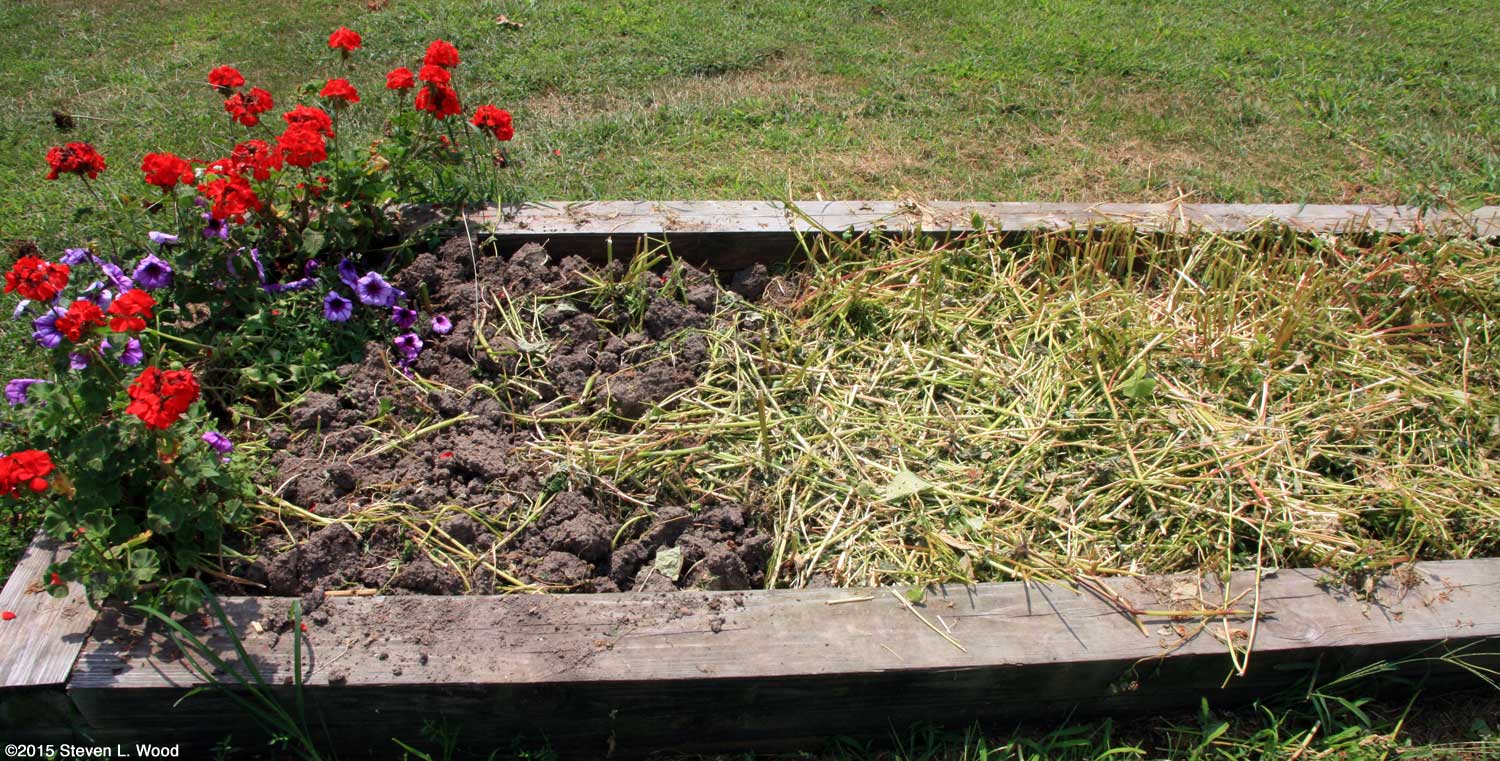
The soil in the narrow raised bed is fertile, but has burned up much of the organic matter that was originally in it. Once the buckwheat is turned under and has had a couple of weeks to begin decomposing, I'll go back and till the bed, possibly adding a bale or two of peat moss, along with some ground limestone. This bed is slated to be planted to early peas with caged tomatoes on the ends of the row next spring. After all the fall soil preparation is done, the bed will be heavily mulched with grass clippings for winter. That will allow me next March to just pull back the mulch to plant our early peas. I was working a few minutes this morning on a "part 2" for our 2012 feature story on Succession Planting. I quickly realized that I lacked some of the shots I wanted to use in the feature story update. That was one of the reasons I got going with the camera this morning.
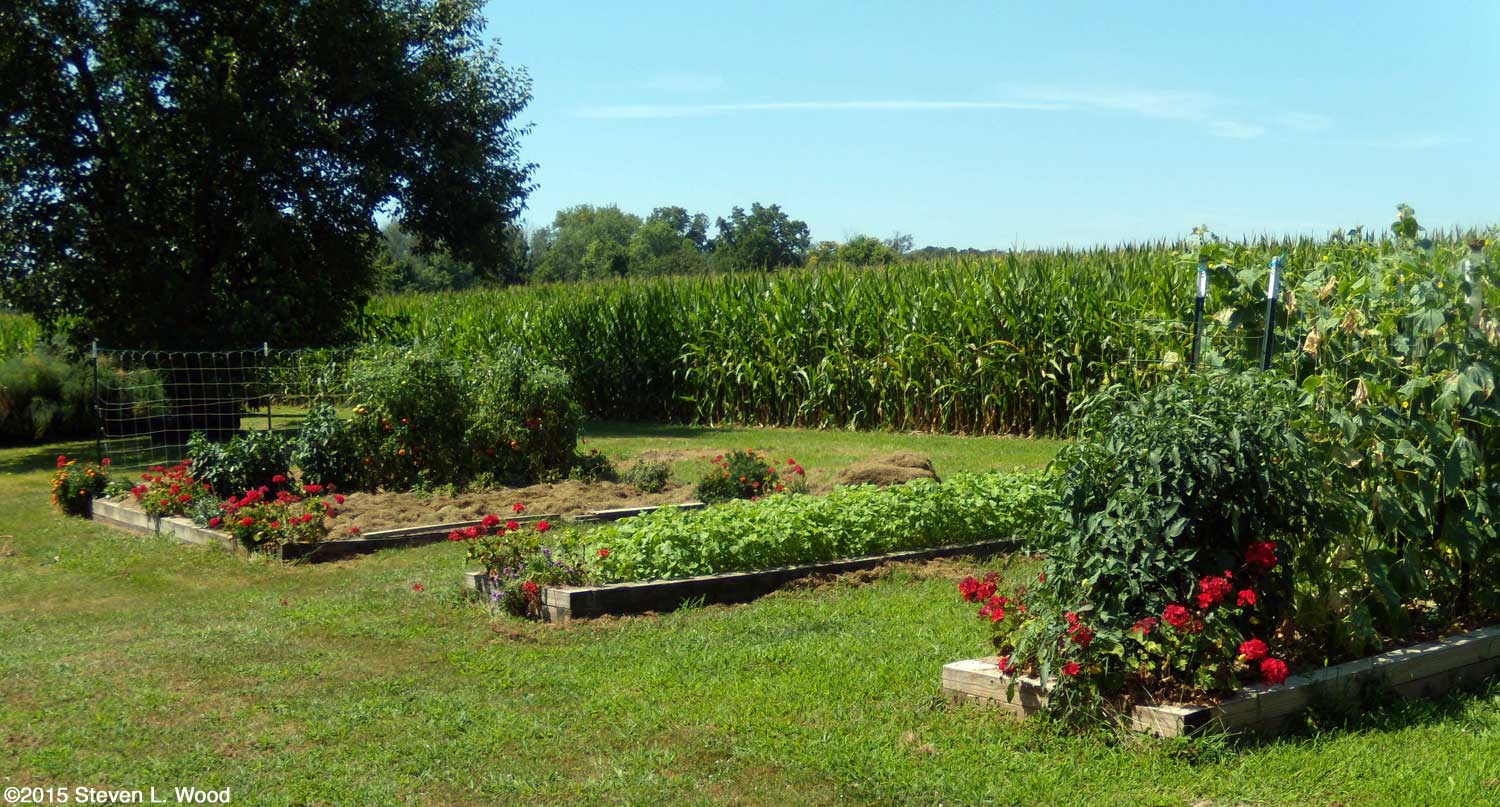
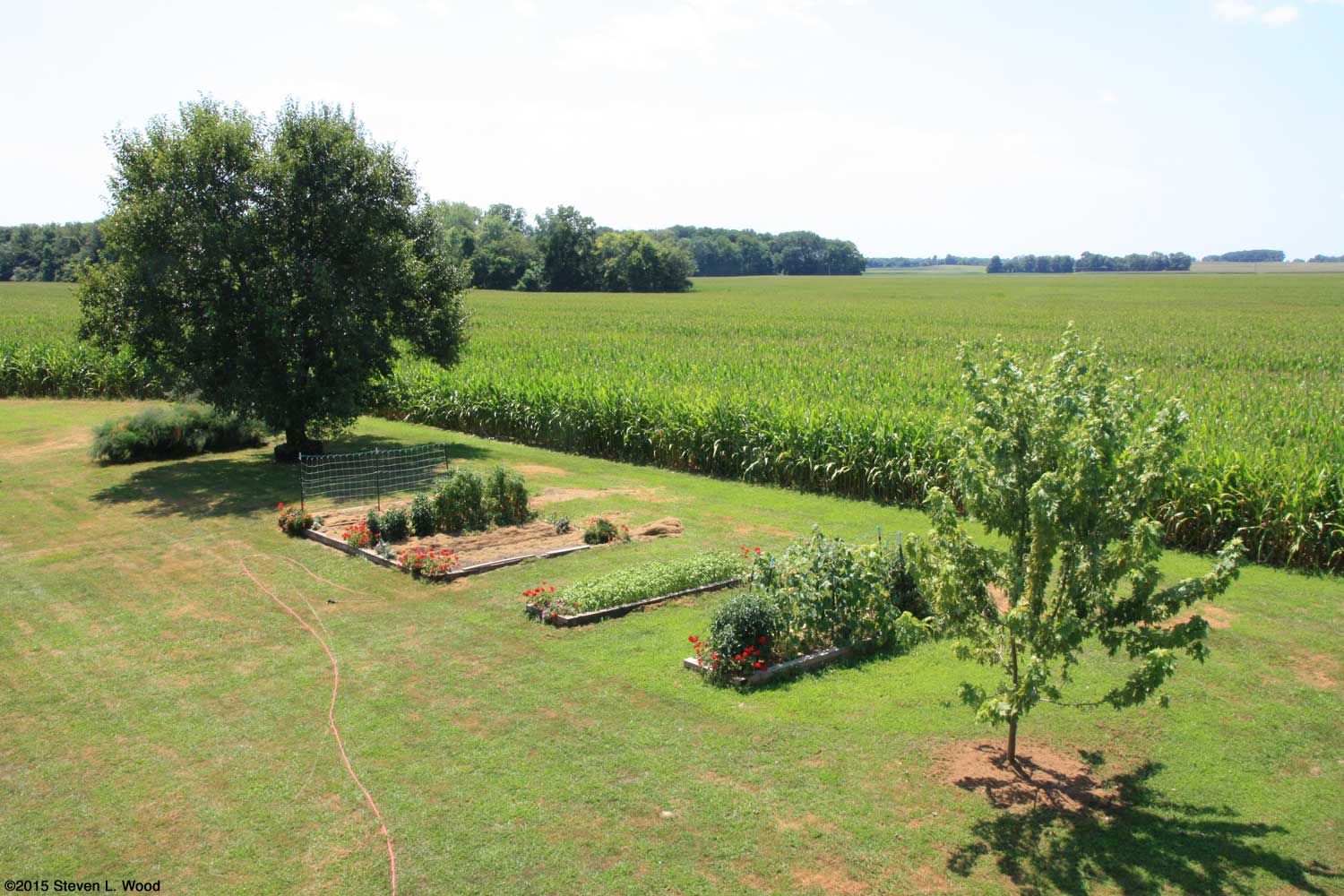
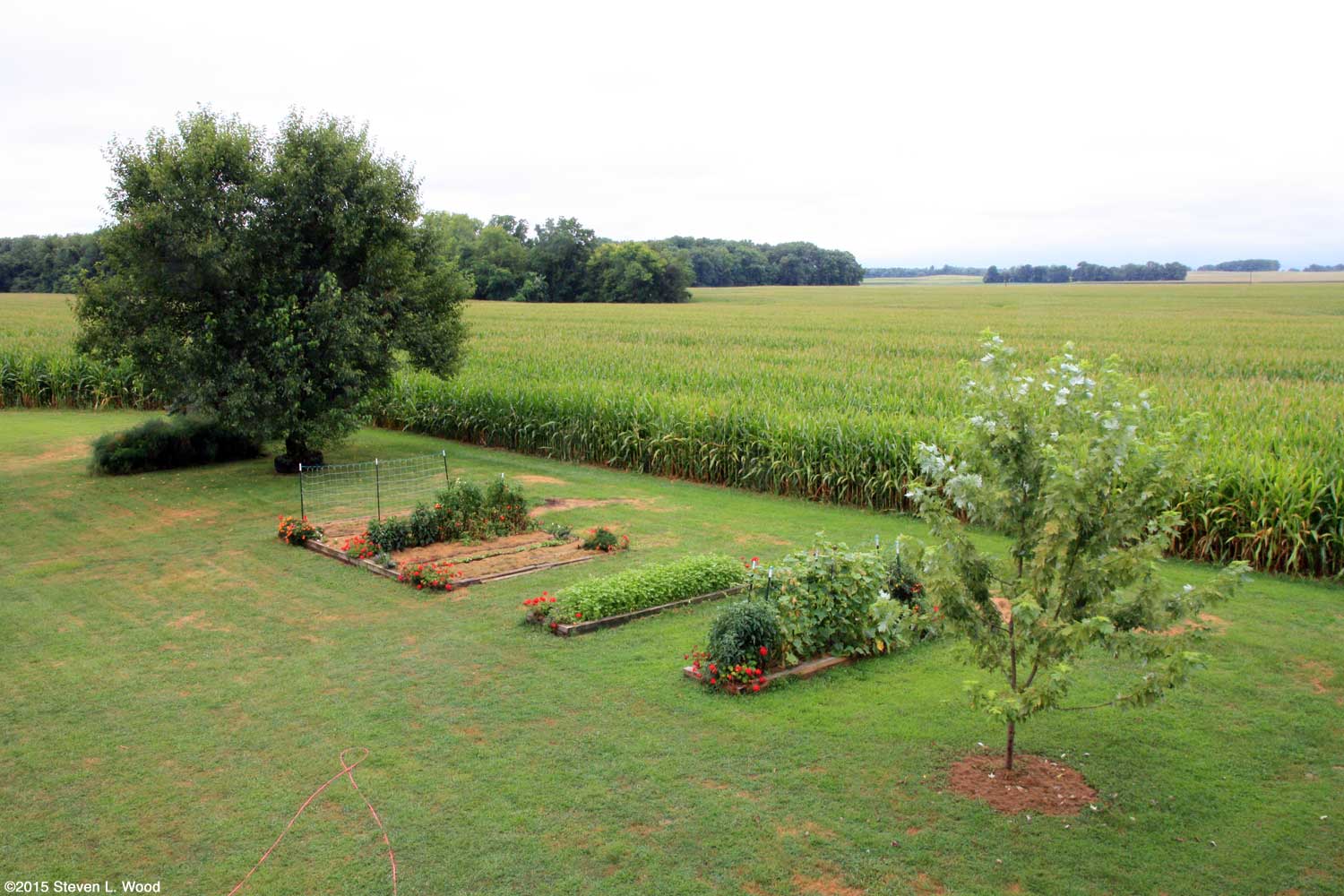
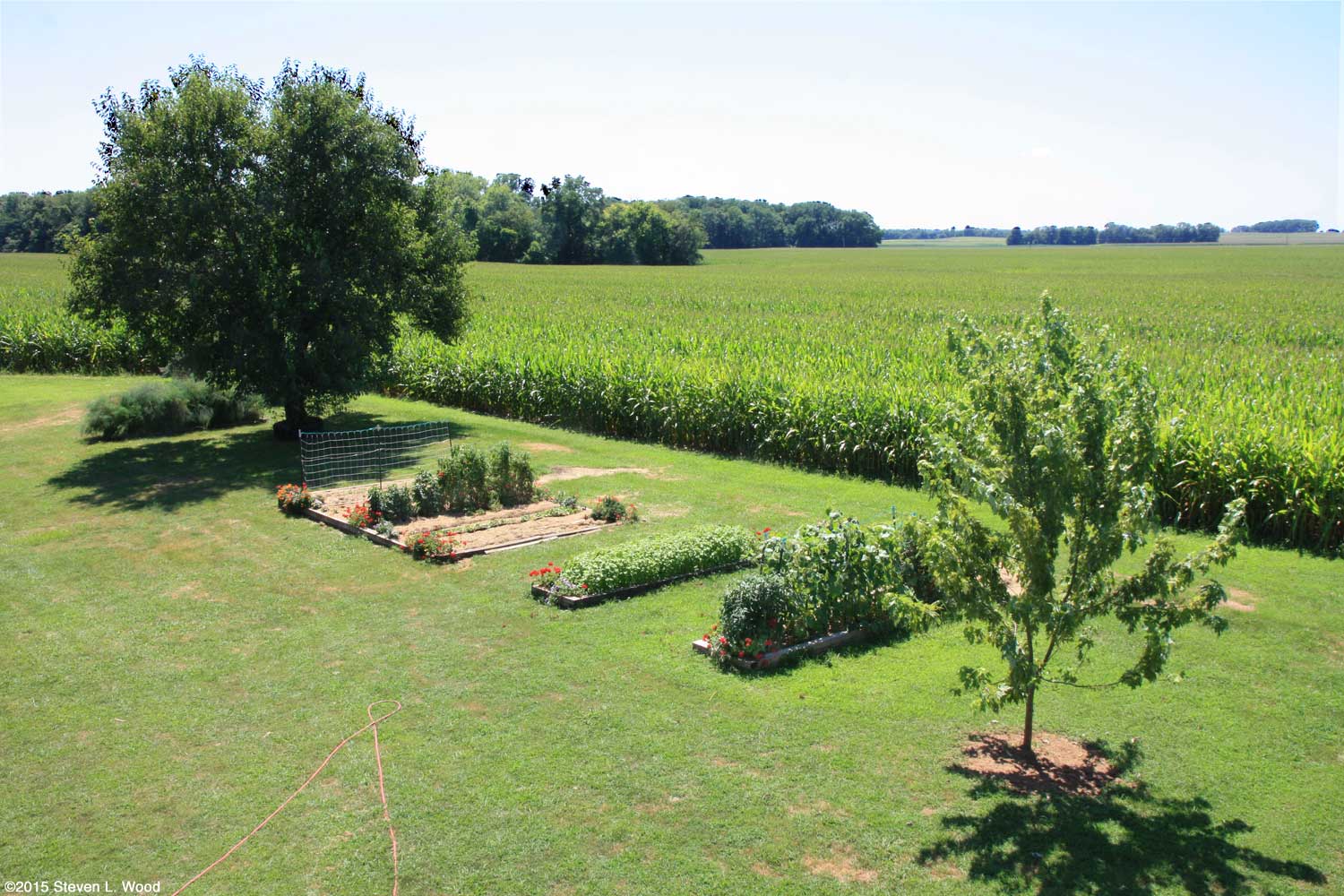
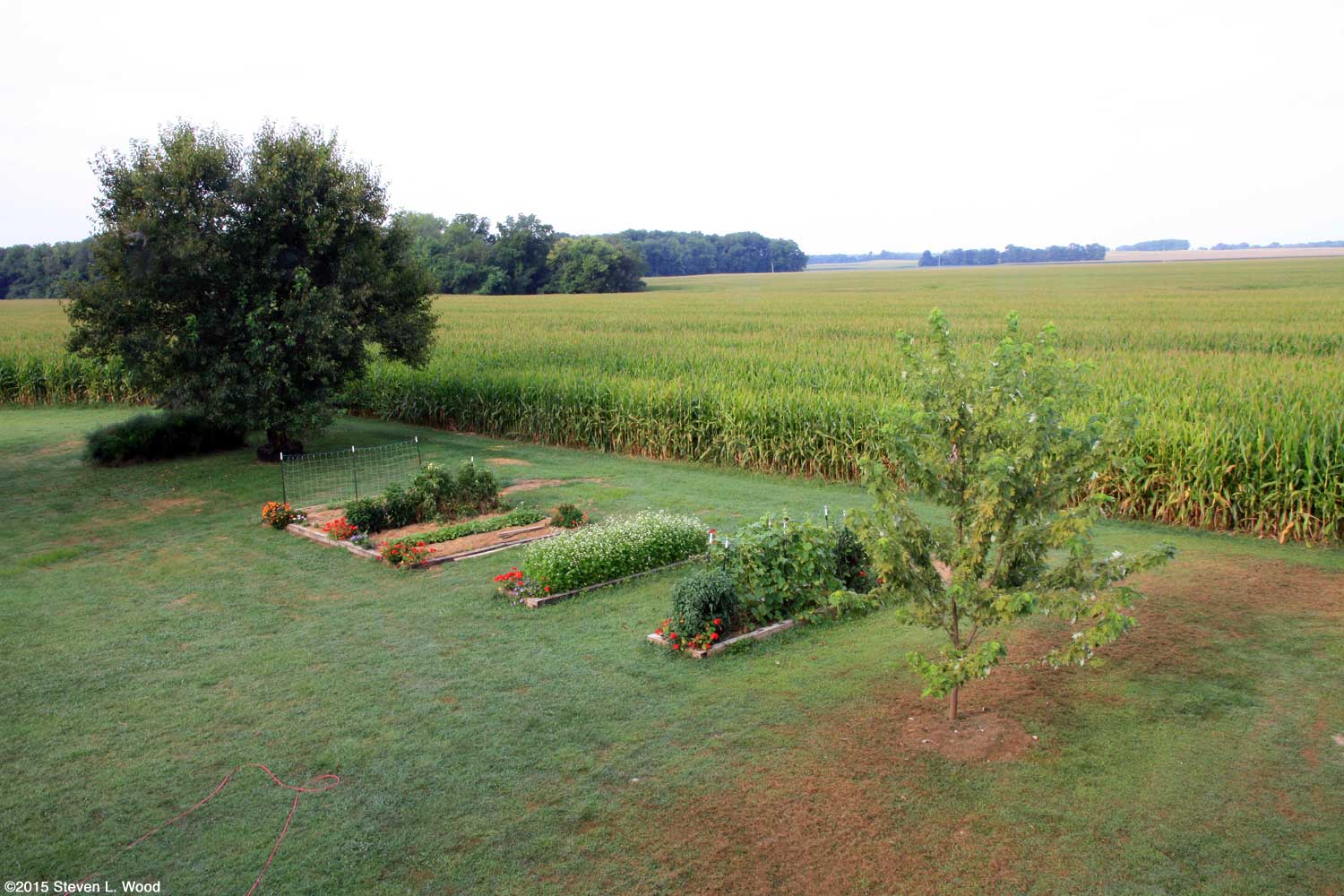
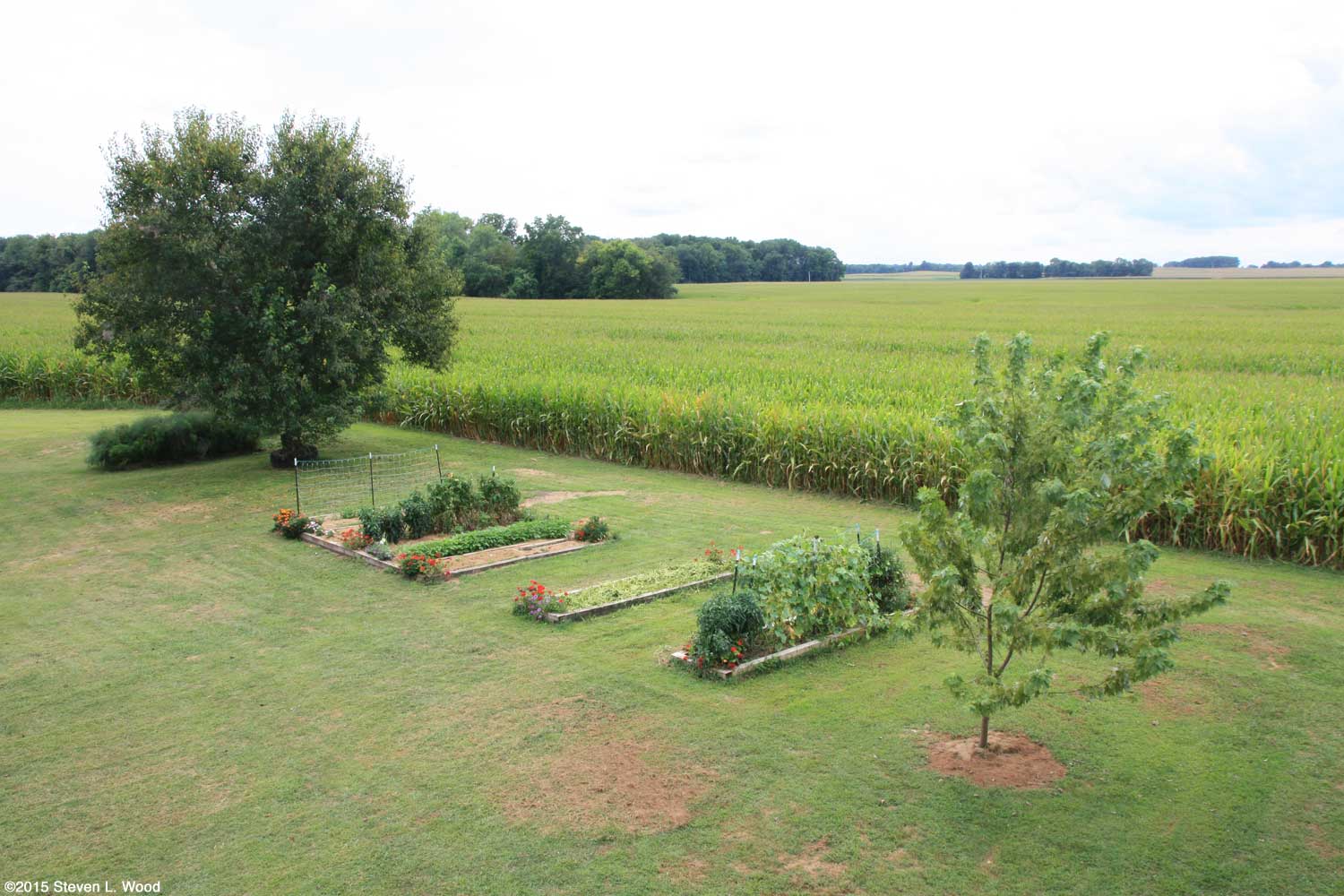
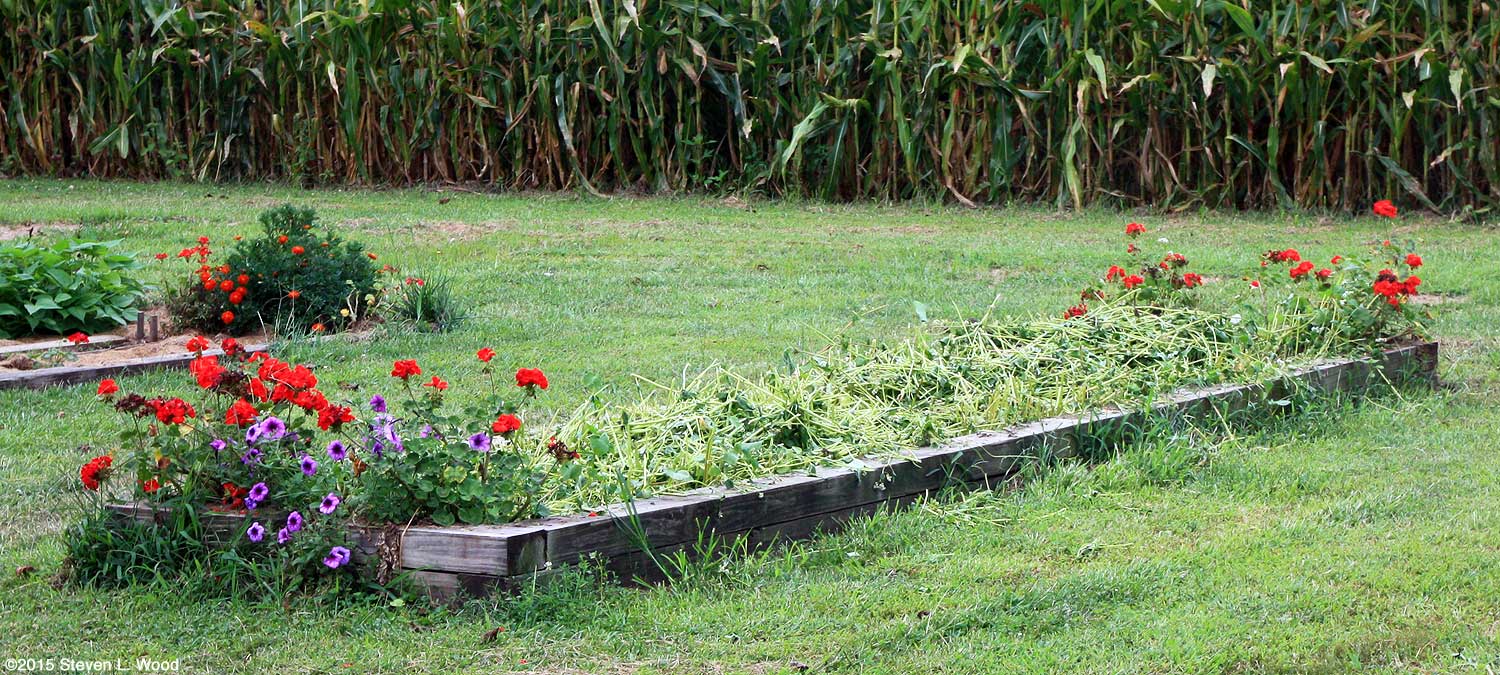
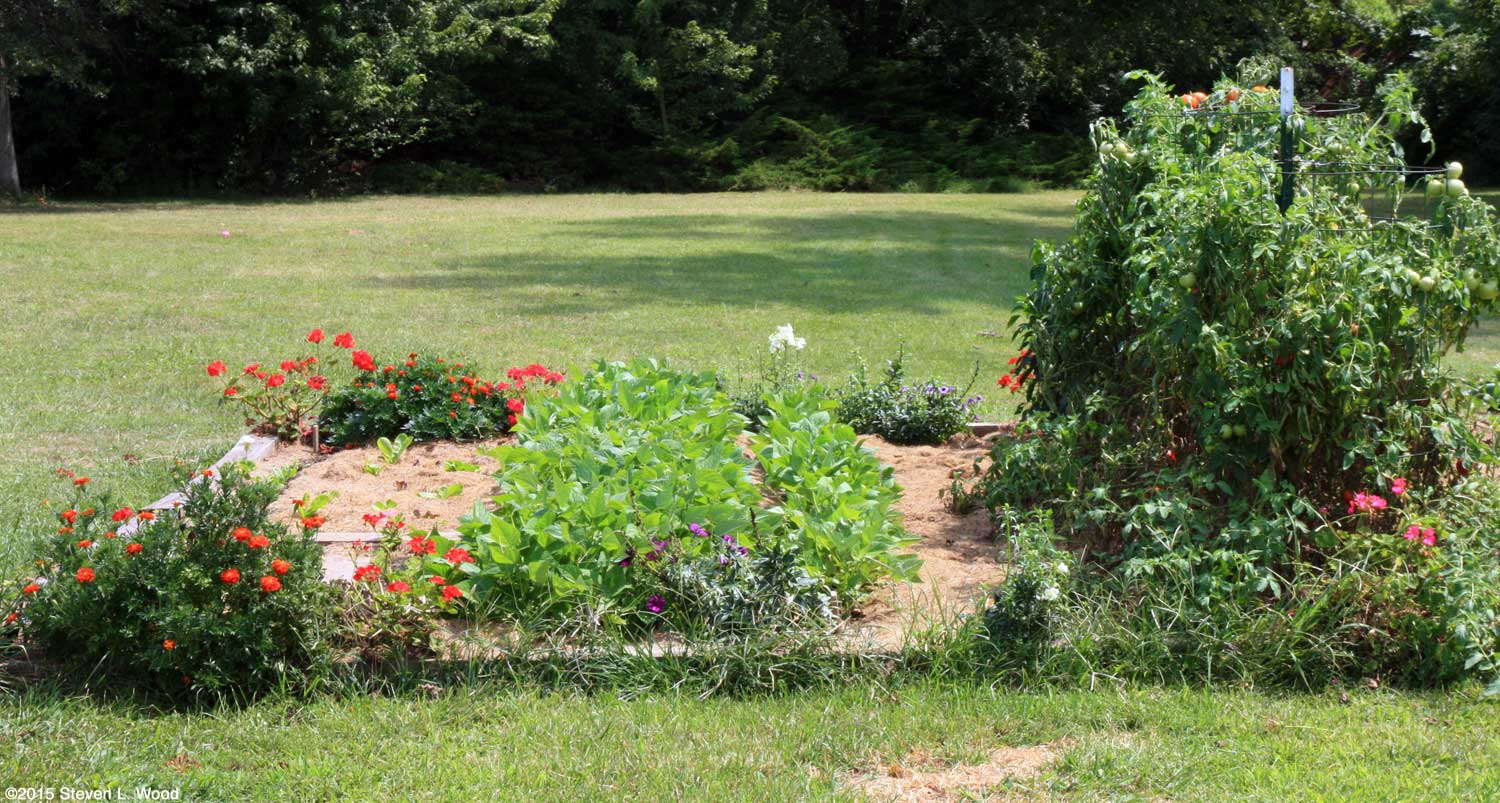
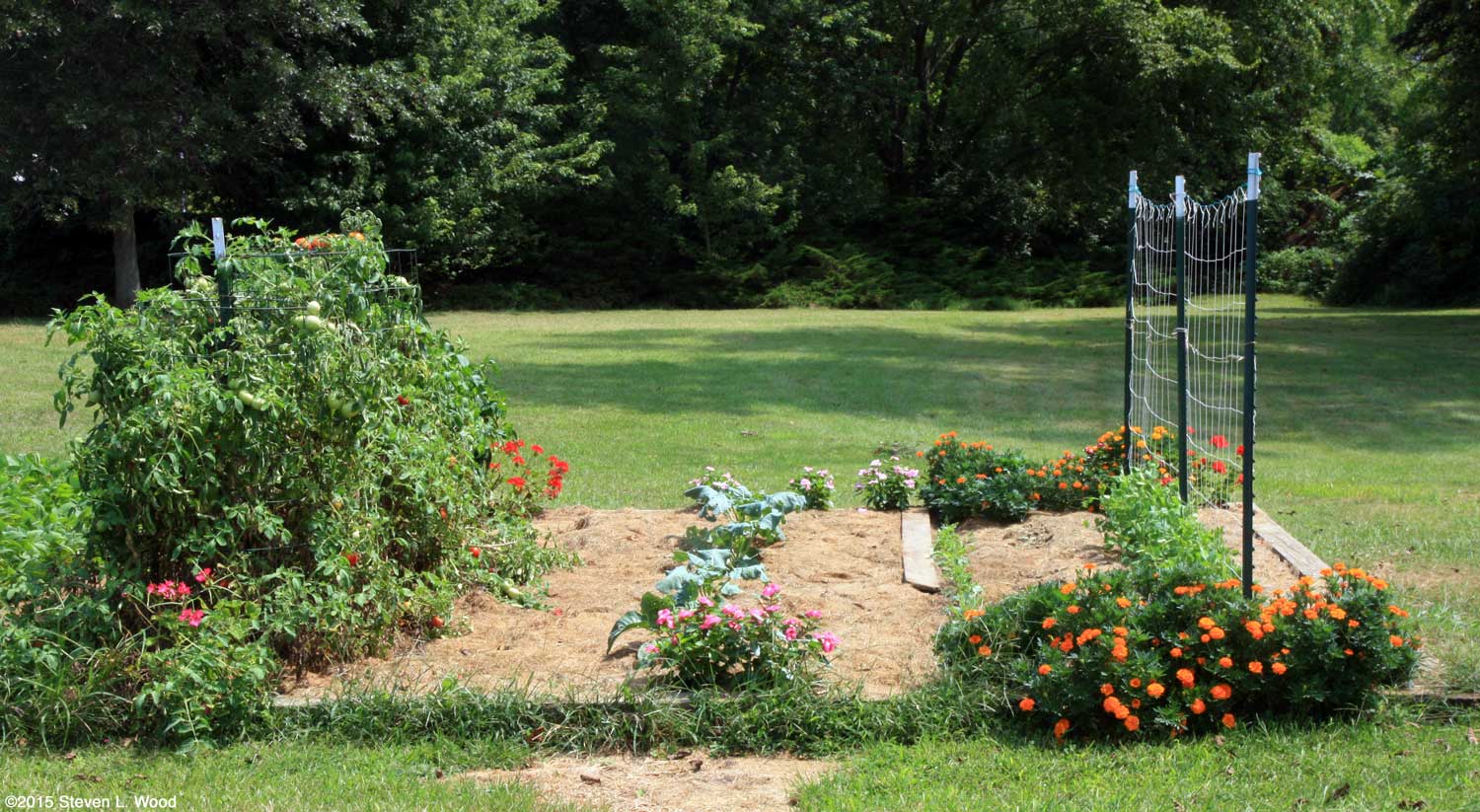
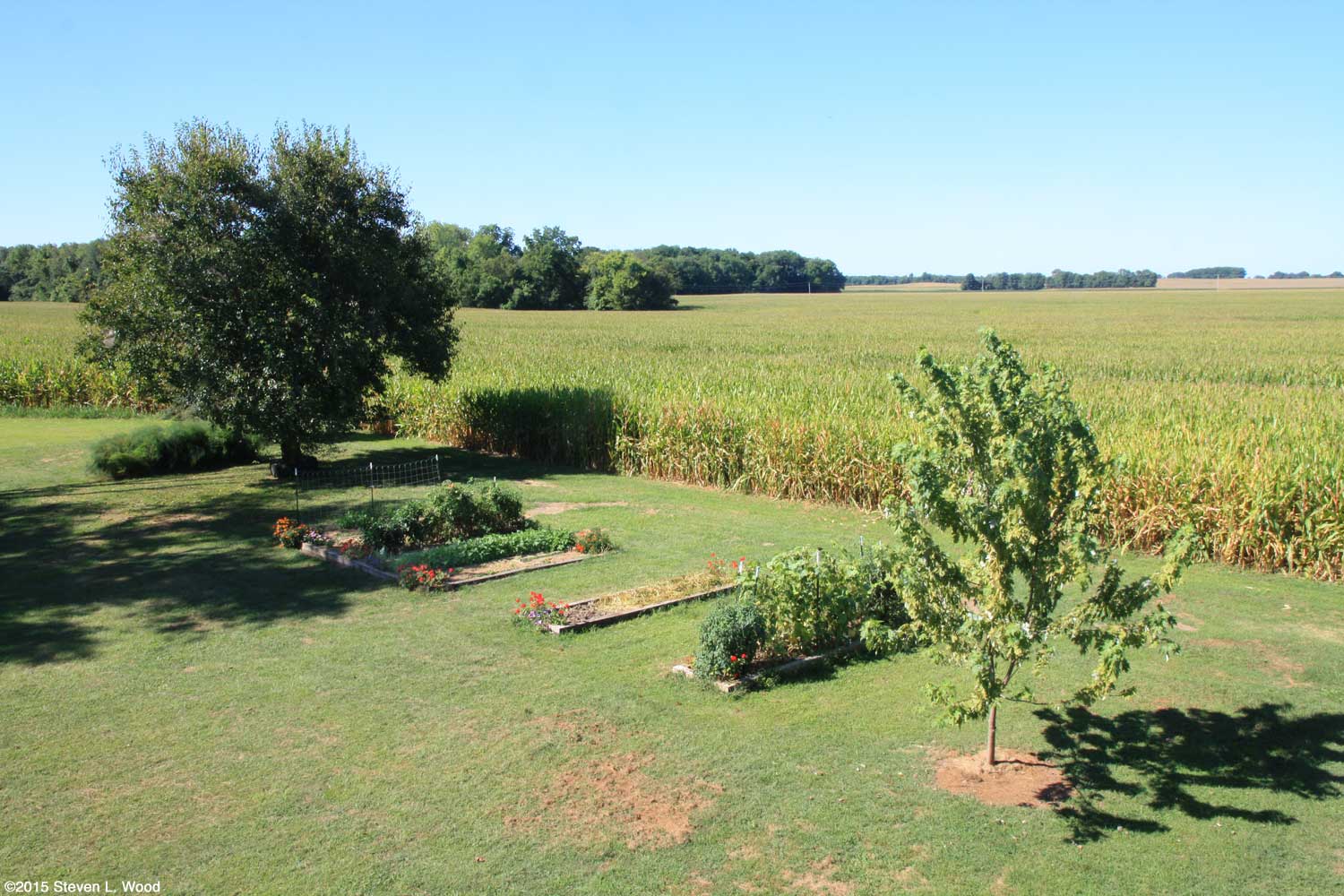
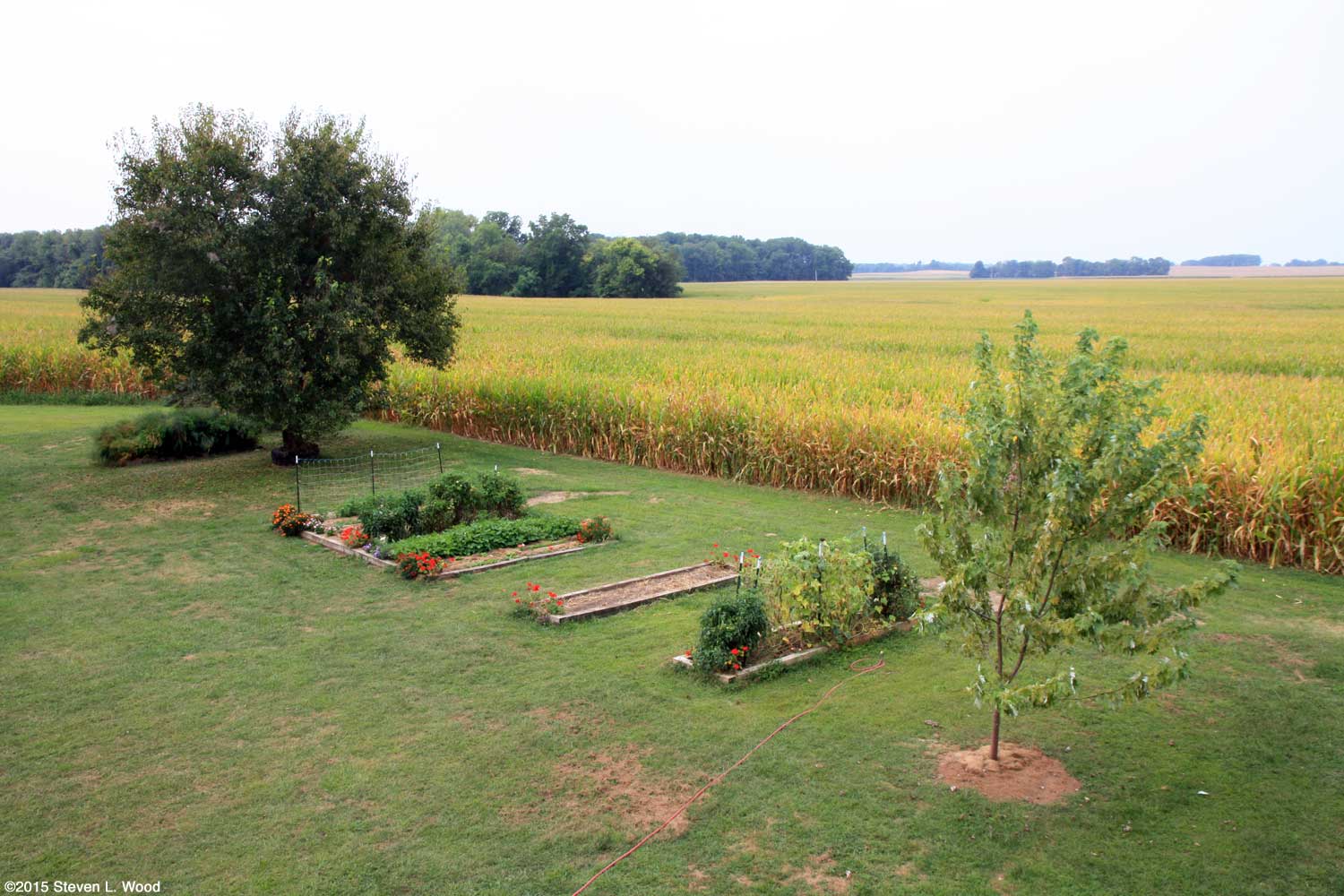
Taking a photo of our main raised bed from the side shown above at this time of year would require cutting some of the farmer's corn in the adjacent field (or an extremely wide angle lens, which I lack), something I suspect he'd not appreciate. So I just split the shot in two.
Fall green beans seem especially attractive to Japanese Beetles and Colorado Potato Bugs, along with a host of other bad bugs. When I sprayed our brassicas with BT and insecticidal soap this week, I also doused our bean plants, as they were showing just a bit of bug damage. While that spray was with totally organic materials, I'll go back and spray the beans with something a good bit stronger and certainly not organic just before they begin blooming. I don't even try growing late green beans when the field adjacent to our main garden is planted to soybeans. Bugs from the soybeans just migrate to our green beans, often seriously damaging the crop. With field corn next door to our main garden this year, we can probably get a good crop of beans with minimal spraying.
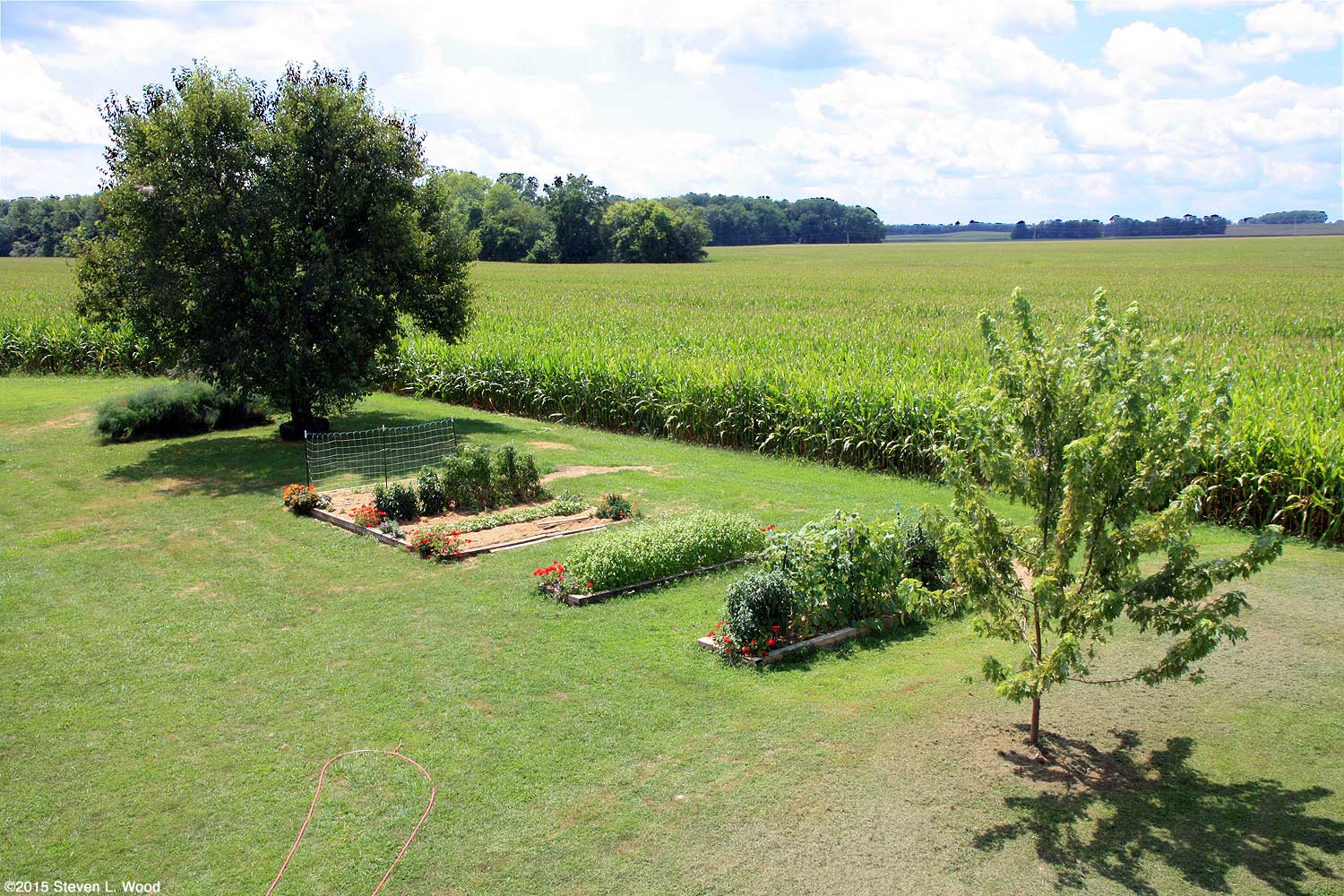
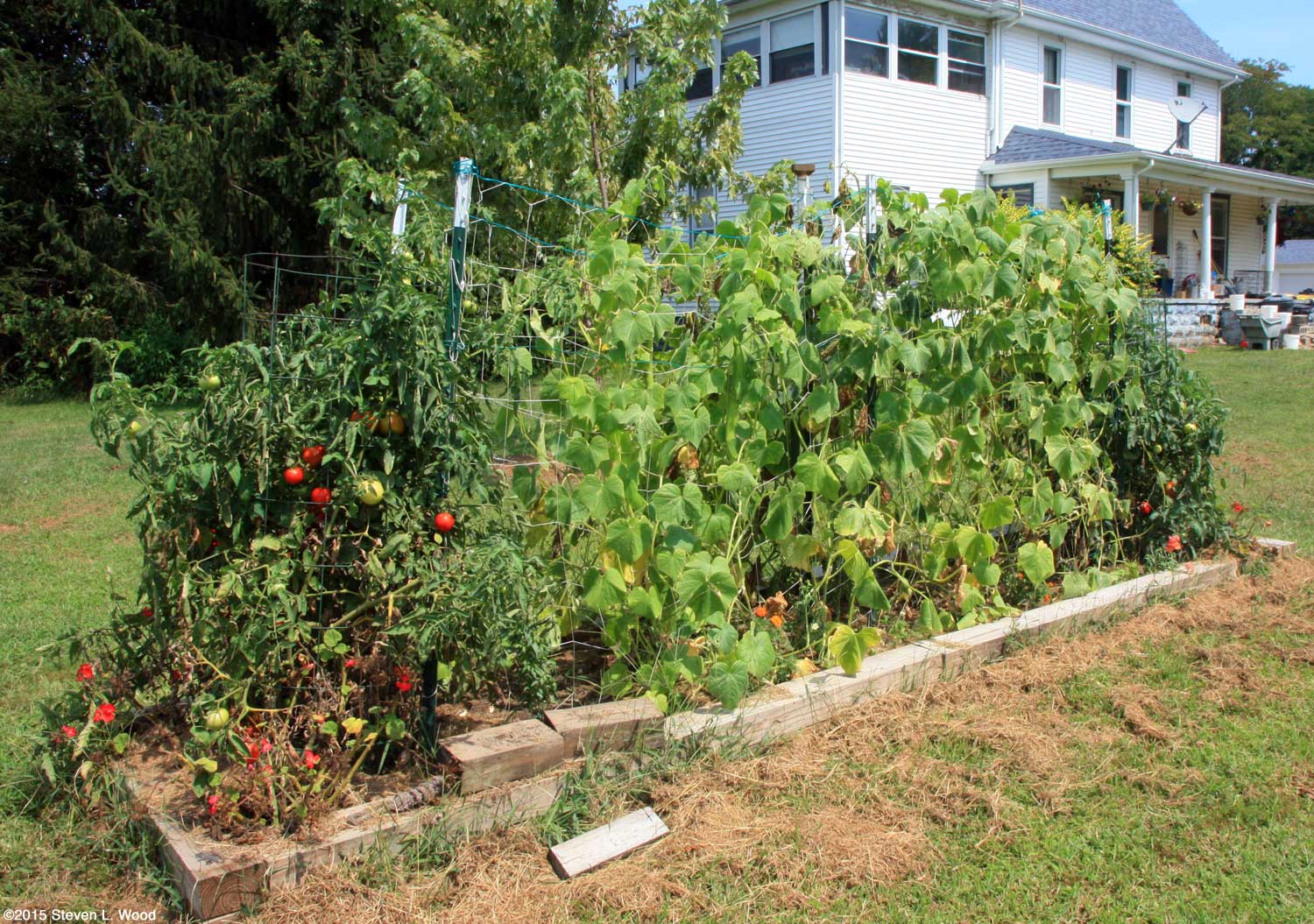
Note that in the the top of the image at right is our sunroom. The middle window is the one I use to grab our almost daily splash shot of our garden that tops this page. The sunroom is cluttered with used computer equipment, a legacy from my days as a school teacher employing technology to improve education. I do keep a path to the sunroom window cleared, however.
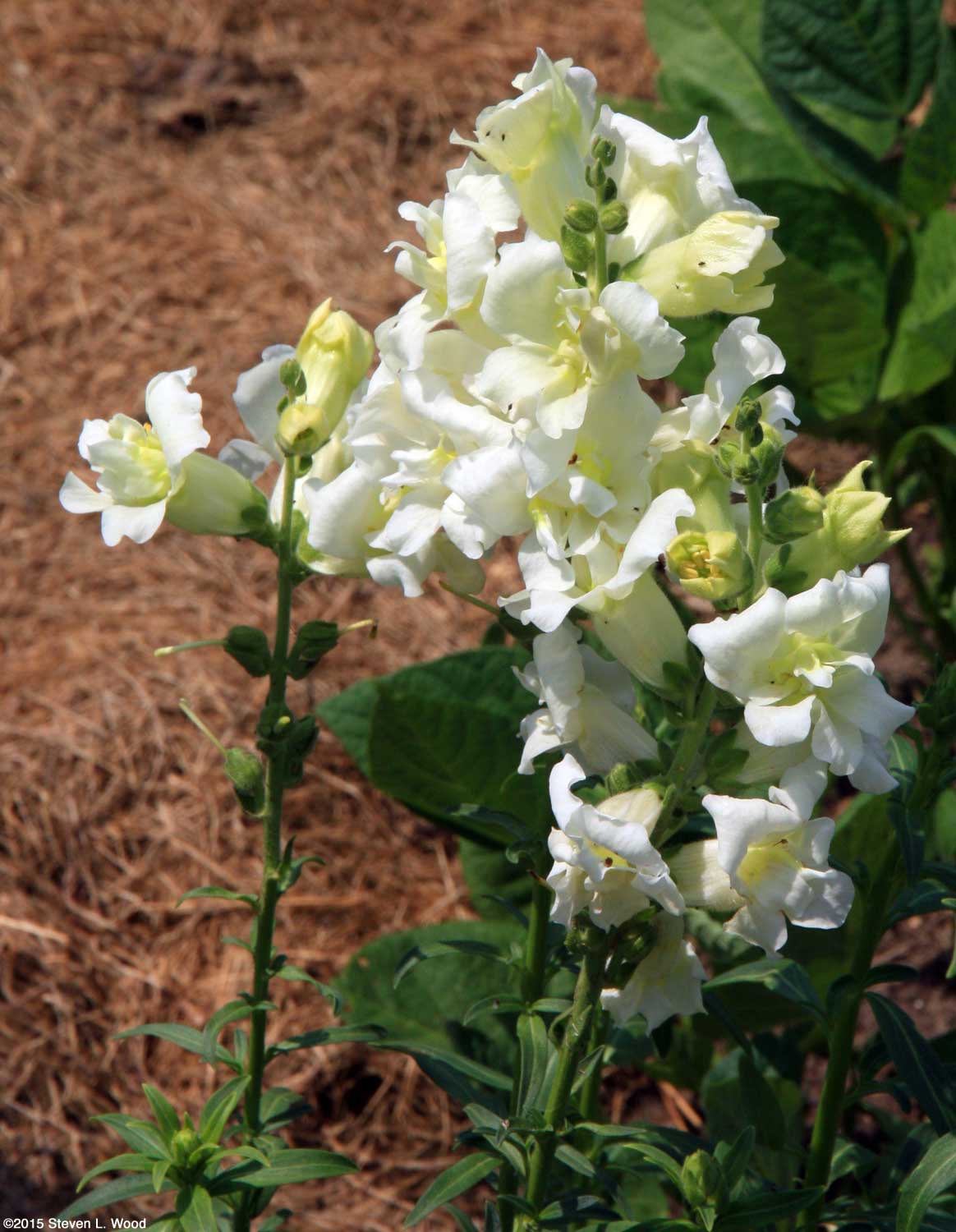
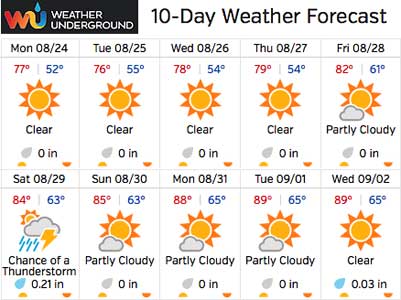
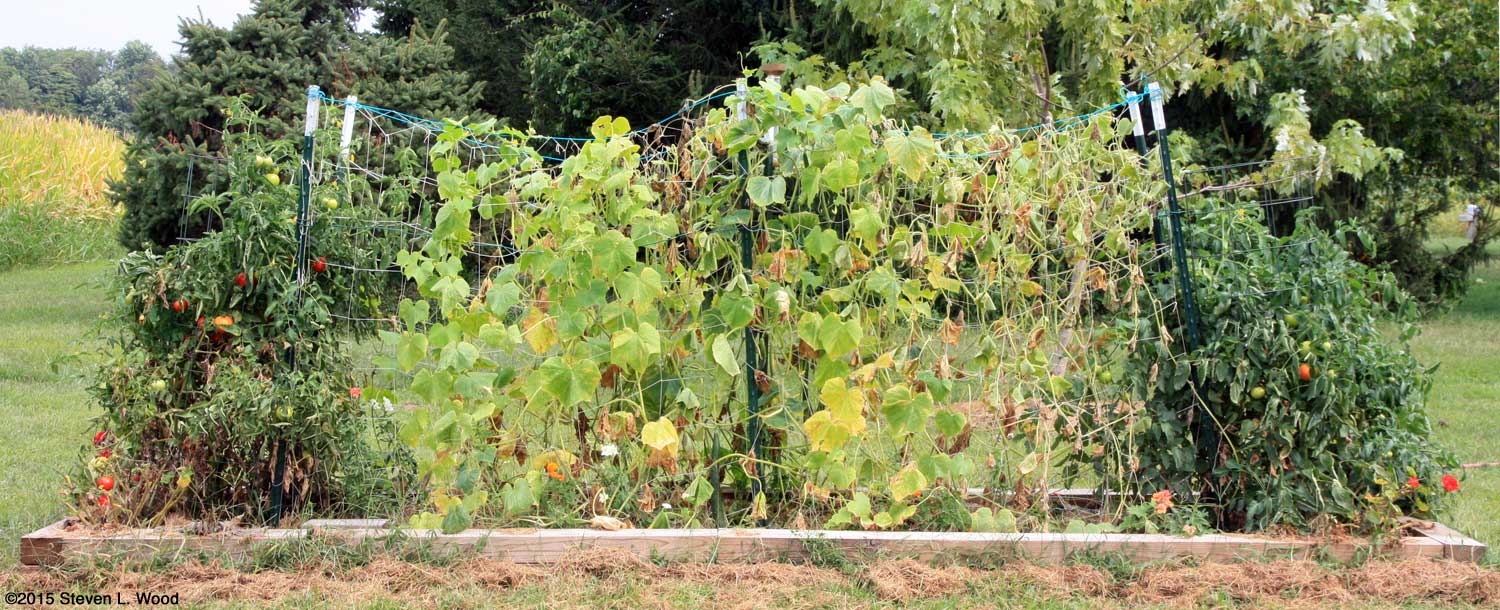
If I have enough years left, I may someday just put up a trellis to support them and plant a whole row of snapdragons without any other crop. They often produce some of the most spectacular displays of blooms we see in our garden plots. There are a few surviving snapdragon plants currently growing under our planting of Japanese Long Pickling cucumbers. They may yet surprise us with a display of beautiful fall blooms. Winding Up We're still enjoying a few days of cooler weather than what one would expect in central Indiana in mid-August. We'll top out today at around 82-83° F, cool enough to keep the windows open and our air conditioner turned off. Such weather is great for our fall planted crops, although a little rain would be nice.
Monday, August 24, 2015 - Cool and Dry
While messing around with our East Garden plan for next year, I wondered if I might yet till that area and grow a quick cover/smother crop of buckwheat on it. At this point, fourteen weeks after a total hip replacement, I'm not sure I'm physically able to drop the mower deck out and mount our pull-type tiller on our lawn tractor. But if I can, tilling our East Garden plot a few times, with a few days in between tillings for weeds and weed seed to dry up and die, could offer us a fairly weed free planting area next spring. It would also allow me to apply lime where needed and sulfur to our planned area for potatoes next season. Home Flock Layer Alert
H. Lee Schwanz's The Backyard Chicken Book: A Beginner's Guide Hummingbird Nectar We still have lots of hummingbirds visiting our feeders, and that may only intensify very soon. The tiny birds begin to "tank up" just before they begin their fall migration south. In our area, the birds begin to thin out at the feeders in late August and/or early September. After that, we see hummingbirds that are probably transients from the north on their way south, stopping off for a bite to eat (or drink, really). I read somewhere that this is a good time to make our homemade nectar for the birds just a bit more concentrated to fortify them for their long trip. We usually mix water with granulated sugar in a 4:1 ratio for the nectar. I began this week adding just a bit more sugar to make the mix about an 8:3 ratio. The birds still seem to like the stronger nectar, but it's not so sweet as to draw lots of wasps or yellow jackets to the feeders.
Wednesday, August 26, 2015 - Hummingbirds Depart I wrote here on Monday about making our hummingbird nectar slightly more concentrated to provide a bit more energy for the birds just before their southern migration. I may have been a bit late with the adjustment, as traffic at our feeders has dropped in the last two days to less than half of what it previously was. I'm guessing that "our birds" are now somewhere in southern Indiana or Illinois on their long journey south. We still have some hummingbirds at our feeders. The big difference is that I only have to fill the feeders once a day now, instead of three times a day. Really Bad Freezer Bags The folks at C. Johnson & Son, Inc. redesigned their pint Ziplock freezer bags with what they call "Easy Open Tabs." It appears what they've really done is add a pretty useless feature while making the bags much thinner and less able to protect the food inside them. I dropped a package of bacon on a pint bag of peas in our big freezer last night and the bag split open. I knew the bags were thinner to the touch, but I hadn't counted on them also becoming brittle in the freezer. If you're going to be freezing produce in pint bags, I'd suggest avoiding the Ziplock brand (with the new "Easy Open Tabs"). I set aside the new type bags for junk use and rummaged through the shelf of our grocery for a couple of boxes of the heavier, old style bags. When they're gone, I'll need to find a new brand of pint freezer bags to use. Friday, August 28, 2015 - Still Very Dry Here With very little rain this month, our gardening has slowed to a crawl. I'm still picking a few tomatoes, peppers, and cucumbers every few days, but there's really not much going on in our garden plots right now.
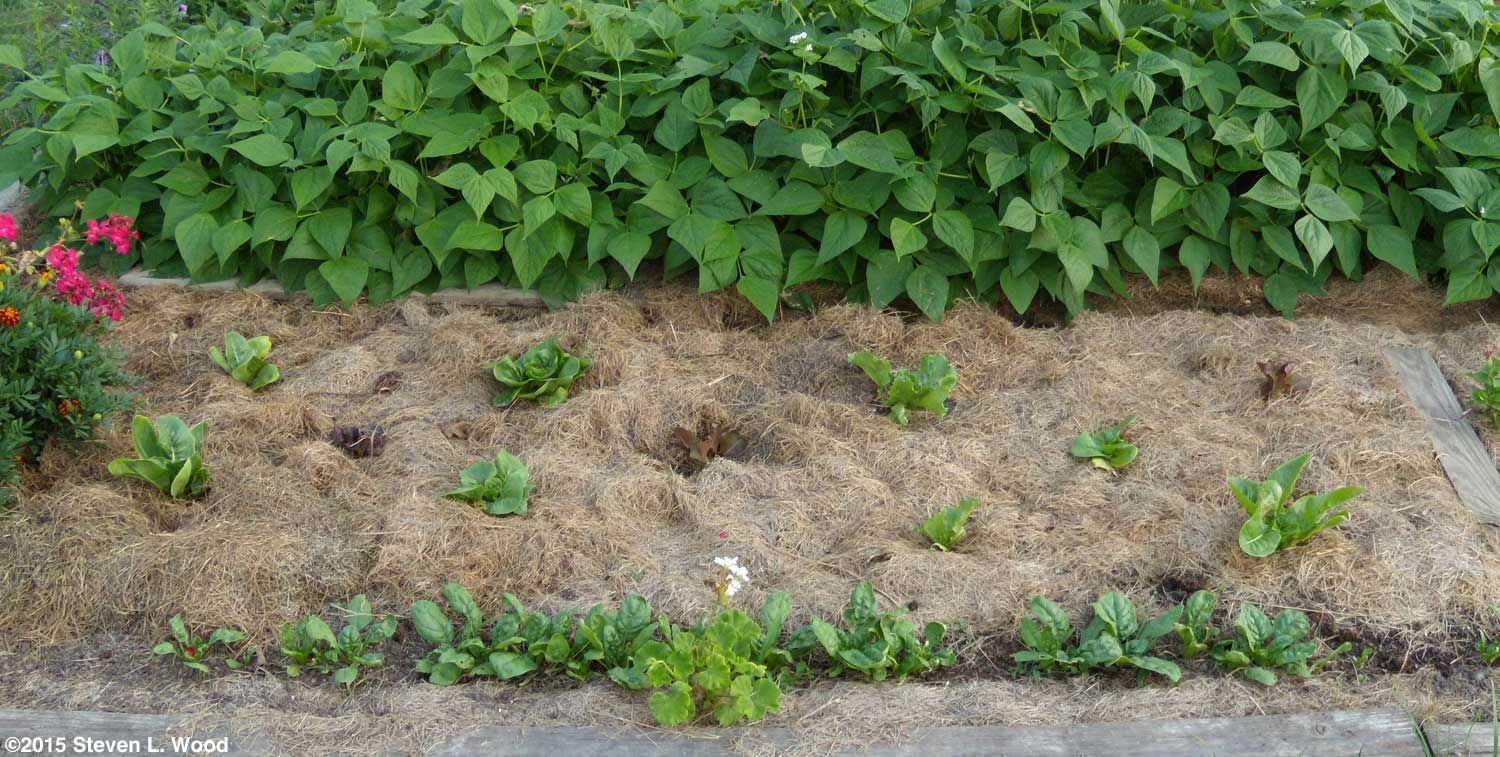
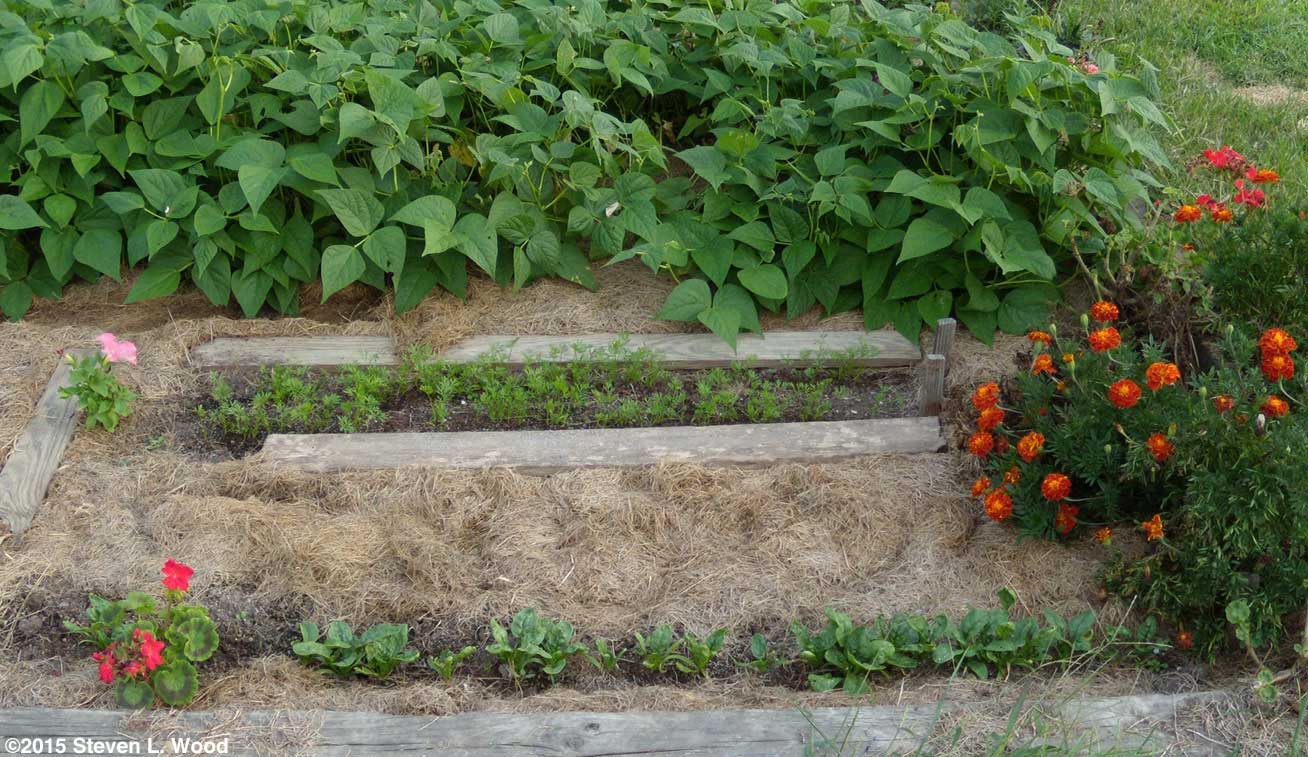
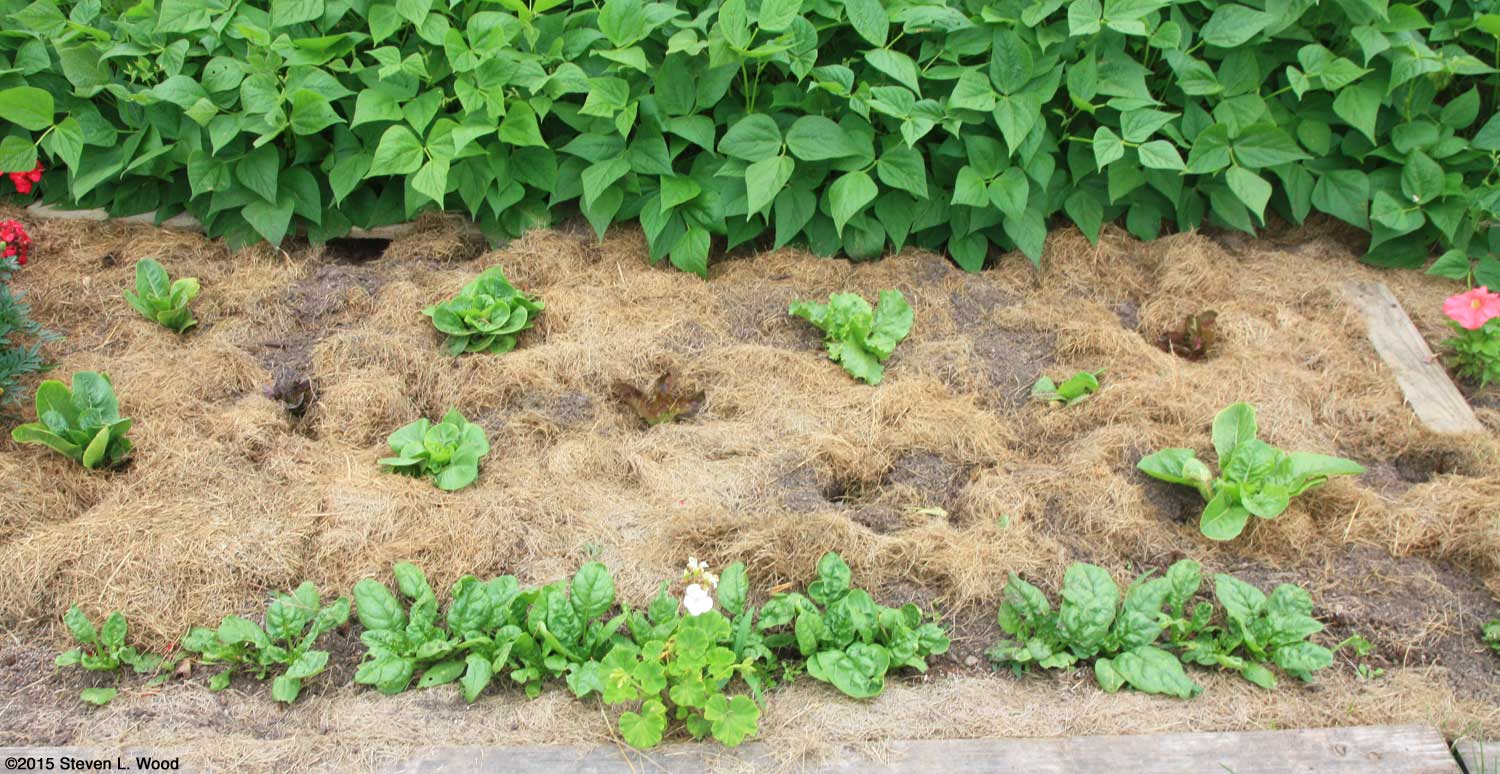
With fairly regular (every other or third day now) waterings, our spinach, lettuce, and carrots are doing well. The very healthy rows of green beans in the background of the images above aren't being watered, but are still doing pretty well. Buckwheat Turned Under
I plan to let the bed just sit for a week or so to allow the buckwheat to begin breaking down. Since the soil level in the bed has gone down two or three inches, I hope to add a couple of big bales of peat moss to it to raise the soil level while also further improving the tilth of the soil. When I till in the peat moss (and the remaining buckwheat trash), I'll also fertilize and lime the bed before covering it with grass clippings for the winter. A Quick Overnight in Effingham and a Dangerous Situation Annie had given me tickets to a concert at the Effingham Performance Center for my birthday. We made the trip to Effingham, Illinois, on Tuesday and saw a bunch of aging rock musicians, many of whom were struggling mightily to stay on pitch. While Annie pretty much enjoyed the concert (other than the terribly off key rendition of Cherish), I found it disappointing when compared to our previous trips there to see the Gin Blossoms, Foreigner, Air Supply, and REO Speedwagon. Beyond my mild disappointment with the performance, I was uneasy all through the concert. A heavy curtain hung at the left rear of the theater, blocking access to the left aisle and hiding fire exits presumably behind it. The acoustic curtain actually covered the aisle seat next to my wife. An email to Rick Jorn, the executive director of the EPC produced an arrogant denial of the issue. I'm hoping that the complaint I sent to the Illinois State Fire Marshal will produce better results. Until I receive assurance from the fire marshal or Mr. Jorn that the dangerous situation has been corrected, we'll have to forego any events at the EPC. That's too bad, as the 1500+ seat theater is a great venue for concerts. Update: After a second email from me that pointed out this posting and my complaint to the Illinois State Fire Marshal, Mr. Jorn apparently went into the theater to inspect the problem. He responded to the problem about the acoustic curtain, but avoided answering my question about a fire exit on the left center side of the theater.
After another round of emails, he wrote that no fire exit was designed into the middle of that side of the theater. He wasn't there when the original Rosebud Theater was built, so you've gotta give him a free pass on that one. He noted that the theater "has always passed inspection for both emergency egress and accessibility," but added that "one of my long term goal[s] is to add a new lobby to the back of [the] house providing better entrance and more exits." In my opinion, the EPC still has a fire safety issue at this point. They need to bust a hole in the wall and make a new fire exit midway on the left side of the theater. A further problem they may have is with an executive director who blows off the initial accurate safety complaint from a theater guest. Possibly the highlight of the trip was dinner Tuesday afternoon at the Firefly Grill. We'd forgotten to allow for the time difference between Indiana and Illinois and got in pretty early. I moved up our dinner reservations into the afternoon, which allowed us time after dinner to stroll some of the garden plots behind the Firefly and a short nap before the concert.
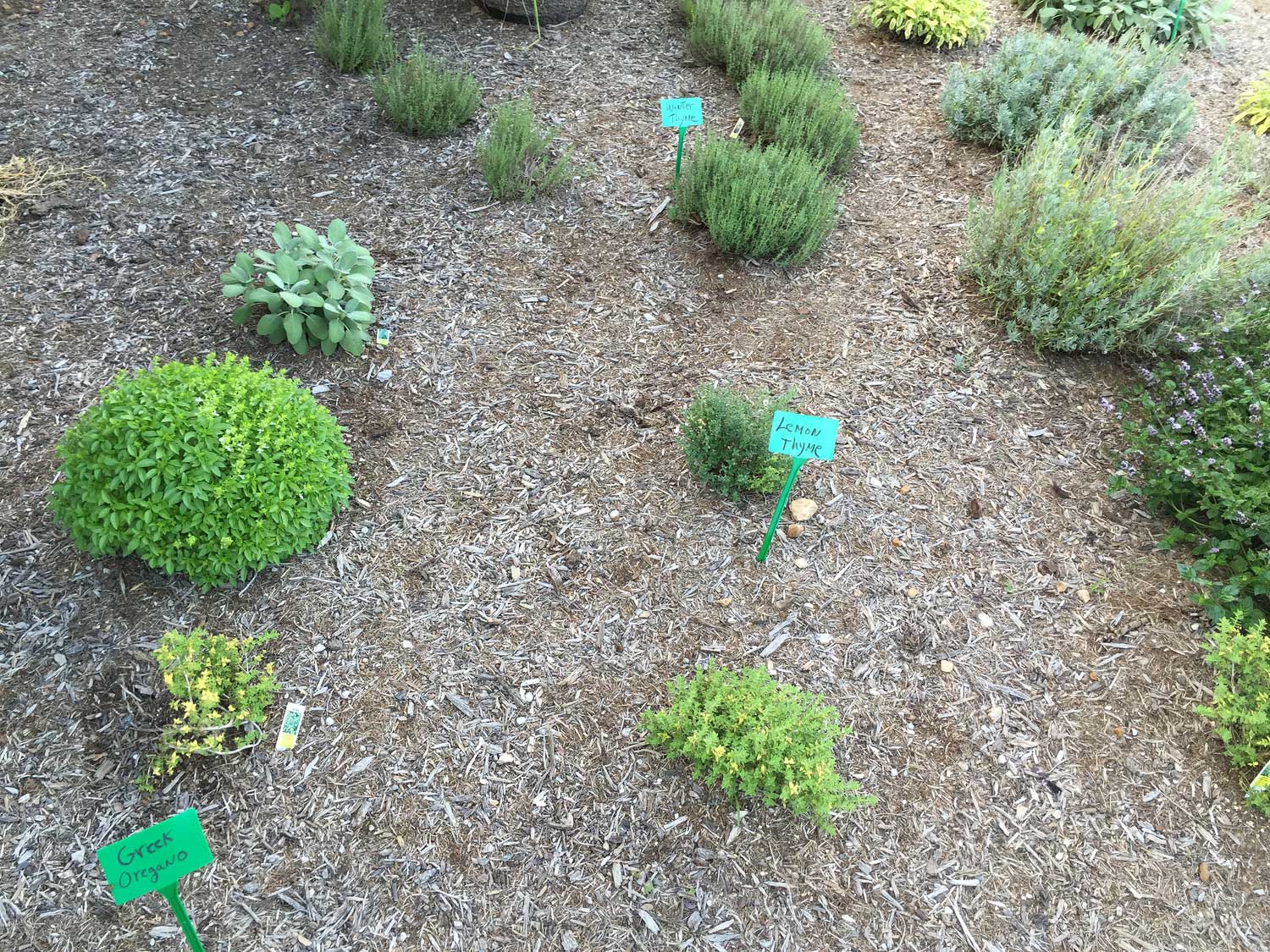
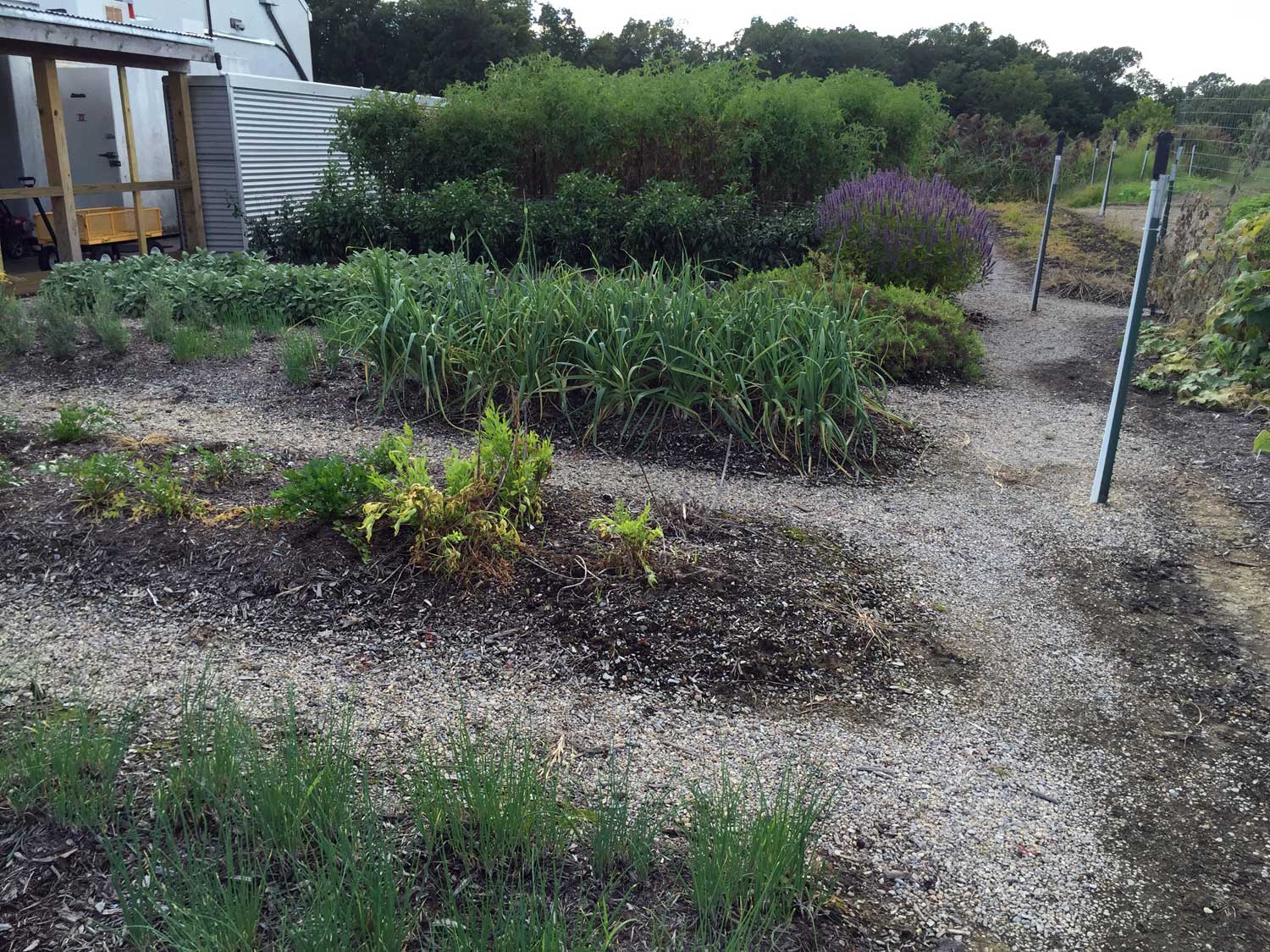
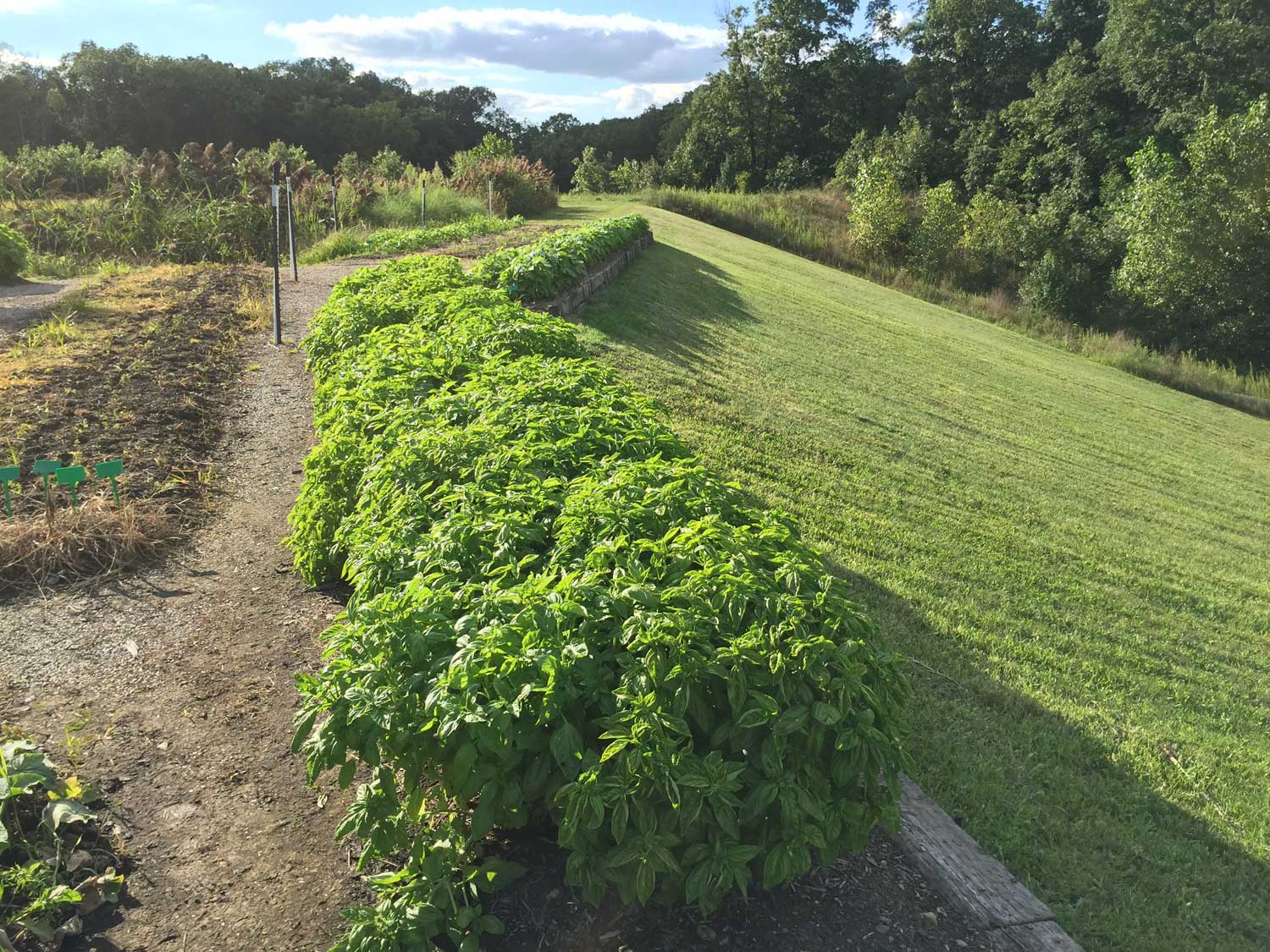
The Firefly prides itself in using lots of local produce and beef, along with growing some of their own vegetables and herbs. While we were walking their garden plots, I saw someone rush out of the kitchen and pick what I think was some dill. Do note that the Firefly provides "fine dining" and is priced accordingly. But the constantly changing menu of deliciously prepared foods by owner and chef Niall Campbell (well, co-owner along with his lovely wife, Kristie), are perfect for a special outing.
Note: The Firefly Grill is not a Senior Gardening Affiliated Advertiser. Really Early Morning Edition of Senior Gardening For the first time since my hip surgery in mid-May, I awoke Annie this morning with a cry of pain caused by my hip. Before the surgery, that was a nightly occurrence. Driving to and from Effingham and then tilling under our narrow bed of buckwheat had me up this morning at 4 A.M.! After downing a couple of pain killers, I decided sleep would be impossible until the bombers kicked in, so I started writing this posting. The images of the Firefly Grill's garden plots were taken with my iPhone 6 in seriously fading light. I had to massage a few of the shots in Photoshop, mainly lightening them for use here. The improvement in the camera in my current iPhone over the iPhone 3G that I used for so long is impressive. I would, however, like to get back to the Firefly's garden plots in the height of the growing season sometime with my Canon XSi. Saturday, August 29, 2015 - Late Cucumbers and Tomatoes
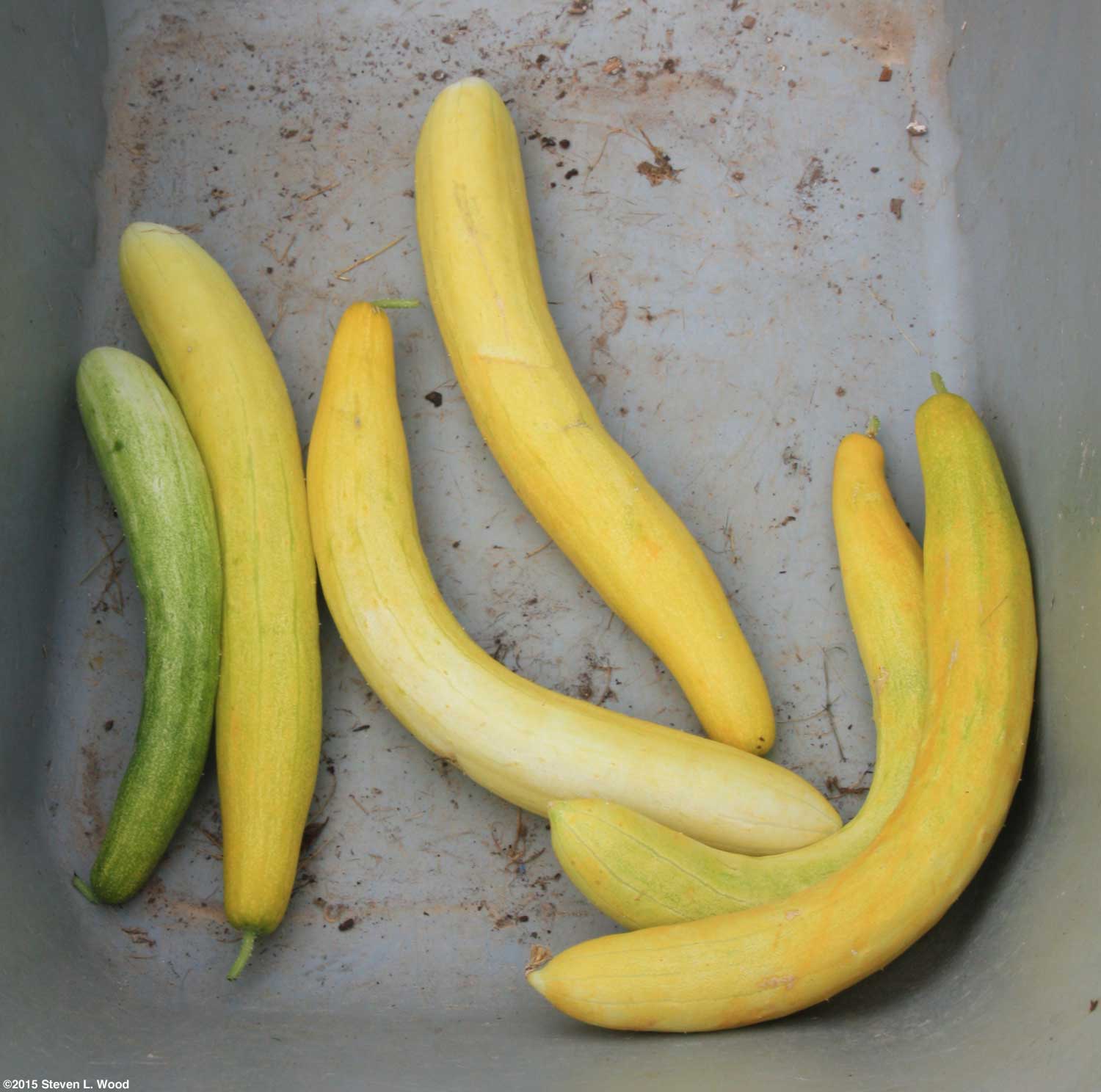
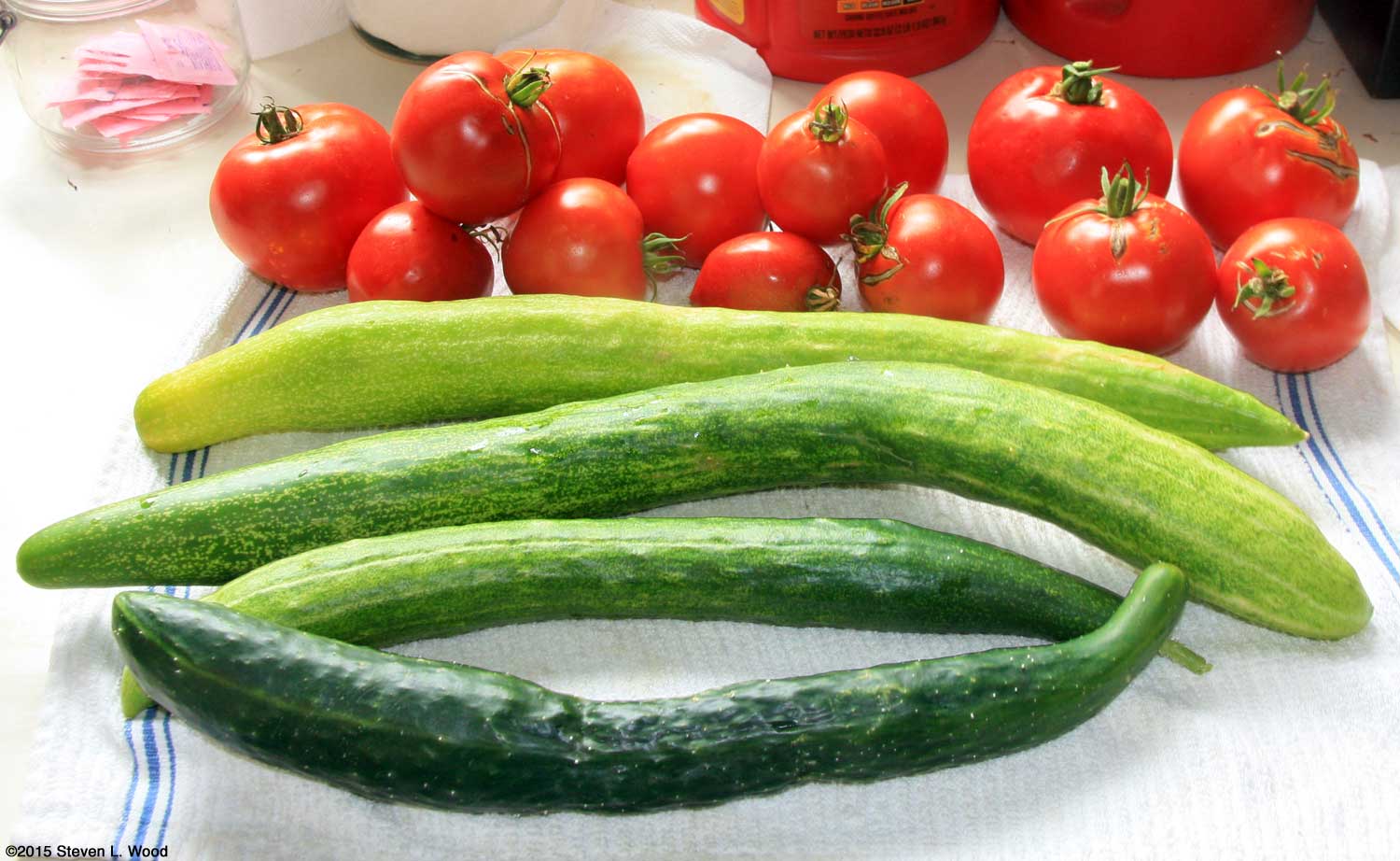
Our Japanese Long Pickling cucumber vines are wearing down. A month of heavy production, a brief insect infestation, and dry weather have left them just barely producing. I've been watering them, trying to coax the vines into ripening a few last cucumbers for a batch of bread and butter pickles. But last week I noticed new blooms and was able to hand pollinate a couple of female blooms on our strain of the JLPs from male blooms of the strain from Reimer Seeds we're crossing into ours to invigorate it. Our harvest this morning included four long JLP cucumbers and several tomatoes from both our Mountain Fresh plant and our four Earlirouge plants. The cucumbers vary in appearance, as there are whitish cukes from our old strain, very green ones from the Reimer strain, and some in between that are from our plants that were crossed with the Reimer strain over the last few years. The tomatoes we're picking are ones you could never sell at a farmers market. That's not a problem for us, since we don't sell any produce. We just cut out the cracks and bad spots on the late fruit for fresh use, cooking, and still share some with friends. Without any children living with us now, we already have enough tomatoes canned whole and as tomato sauce/purée to last us through the winter. Funny, as I wrote the last sentence, granddaughter Katherine called upstairs asking if she could have a tomato. She used to love grape tomatoes, but has now moved on to consuming lots of fresh, full sized tomatoes. So this year I didn't plant any grape tomatoes, instead using our limited garden space for our Earlirouge open pollinated plants and a couple of hybrids at either end of our cucumber row. Trouble in Lettuce Land
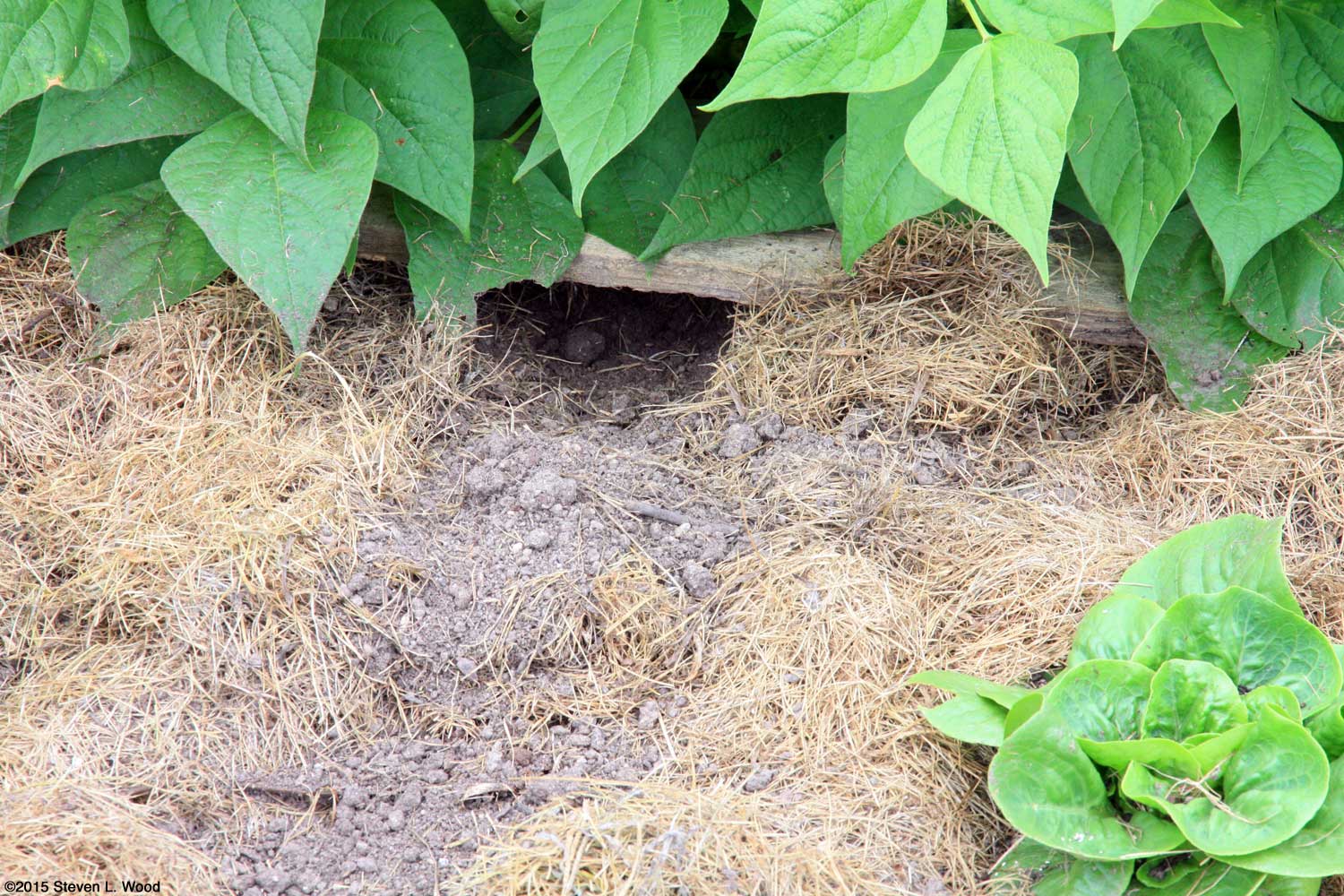
We have some kind of critter tearing up our lettuce patch and other areas in our main raised garden bed. It's not a rabbit, as they'd just eat the lettuce leaves. It could be a mole, although the characteristic paths moles leave aren't evident. Our dogs killed a woodchuck earlier this summer and left it by the back porch for us. We've never had woodchucks (groundhogs) in our garden plots before. Whatever is there is digging or causing our dogs to dig going after it. One lettuce plant got destroyed overnight and had to be replaced this morning. Fortunately, I still have some very healthy lettuce transplants left on the back porch (with more on the way under plant lights in the basement). But if we don't clear up the critter problem, all the transplants in the world won't produce much of a crop. Interestingly, if the dogs were going after a critter, the damage would be much more widespread. I'm pretty much at a loss as to what we're dealing with here. If you have any experience with this kind of thing, I'd appreciate any advice you might share. Pets on the Porch
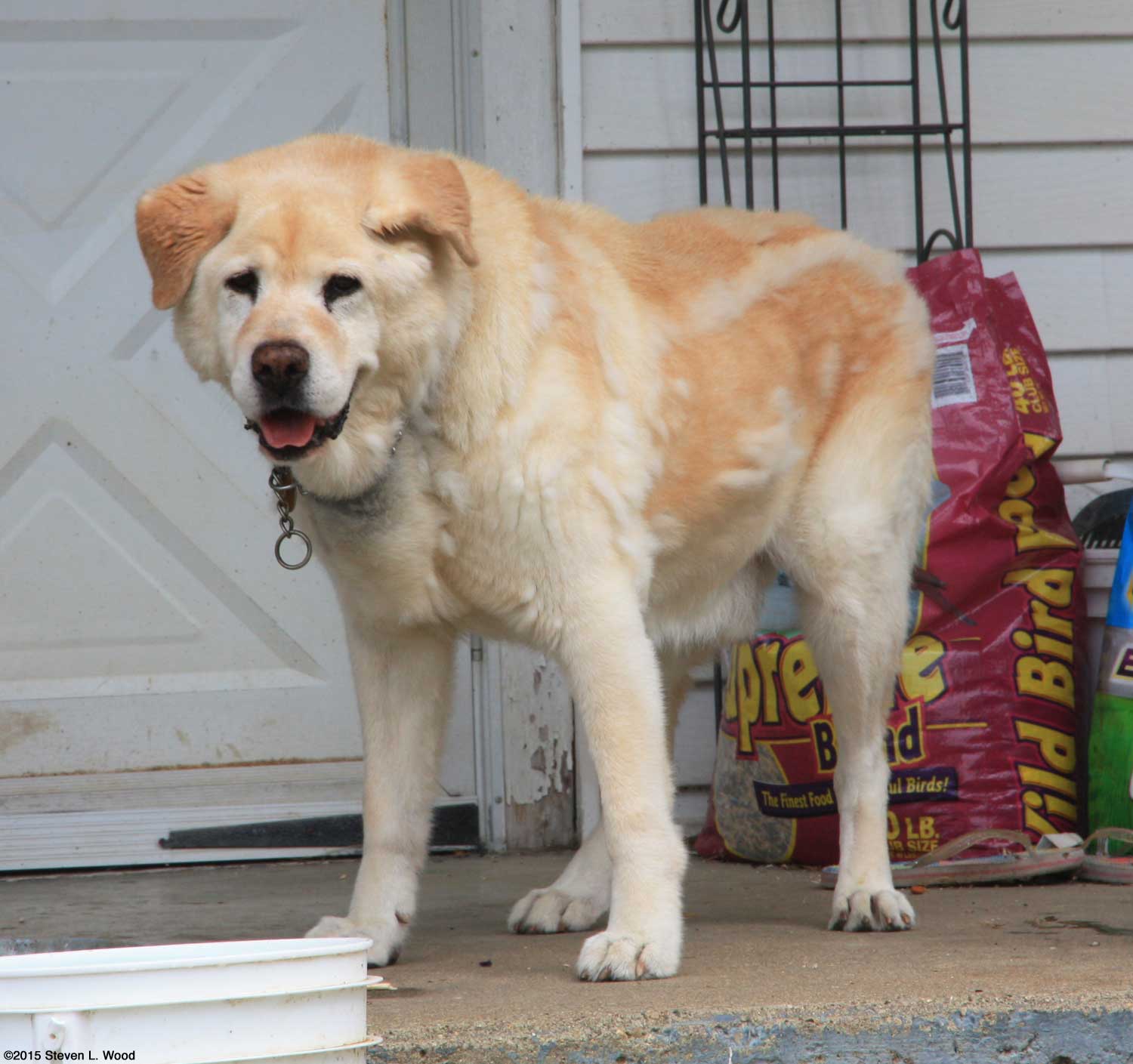
At left, littermates Callie Jo and Dolly enjoy resting on a glider. Both are over ten years old and are still quite healthy. Our much younger tuxedo cat, Tux, occasionally ventures outside, although he had a toothmark injury to his back last summer and has become much more respectful of the dogs. Mac, our "Senior Dog," is a cross of half lab and quarters of rottweiler and chow. He's probably enjoying his last summer, as his health is failing. One back leg often slips out from under him on slick floors. We have to lift his rear end sometimes to get him back up. Mac was raised around cats, so he's good with them. The cats will often rub up against him and occasionally curl up to sleep with him. He's become pretty much a full time indoor dog over the last two years. Monday, August 31, 2015 - August Wrap-up
We got a good bit of our fall garden planted in late July, but put in our fall spinach, carrots, and lettuce this month. I staggered the fall plantings, as we can only water so much at one time without running our well dry. The plan has worked out well so far, as long as the crops have time to mature before frost sets in.
With our spring crops out, we only harvested bell peppers, tomatoes, and cucumbers this month. Our last heavy picking of our open pollinated Earlirouge tomato plants was put up as tomato purée (or tomato sauce), yielding seventeen pints canned. We had lots of Japanese Long Pickling cucumbers despite an infestation of striped cucumber beetles in late July. The bug damage slowed production, but didn't stop it. By the end of the month, the vines were getting pretty worn out, which is normal for cucumbers, but they still are ripening a few nice, long cukes. Seed saving this month was iffy. I wiped out a couple of batches of seed by getting the hot water treatment bath too hot for a few seconds and damaging those batches of seed. But we still got good batches of Earliest Red Sweet bell pepper, Earlirouge tomato, and Japanese Long Pickling cucumber seed, just not as much as I would have liked. I was especially pleased to see that our Earliest Red Sweet peppers have returned to producing full sized fruit. When grown in our East Garden the last few years, we often got a lot of dwarfed peppers. While we can get away with growing good potatoes, sweet corn, and melons on that poor ground, peppers apparently aren't nearly as tolerant of poor soil. A Political Statement You May Want to Skip
I wish we could all be so carefree about our retirement. In a time when some politicians seem determined to destroy Social Security and Medicare, I can only hope that reason prevails and America rejects those who would take away our security net. I'm to the point now where I can almost walk normally again without a cane due to advances in medical care supported by Plan B and Medicare and the incredible skills of an old friend, Dr. Bob Clayton, my orthopaedic surgeon. Without such programs, my recent restorative surgery would have been financially impossible, leaving me a cripple for the rest of my life. We senior citizens need to let our state and federal representatives know that abandoning support for us and our progeny is totally unacceptable. And About That New Hip... If I would just behave myself and stop pushing the envelope in my recovery from a total hip replacement in May, I could probably get off some annoying, but currently essential pain killers. But I continue to do things such as driving myself on a five hour round trip to see the surgeon, turning buckwheat under with a garden fork, tilling in the rest of the buckwheat, and climbing on a stepladder to trim bushes. Each one of those forays put me back on pain killers for a day or two afterward. But the good news is that when trimming said bushes or tilling the buckwheat, I was able to do so without my cane. It's still needed every morning when I wake up stiff from spinal arthritis, but I'm occasionally popping in and out of stores these days without the cane. Of course, shopping carts are a great substitute for a cane or walker when shopping. Contact Steve Wood, the at Senior Gardening |
|||||||||||||||||||||||||||||||||||||||||||||||||||||||||||||||||||||||||||||||||||||||||||||||||||||||||||||||||||||||||||||







 (
(


 Today has been one of those days when you wake up and everything hurts. I don't know what I did to deserve such pain, but I'm taking it easy today, despite having three full-day chores glaring at me from my to do list. While I probably should feel guilty about not working on such a glorious summer day, I'm post several painkillers and sips of scotch, so will have to put off feeling guilty until tomorrow. Maybe it's something like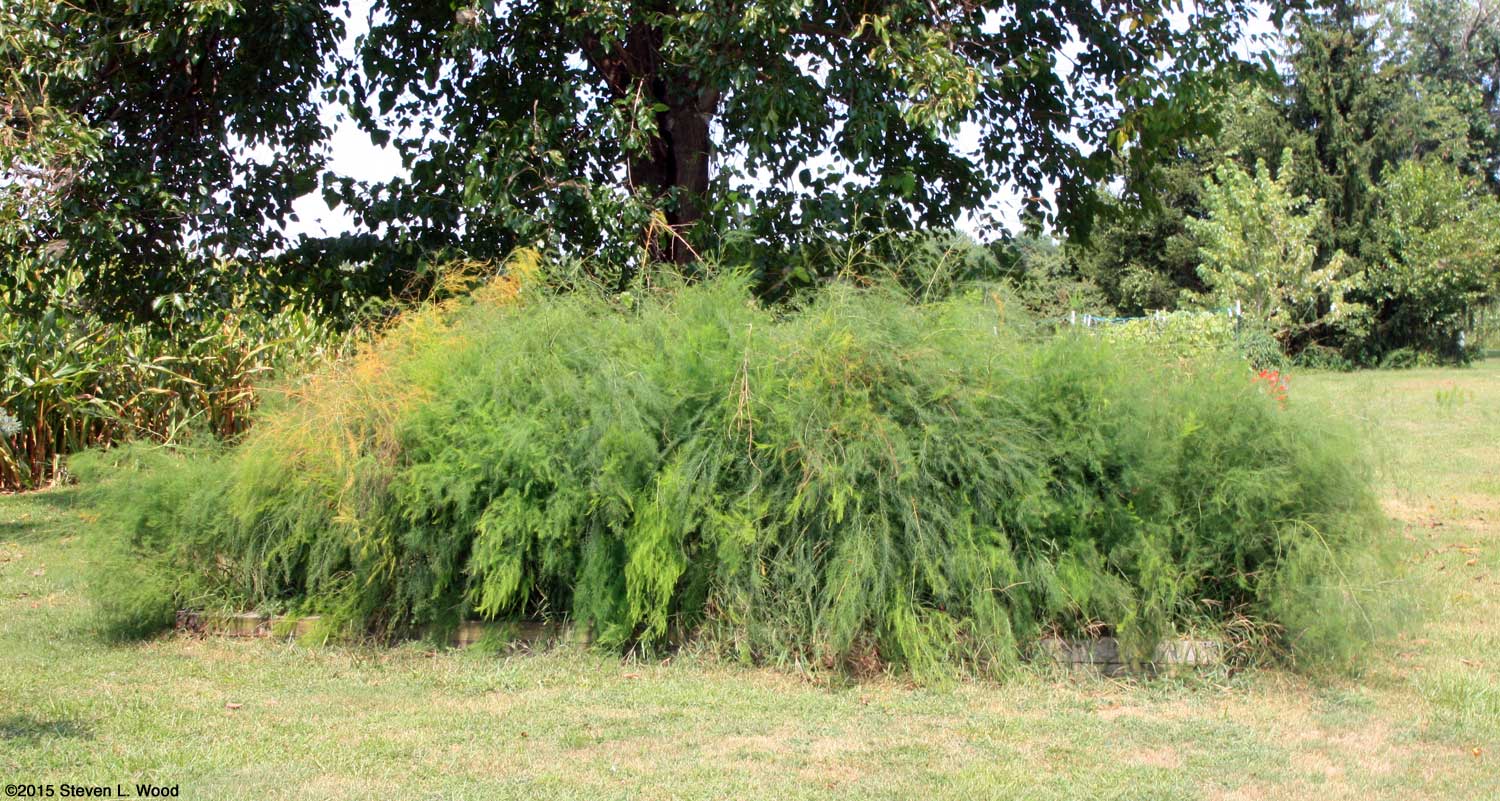




 has an excellent discussion about light requirements for laying flocks and some cautions about lighting baby chicks too much too soon. His previous volume on the subject,
  and some circulars from our county extension office proved to be excellent guides for us during our farming years. Having really enjoyed raising chickens for both meat and eggs, I'm excited to see and talk to folks now keeping four or five laying hens in urban situations.



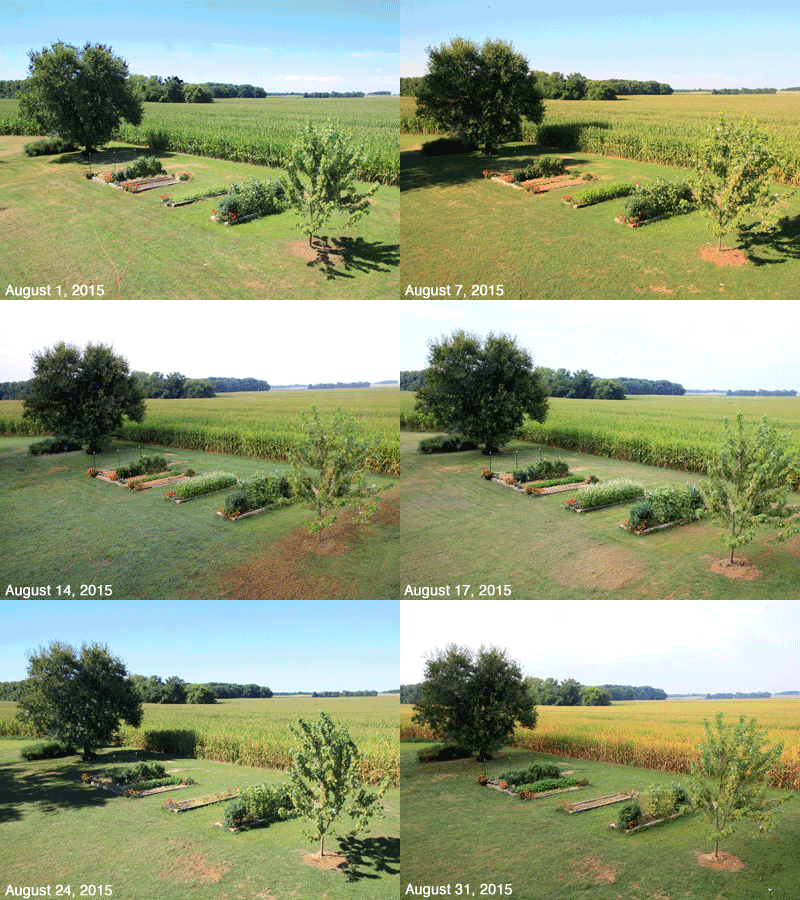 August turned out to be a dry and fairly cool month. The dry part presented some challenges in getting our fall succession crops started. The cool part made for several weeks of unusual weather where it was quite pleasant working in the garden in the mornings. It also helped with our electric bill, as we had our air conditioning turned off at a time of year when it normally would be running full blast all month long.

| Affiliated Advertisers |
©2015 Senior-Gardening.com